
Brands are swapping real models for AI-generated ones to save money, and viewers are paying the mental health cost.
Across fashion advertising and e-commerce, AI imagery is now common. At a time when beauty standards and body image already dominate the media, AI content is becoming concerning for its ability to set false standards and unreachable expectations. In 2025, a Guess advert in Vogue sparked severe backlash. Meanwhile, H&M announced in March 2025 that it would create AI “digital twins” of 30 real models for its marketing and social media. These images are not only taking work away from real models, but are severely damaging to viewers, especially younger audiences who look up to these models as their picture of beauty.
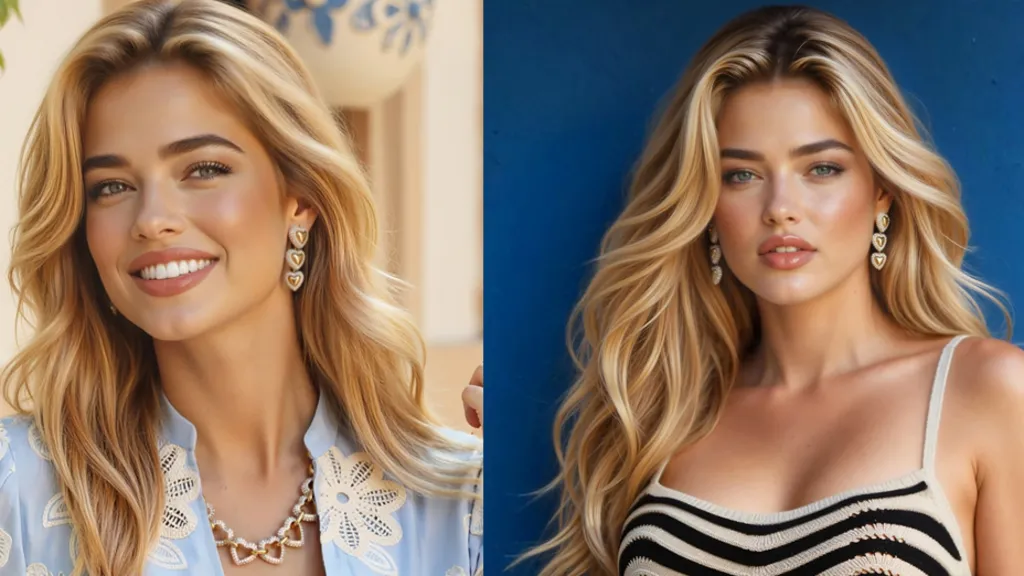
This is Vivienne: a flawless blonde in a striped dress, posing in the pages of Vogue. With her sculpted face, light eyes and full lips, some would call her the picture of beauty.
There’s just one catch: Vivienne isn’t real.
Vivienne was created by Seraphinne Vallora, a London-based AI marketing agency. Its founders, Valentina Gonzalez and Andreea Petrescu confirm they were asked by Guess’s co-founder, to create an AI model as part of the brand’s summer campaign.
The ad sparked immense backlash, with readers feeling it betrayed what Vogue stands for. This lead to boycott calls and cancelled subscriptions for Vogue, however the magazine remained adamant that it was a paid advert not an editorial decision and the company refused to comment on it any further. According to former model and tech entrepreneur Sinead Bovell, Vogue is “seen as the supreme court of the fashion industry”, so running the advert means it is “in some way ruling it as acceptable”. The advert not editorial distinction means little to readers of Vogue when the company sets the standard. Whether it was paid for or not, the magazine effectively chose to include it, and in doing so, put its stamp of approval on AI models. For a magazine built on authentic photography and human craft, it looked like Vogue had sold out to AI. The real question is why would a brand take that risk? There is an alternative outlook on the concept of AI modeling; H&M partook in a similar situation, known as the “Twin Case”. Models signed themselves over to become AI replicas.
For brands, AI models are often the most cost-efficient choice, and H&M offers what may be the most responsible version. In March 2025, H&M announced digital twins of 30 real models for its marketing and social media, a move described as a historic milestone for fashion and tech. The upside for brands is clear: AI models can be placed in infinite poses, lighting setups and locations without the cost of travel, photoshoots or carbon emissions, and campaigns can be created and adapted quickly to keep up with social media. H&M has also tried to answer the ethical concerns. Models keep the rights to their AI likeness and are paid as they would be for normal image licensing, and the company says no likeness is used without explicit consent. According to model Mathilda Gvarliani, her digital twin is “like me, without the jet lag”. On paper, H&M has addressed everything Guess and Vogue were criticised for: consent, pay and disclosure. But is being fair to the model the same as being harmless to the viewer?
Even the ethical version has costs, for those behind the camera and infront of the screen. Influencer Morgan Riddle called the move “shameful” placing emphasis on the potential loss of jobs like photographers, stylists, and make-up artists. According to Paul W. Fleming of UK performers’ union Equity, “full control over likeness and fair pay is vital”, with the union calling for enforceable rules to protect models from being exploited.The shift to AI is already underway, and without proper protections in place, it will damage the models and creative workers whose livelihoods depend on the industry. The models may have consented, but the people scrolling never did. A watermark might tell a viewer an image is AI, but who protects them from comparing themselves to it? The twins are so convincing that one model’s own boyfriend couldn’t tell her real photos from her digital twin’s. If he can’t, what chance does a teenager scrolling through Instagram have? Some argue this isn’t anything new, as fashion has always edited its photos.
For decades, magazines and brands have used Photoshop to smooth skin, slim waists and sharpen features, and today social media filters and apps like AirBrush let anyone do the same. But there’s a crucial difference: retouching edits a real person, while AI starts with no person at all. AI models can be perfected endlessly. No makeup, diet or surgery can match someone who doesn’t exist. And AI doesn’t just copy existing beauty standards; it narrows them.
AI image tools tend to default to an idealised version of beauty, creating a standard no real person can reach. When researchers at the University of Toronto analysed 300 AI-generated images, they found the tools consistently produced bodies with very little fat and highly defined muscle. The study also found that AI images of women were more likely to be young, blonde and dressed in revealing clothing such as bathing suits. Sound familiar? Vivienne fits this description almost exactly. The company behind Vivienne admits to this narrow ideal being partly audience driven. According to Seraphinne Vallora co-founder Valentina Gonzalez, AI images of women with different skin tones “don’t get any traction or likes”. The agency has also yet to create plus-size models, claiming “the technology is not advanced enough for that”. Brands have the choice of what to create, its when they chase likes, beauty gets narrower and it becomes damaging for viewers. These standards don’t stay on the screen; they shape how viewers, especially young, impressionable ones, see themselves. And comparing yourself to a model digitally designed to be flawless can do real damage.
The real cost of AI modelling is paid by viewers’ mental health, especially young viewers. According to Vanessa Longley, chief executive of UK eating disorder charity Beat, the advert is “worrying”, as exposure to unrealistic bodies can damage self-esteem and increase the risk of eating disorders. A peer-reviewed study found that people consistently rated AI-generated female faces as more attractive than real ones, and warned the effect could be significant on social media, where audiences are often young and impressionable. If viewers rate AI faces above real ones, they are fighting a comparison they can never win. Bovell warns that AI is already shaping beauty standards, noting that young girls are getting plastic surgery to look like a filtered face, and “now we see people who are entirely artificial”. The escalation is worrying: what began as a simple retouch has become people measuring themselves against women who aren’t even real. Bovell further argues that failing to clearly label AI content is “exceptionally problematic” because of the damage it can do to people’s mental health. Vivienne’s AI disclaimer appeared only in very small print; for a young reader scrolling through Vogue, it might as well not have existed. If the harm is real, then something has to change.
AI models may be cost effective for brands but the real cost is paid by the poeple scrolling past them. Even Australia’s eSafety Commissioner has warned that we may be entering an “age of unreality”, where realistic AI images make it hard to tell fact from fiction. Although it may seem all doom and gloom, there is still hope, if brands and viewers each play their part. Brands need to label AI images clearly, with no attempt at hiding them in the bottom corner of an image. Brands must label AI images clearly and visibly, not in a footnote few readers will notice. Lawmakers can follow the lead of New York’s Fashion Workers Act, which requires models to approve any use of their AI likeness. And as viewers, we need to question what we see before we start comparing ourselves to it. Vivienne looks flawless because she was never real. Real beauty belongs to people, not to a narrow-minded advert.
 Jordey Petersen
 Oliver BF
 Maddison