
A person watching TV in a dark room, lit only by the screen
Image: Ron Lach / Pexels
Think about the last time you saw a police interrogation. Chances are it wasn’t in real life – it was on a screen. We know exactly how these scenes go: the detective slams a folder on the table, the suspect sweats, and someone eventually cracks. Most of us have never sat in an interview room or a courtroom, but we’ve watched hundreds of fictional ones from the couch. Media scholar Michael Z. Newman argues that a lot of what audiences think they know about government and criminal justice comes from shows like The West Wing and Law & Order, rather than from newspapers or textbooks.1
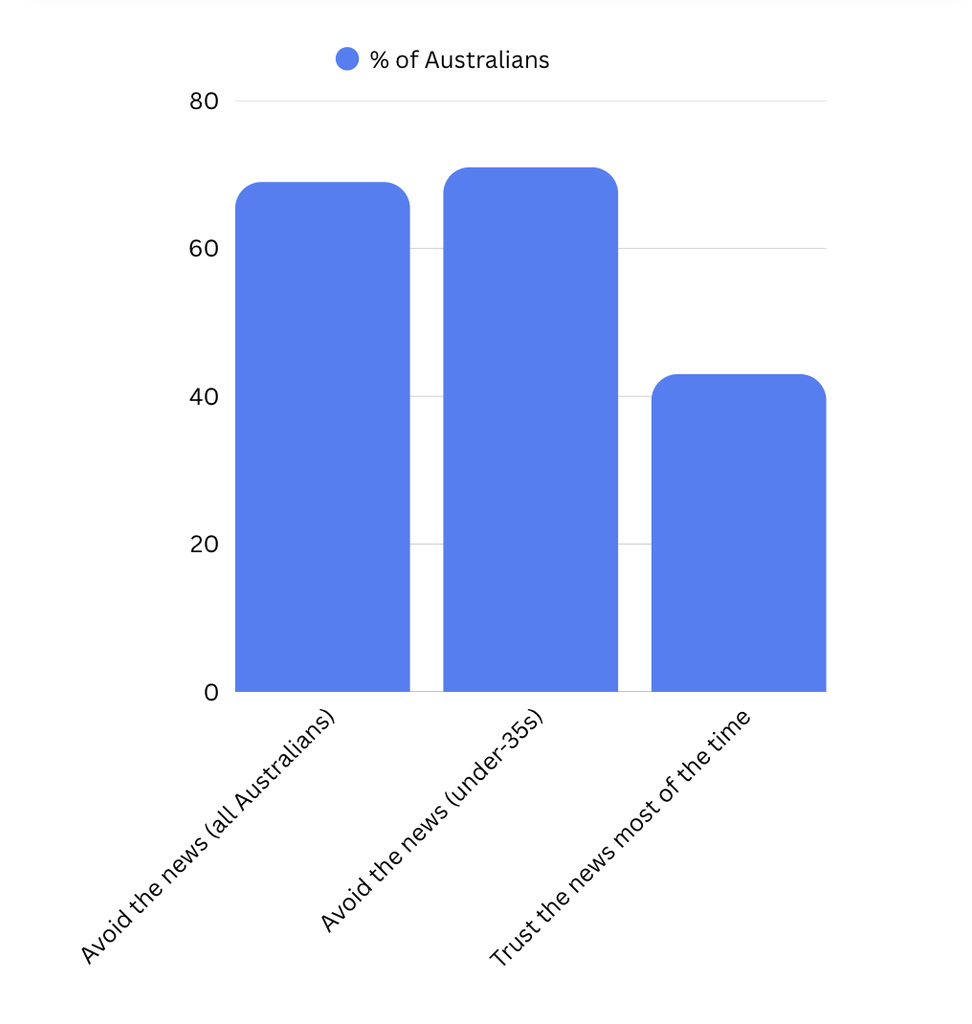
Meanwhile, Australians are switching off the news. In 2025, 69% of Australians said they avoid the news at least some of the time, and among under-35s that figure climbs to 71%.2 Nobody’s avoiding the next episode of their favourite show, though.
So how does pop culture shape the way we understand big civic issues like justice and equality? My argument is that it now does more to shape our civic views than the news does, because we trust it, we get emotionally attached to it, and we soak up its messages without really questioning them.
They Say: Pop Culture Teaches Us the Wrong Lessons
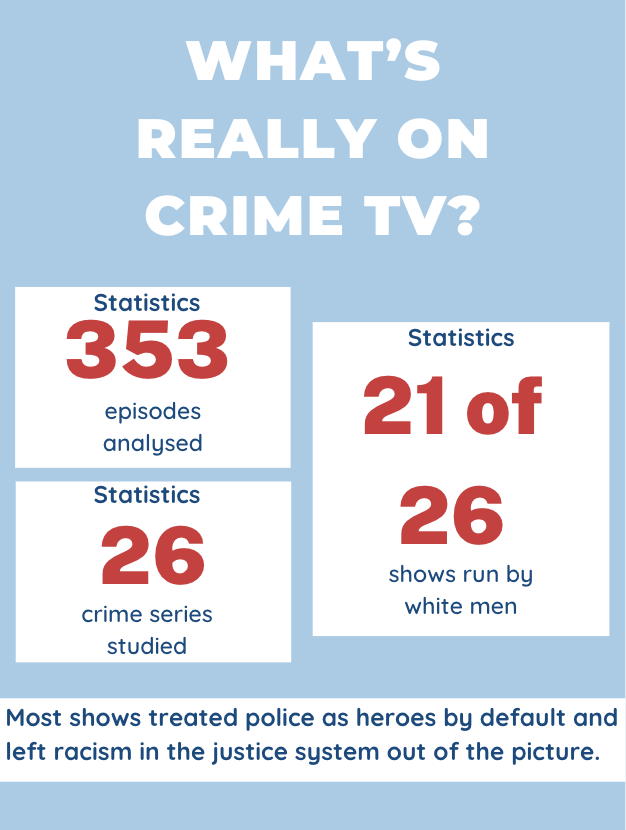
Plenty of critics argue that entertainment doesn’t just reflect society – it bends it out of shape. Crime TV is the clearest example. In 2020, the US civil rights organisation Color of Change teamed up with the USC Annenberg Norman Lear Center to look at how scripted crime shows portray the justice system. The researchers went through 353 episodes from 26 crime series that aired in the 2017–2018 season.3
What they found wasn’t great. The shows pushed crime myths that research has already disproven, treated police as heroes by default, and mostly left racism in the justice system out of the picture.4 Cops on screen regularly bent the rules or crossed ethical lines, but the storylines framed this as what it takes to catch the ‘bad guy’, rather than as misconduct that should have consequences. Viewers were invited to cheer for exactly the kind of behaviour that would cause outrage if it turned up in a real news story.
The researchers also looked at who was writing these stories. Of the 26 series, 21 were run by white men.5 That matters, because whoever makes a show decides whose experiences get told and how. When the same small group is behind the stories millions of people watch every week, their assumptions quietly become the audience’s assumptions.
The report describes crime TV as one of the main ways tens of millions of people learn to think about the justice system. If that’s the case, then the warped picture these shows paint isn’t just harmless fiction. It feeds into how viewers think about policing, guilt and fairness in real life.
Source: Color of Change & USC Norman Lear Center (2020).
Others Claim: Pop Culture Can Change Minds for the Better
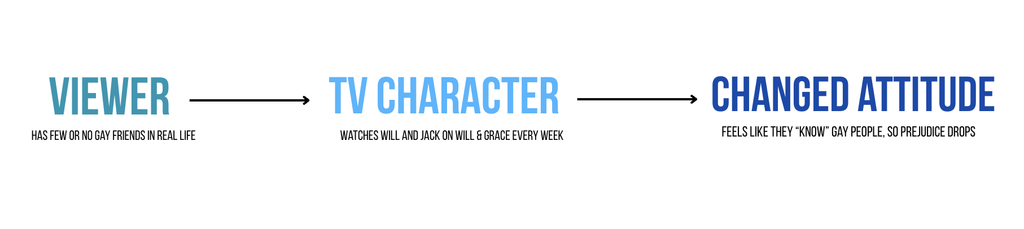
Not everyone sees pop culture’s influence as a bad thing. Some researchers argue that the same power can be used to break down prejudice. Communication scholars Edward Schiappa, Peter Gregg and Dean Hewes came up with what they call the parasocial contact hypothesis. It builds on a well-known idea – that spending time with people from different groups makes us less prejudiced – and suggests that TV characters can have a similar effect to meeting people in real life.6
To test the idea, they studied viewers of Will & Grace, a sitcom that ran from 1998 to 2006 with two gay men in leading roles. They found that watching the show was linked to lower levels of prejudice towards gay men. The interesting part is that the effect was strongest for viewers who had few or no gay friends in real life.7 For them, the characters on screen were basically standing in for real relationships.
This suggests pop culture can reach people that other kinds of communication can’t. A news report about discrimination is easy to scroll past or argue with. A weekly catch-up with characters you like and laugh with is a lot harder to ignore, and over time it can change how you see a whole group of people.
On the surface, this seems like the opposite of the Color of Change findings. One says pop culture spreads harmful ideas; the other says it can reduce harm. But look a bit closer and they actually agree on the most important point: what we watch changes what we believe. The real question isn’t whether pop culture influences us, but how much – and whether it now influences us more than the news.
I Say: Pop Culture Now Shapes Civic Views More Than the News
Here’s where I land: pop culture now has more influence over how we understand civic issues than the news does. That’s not because the news doesn’t matter anymore. It’s because we trust entertainment, connect with it and absorb it in ways we just don’t with journalism.
The first reason is pretty simple: people aren’t watching the news. Australia’s Digital News Report 2025 found that 69% of Australians avoid the news at least sometimes, and that jumps to 71% for under-35s.8 Only 43% said they trust the news most of the time, and for the first time, social media overtook news websites as people’s main source of news.9 Compare that to the next episode of a show you love – nobody needs convincing to press play. If young Australians are dodging the news but still streaming crime dramas and sitcoms, then entertainment is reaching them in a way journalism isn’t. Whatever those shows say about justice and equality is what a lot of people are actually hearing.
Source: Park et al. (2025).
The second reason is that fiction persuades us differently. The news gives us facts and arguments, and we decide whether to accept them – often depending on whether we trust the outlet. Pop culture works through characters we actually care about. The Will & Grace research shows viewers formed something like a relationship with the characters, and that relationship changed their attitudes.10 Psychologists Melanie Green and Timothy Brock call this process ‘transportation’: when we get absorbed in a story, we become more likely to adopt the beliefs it contains, and less likely to notice anything that seems off.11 In other words, the more a story pulls us in, the less we push back. We don’t argue with a character we love the way we might argue with a journalist. Because the message comes through emotion and connection, it slips past the defences we normally put up against being persuaded.
The third reason is repetition. A news story about police misconduct might be around for a day or a week. A crime drama runs for years, hammering home the same message episode after episode: the cops are the good guys, and rules just get in the way of justice.12 Over time, that builds up a mental picture of how the justice system works. Media researchers George Gerbner and Larry Gross described this decades ago with what became known as cultivation theory. They argued that heavy television viewers gradually come to see the real world as looking like the world on their screens, simply because they’ve seen it shown that way so many times.13 It’s not one show that does it, but the steady drip of hundreds of similar stories. So when a real news story challenges that picture, it’s easy to write it off as a one-off instead of questioning everything we’ve picked up from years of TV.
For me, that’s ten years of Criminal Minds. After that many episodes, I’d absorbed the idea that all FBI agents were extremely good looking and always caught the bad guys – usually within the hour, and usually just in time. I never decided to believe that. It just built up, one episode at a time, which is exactly the point.
The fourth reason is that we let our guard down for entertainment. We go into the news half-expecting bias, but a TV show is ‘just entertainment’. Newman argues that this is exactly why pop culture matters: we use fiction to work through real social issues, so it deserves the same tough questions we’d ask of any news outlet.14 Who made the show? Who owns it? Whose values is it pushing? We’re used to asking these questions about media owners and newspapers, but most of us never ask them about our favourite series, which means its messages get through unchecked. A TV series is made by a studio, funded by a network or streaming platform, and shaped by the people at the top of those companies – exactly the kinds of powerful interests we’d be suspicious of in a newsroom. Yet when the message arrives with a laugh track or a cliffhanger, we rarely stop to think about who is sending it, or why.
But doesn’t the news still matter?
Of course, some would say the news is still essential, because it reports real events while fiction just makes things up. That’s fair. Without journalism, we wouldn’t know about real police misconduct or political decisions at all. But the news tells us what happened, while pop culture often shapes how we feel about it. When a story breaks, we interpret it through the beliefs we already have – and a lot of those beliefs came from what we’ve watched. A viewer raised on years of heroic TV detectives might read a report of police wrongdoing very differently from someone who has never watched a crime show. The facts in the article are identical, but the story each reader brings to it is not. So pop culture doesn’t replace the news, but it does frame how we understand it – and in that sense, it often gets the final word.
Conclusion
Pop culture is civic culture. The Color of Change research shows crime TV can spread harmful myths about justice, and the Will & Grace research shows the right characters can reduce prejudice. Either way, what we watch shapes what we believe. Stories pull us in, repeat their messages until they feel like common sense, and reach us when our guard is down. And with most Australians now avoiding the news at least some of the time, entertainment has become one of the biggest influences on how we understand justice, equality and politics – arguably a bigger one than the news itself.
That doesn’t mean we should stop watching. It means we should watch a bit differently. Next time you binge a crime drama or a political series, ask the same questions you’d ask of a news outlet: who made this, what do they want me to believe, and is it actually true? That’s what critical writing about culture – like the articles on this blog – is for. If pop culture is going to shape our views, we should at least be paying attention to how.
- Newman (2022), as cited in Ruch (2025). Ruch, A. (2025). Big “M” media ownership & democracy [Unit content]. NETS2001 Writing on the Web, Curtin University. Blackboard ↩︎
- Newman (2022), as cited in Ruch (2025). Ruch, A. (2025). Big “M” media ownership & democracy [Unit content]. NETS2001 Writing on the Web, Curtin University. Blackboard. ↩︎
- Color of Change, & USC Annenberg Norman Lear Center. (2020). Normalizing injustice: The dangerous misrepresentations that define television’s scripted crime genre. https://hollywood.colorofchange.org/ ↩︎
- Color of Change, & USC Annenberg Norman Lear Center. (2020). Normalizing injustice: The dangerous misrepresentations that define television’s scripted crime genre. https://hollywood.colorofchange.org/ ↩︎
- Color of Change, & USC Annenberg Norman Lear Center. (2020). Normalizing injustice: The dangerous misrepresentations that define television’s scripted crime genre. https://hollywood.colorofchange.org/ ↩︎
- Schiappa, E., Gregg, P. B., & Hewes, D. E. (2005). The parasocial contact hypothesis. Communication Monographs, 72(1), 92–115. https://doi.org/10.1080/0363775052000342544. ↩︎
- Schiappa, E., Gregg, P. B., & Hewes, D. E. (2006). Can one TV show make a difference? Will & Grace and the parasocial contact hypothesis. Journal of Homosexuality, 51(4), 15–37. https://doi.org/10.1300/J082v51n04_02 ↩︎
- Park, S., Fisher, C., Lee, J. Y., & Fujita, M. (2025). Digital news report: Australia 2025. News and Media Research Centre, University of Canberra. https://apo.org.au/node/330740. ↩︎
- Park, S., Fisher, C., Lee, J. Y., & Fujita, M. (2025). Digital news report: Australia 2025. News and Media Research Centre, University of Canberra. https://apo.org.au/node/330740 ↩︎
- Schiappa, E., Gregg, P. B., & Hewes, D. E. (2006). Can one TV show make a difference? Will & Grace and the parasocial contact hypothesis. Journal of Homosexuality, 51(4), 15–37. https://doi.org/10.1300/J082v51n04_02 ↩︎
- Green, M. C., & Brock, T. C. (2000). The role of transportation in the persuasiveness of public narratives. Journal of Personality and Social Psychology, 79(5), 701–721. https://doi.org/10.1037/0022-3514.79.5.701 ↩︎
- Color of Change, & USC Annenberg Norman Lear Center. (2020). Normalizing injustice: The dangerous misrepresentations that define television’s scripted crime genre. https://hollywood.colorofchange.org/ ↩︎
- Gerbner, G., & Gross, L. (1976). Living with television: The violence profile. Journal of Communication, 26(2), 172–199. https://doi.org/10.1111/j.1460-2466.1976.tb01397. ↩︎
- Newman (2022), as cited in Ruch (2025). Ruch, A. (2025). Big “M” media ownership & democracy [Unit content]. NETS2001 Writing on the Web, Curtin University. Blackboard ↩︎
 Montana K
 Oliver BF
 Maddison