

From chin straps and mouth tape to elaborate overnight face masks, the viral “Morning Shed” presents itself as a wellness routine while raising questions about how much effort we are expected to invest in our appearance and how young that expectation may begin.
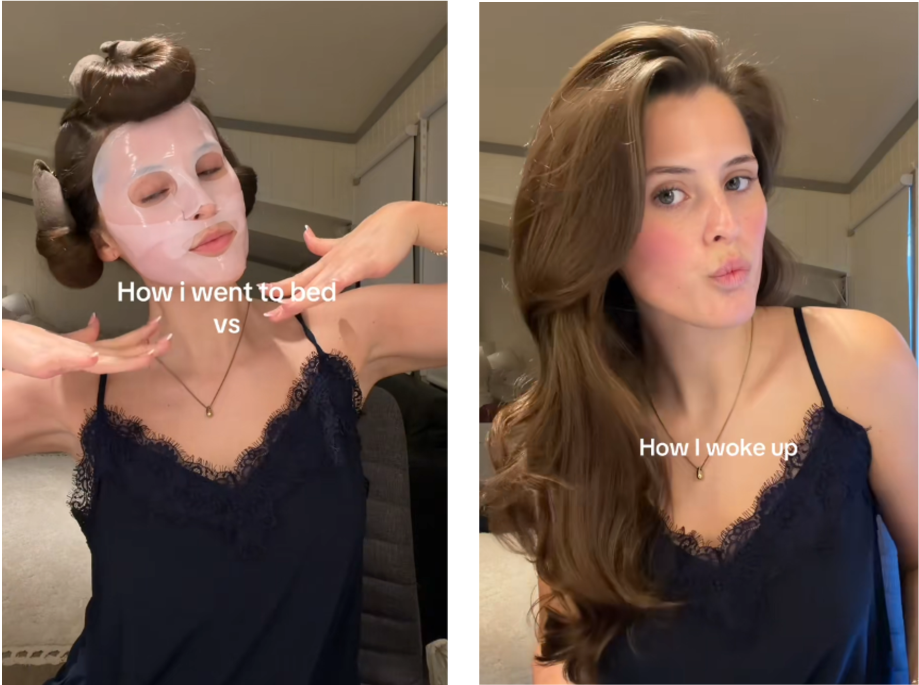
Imagine you finish your evening skincare routine, apply your moisturiser and get into bed. For many people, that would be enough. But on TikTok, the night is only just beginning. Chin straps are tightened, mouth tape is applied, hair is wrapped in rollers, silk bonnets are secured and skincare products are layered onto the face. By morning, the routine is finally complete; or, more accurately, ready for its reveal.
Welcome to the “Morning Shed”, a social media beauty trend in which creators’ film themselves removing the products and accessories worn overnight in pursuit of smoother skin, styled hair and an improved appearance. The process has become a form of beauty entertainment, with viewers watching as creators peel away layer after layer to reveal the results underneath. What once was a simple 3-step cleanse and moisturise routine has now evolved into a staged reveal, with some content creators using more than ten products or treatments before their heads even hit the pillow.
The trend might appear to be harmless fun. Looking after yourself can be enjoyable, and there is nothing inherently wrong with having a skincare routine. However, the “Morning Shed” raises a more complicated question: When did looking after ourselves become so closely tied to improving how we look?
The “Morning Shed” demonstrates how social media has blurred the boundary between self-care and appearance maintenance, normalising excessive beauty practices while exposing increasingly young audiences to appearance-focused beauty standards. While these routines are categorised as “wellness” content, their popularity raises concerns about whether self-care is becoming another source of online performance, as expectations for how we should present ourselves continue to grow as the “norm”, even before the day begins.
When Self-Care Becomes A Performance
“…anti-feminism dressed up as self-care..”
– Kayleigh Donaldson, 2025
The social media platform TikTok has been the primary distributor of these beauty routine trends. It initially went from James Charles sharing his elaborate makeup routines to the “Get ready with me” trend. The Morning Shed uses the same initial skin-preparation process, with the anticipated satisfaction of shedding it all off the next morning.
Creators such as @manelparletrop on TikTok demonstrate how beauty routines can be presented as entertaining lifestyle content. While the appeal of her videos is visual, easy to follow and offers a glimpse into someone else’s routine, it also invites audiences to feel obliged to develop their own similar self-care habits.
However, there is a difference between sharing a routine and presenting an increasingly elaborate performance as something worth aspiring to. When multiple products and accessories become part of this process, the messaging behind these routines can shift from “looking after yourself” to constantly finding “new ways to improve yourself”.
In Kayleigh Donaldson’s (2025) critique regarding the “Morning Shed” trend, she describes influencer beauty routines as “anti-feminism dressed up as self-care”. Her argument challenges the idea that every beauty routine is automatically empowering simply because it is framed as a personal choice. A routine may be described as a relaxing or satisfying way to take care of yourself, but it can also involve considerable preparation, products and commitment to maintaining a particular appearance. And while these routines may look effortless in these “Morning Shed” videos, it may require a surprising amount of labour behind the scenes.
Of course, not everyone who participates in this trend feels pressured to do so. Some creators may genuinely enjoy participating in these rituals, as well as audiences simply watching for genuine entertainment. However, when elaborate routines are repeatedly presented as desirable, they can contribute to a culture in which ordinary skincare begins to seem insufficient.
When Beauty Standards Become Appearance Anxiety
The “Morning Shed” also reflects a broader culture in which appearance is treated as something that can (and perhaps should) be continually improved. Wei, Song and Guo (2026) identify social comparison, algorithmic environments on social media, and the internalisation of beauty standards, as factors associated with appearance anxiety. Their review suggests that repeated exposure to idealised appearance content may encourage people to evaluate themselves against unrealistic standards.
The “Morning Shed” adds another layer to this culture of appearance anxiety by presenting beauty maintenance as a process that is never ending, occurring even while someone sleeps. There is always another product to try, another technique to incorporate, or another feature that “needs improving”. The face becomes an ongoing project instead of a part of oneself to care for.
This does not mean everyone who participates in the trend experiences appearance anxiety, or that enjoying skincare routines is inherently harmful. However, when beauty content repeatedly presents appearances as desirable, audiences begin to see ordinary features as flawed and in need of correction.
Ultimately, the concern is not simply how many products someone may be using before they go to bed. Rather, it is whether beauty routines are being framed in a way that makes people feel that their natural appearance is never quite enough.
Growing Up In A Beauty-Obsessed Feed

These implications become more concerning when beauty content is now reaching younger audiences who are still developing their understanding of appearance, health and identity.
TikTok is a platform through which users encounter advice about their bodies, routines and wellbeing. Lee, Abidin and Leaver (2025) examine the relationship between TikTok and children, highlighting the importance of understanding young people’s experiences on the platform and the content they encounter. Beauty content can be particularly influential due to its combination of entertainment with product recommendations that may appear practical or informative. If you put it into the perspective of the “Morning Shed”, a creator demonstrates a product being used and then shows an apparent result the next morning. To a young viewer, this can make a beauty practice seem normal and necessary, even though the benefits are uncertain or the routine is not age appropriate.
Research reported by Northwestern University (2025) examined popular skincare videos and the potential risks associated with the routines they promote. According to the report, girls as young as seven were using an average of six skincare products, at a monthly cost of $168, and some exceeding $500.
“It’s problematic to show girls devoting this much time and attention to their skin.”
– Dr Molly Hales, corresponding author, Northwestern University
While these findings concern skincare content more broadly, they raise an useful insight into the wider beauty culture in which elaborate routines circulate. The problem is not that children should not be learning about skincare. Basic hygiene and age-appropriate information can be beneficial. However, if young girls are already encountering intensive skincare practices, trends that celebrate adding intensive steps to a beauty routine may reinforce the impression that extensive appearance maintenance is simply part of growing up. O’Brien (2025) supports this concern by examining how social media shapes Generation Alpha’s beauty standards and consumer habits, linking digital content to young people’s developing ideas about beauty. Considered alongside the Northwestern University report, this research raises an important question: What happens when children encounter intensive beauty routines before they have fully developed their own understanding of what is normal or necessary?
The likely answer is that they come to treat the routine as the standard. A child who sees a multi-step, overnight ritual as ordinary may grow up believing that looking after their skin means wearing a chin strap, taping their mouth and layering products overnight, rather than learning what their skin actually needs.
Back To Bed, Back To The Basics
The Morning Shed is not an isolated quirk of TikTok. It belongs to a broader, well-documented shift in how young girls relate to beauty and consumption, one in which appearance becomes something to buy, maintain and perform from an ever-earlier age. The research points in the same direction: more products, more steps and more pressure, reaching children who have barely started school.
For many creators and viewers, these routines bring joy, inspire creativity, and foster a sense of calm. And that’s completely fine. The real issue lies in the surrounding framework, which tends to equate wellness with the number of products used, the time spent, and the visible outcomes by morning. This mindset subtly transforms rest into just another task to complete.
Which brings us back to the question the Morning Shed leaves behind:
What does “self-care” actually mean when it demands this much labour, and when it reaches children as young as seven?
Care that exhausts, costs money and depends on a flawless reveal begins to look less like care and more like upkeep. A simple cleanse, a moisturiser and a good night’s sleep may never go viral, but they carry a quiet reassurance.
Your worth does not depend on what you peel off by morning.
After all, sleep was supposed to be the one part of the day that didn’t need a routine, a ring light or a reveal.
 Joleen Jublee
 claire
 Jonte Siegel