
“I don’t really go on those anymore because I think, well, what would I prefer to do? Watch a TV series or find out what happens next in my book?” Mia, a fourteen-year-old from Bristol, told the BBC how her screen time has decreased as her reading increased. Surprisingly, it wasn’t a school program or a rule at home that encouraged her to read more. It was BookTok, the book-loving community on TikTok. Since early 2020, BookTok has become a major influence in publishing, changing how books are discovered, marketed and read (Dera, 2024). The BBC reported this year a UK publishing income reached a record £7.4 billion pounds in 2025, with BookTok helping fuel renewed interest in reading. While this is good news for the publishing industry, it also raises an important question: how much influence should a social media platform have over what a generation reads?
What is BookTok?
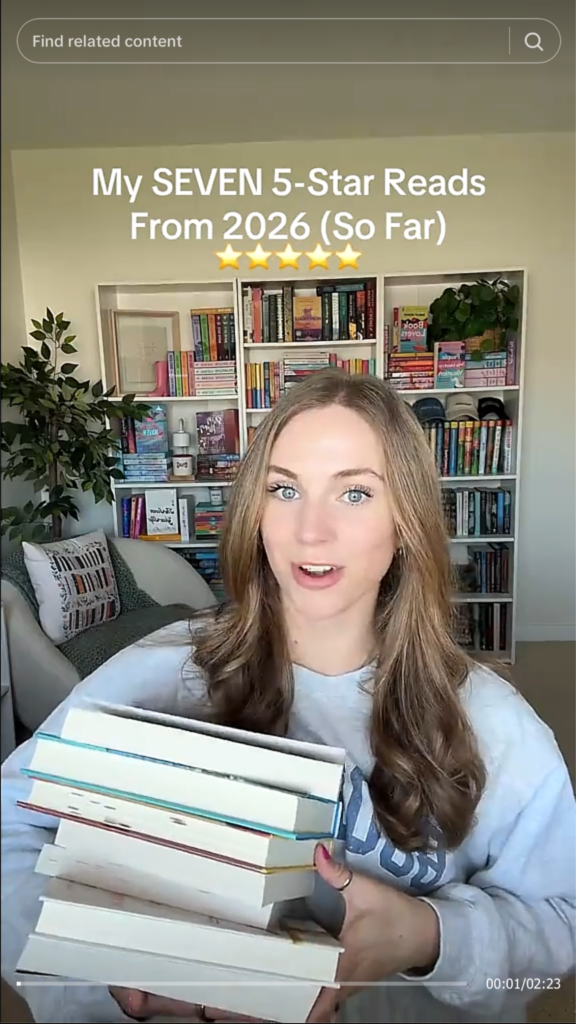
BookTok is a community on TikTok where users share recommendations, emotional reactions, reviews and reading routines usually in under a minute. A content analysis of 116 BookTok videos found that recommendations were the single most common theme, appearing in over 40 percent of the sample. Many other videos focused on reader experiences and emotional response (Merga, 2021). This type of content is easy to see in videos like creator Delaney Smith (@delaneylynnesmith), a Washington-based book creator posted “My 7 Five-Star Reads of 2026 (So far)”, a recommendation video that drew tens of thousands of likes, captioned with hashtags like #booktok and #bookrecs (delaneylynnesmith, 2026).
What makes BookTok different is how personal its recommendations feel. Rather than listening to an expert, viewers are hearing from people who share their interests and experiences. Research found that BookTok helped young people make reading more social and entertaining during the pandemic, combining physical books with online communities. Reading became something to share with others rather than an activity done alone. (Martens et al., 2022).
BookTok has developed its own culture from carefully arranged bookshelves and colour coded page tabs to videos of people crying after finishing novels. (Dera, 2024). For young readers this can make books feel less like homework and more like something they genuinely want to talk about.
Who decides What We Read Now?
For decades, publishers, editors and professional reviewers have influenced which books received the most attention. Publishers decide what gets released, while reviewers help audiences work out what’s worth reading. But the people controlling what gets published can have an influence on what the audiences see. When Fox News killed a fully reported story about Donald Trump and Stormy Daniels in 2016, one editor’s explanation was blunt: “Good reporting, kiddo. But Rupert wants Donald Trump to win.” The “Rupert” was Rupert Murdoch, and the episode showed how ownership interest can shape editorial decisions.
On BookTok, that power is less obvious. Instead of an editor deciding which books deserve attention, TikTok’s algorithm helps determine which videos appear on users’ For You pages. Content that attracts strong engagement can reach large audiences, giving emotional reactions and attention-grabbing recommendations the potential to spread quickly. Dera (2024) found that BookTok reviews tend to be overwhelmingly positive and often focusing on emotional reactions rather than detailed criticism of books, writing or themes. This helps explain why authors such as Colleen Hoover and Sarah J. Maas have become prominent on the platform, while literary fiction receives comparatively less attention.
However, BookTok is not simply a place where readers follow whatever the algorithm recommends. Dezuanni and Schoonens (2024) found that some creators use their platforms to encourage more thoughtful reading, including sharing content warnings, promoting marginalised voices and offering advice to on developing reading habits and introducing audiences to books they might not otherwise discover.
When Book Recommendations Become Business
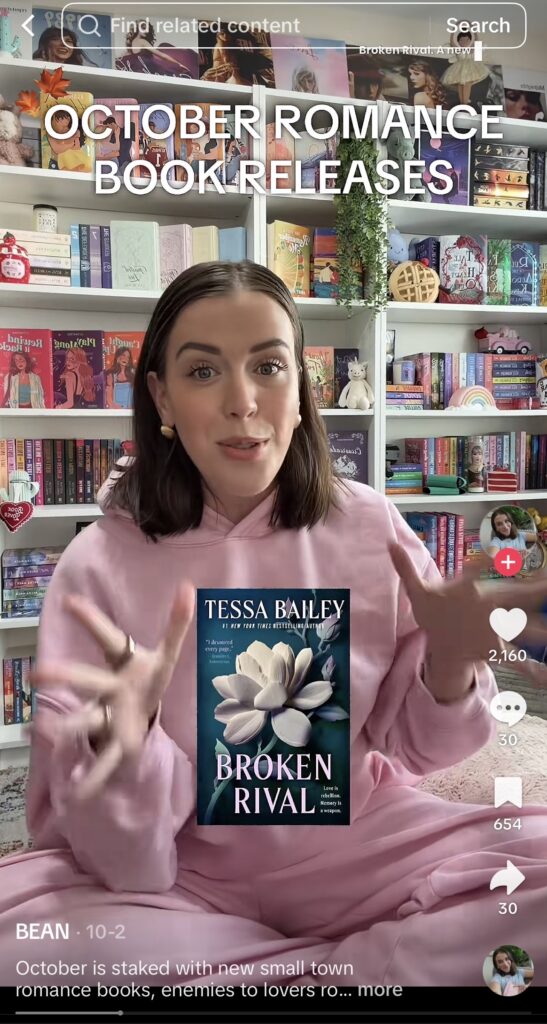
Publishers have quickly recognised BookTok’s potential. What started as readers sharing their favourite books has become an important marketing channel. Publishers now run their own TikTok accounts, send free advance copies to popular creators and use viral recommendations to generate interest in new releases (Dera, 2024). Creator Bean (@bookishwithbean), an “overly optimistic romance reader” with more than 106,000 followers regularly shares new release content. (bookishwithbean, 2026)
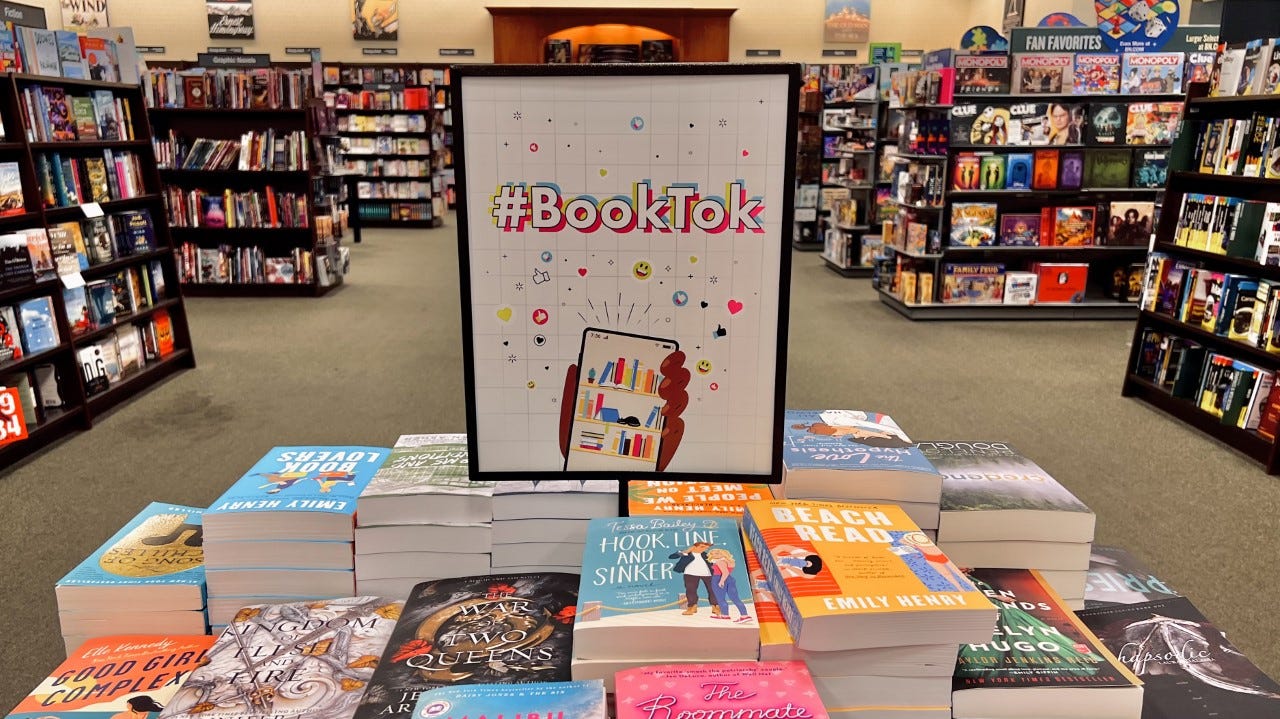
The influence extends beyond social media. Research involving publishers and booksellers in Denmark and the United States found that BookTok can bring older titles back into the spotlight, influence bestseller lists and change how bookstores select and display books (Balling and Martens, 2026). The evidence sits on the shop floor. When researchers visited Arnold Busck, one of Copenhagen’s largest bookstores, they found three tables labelled “BookTok”, piled with romance titles and Colleen Hoover novels, and sales figures showing Hoover’s books in three of the top four bestselling spots in a single year (Balling and Martens, 2026). Distributors have even started labelling shipments “BookTok-books” so retailers know which titles the community is pushing. In the wider market, UK publishing income reached a record £7.4 billion in 2025, while science fiction and fantasy sales jumped 42 per cent in a year (Harcombe, 2026). The trend has even inspired new businesses, including a specialist romance bookshop in England opened by a 20-year-old creator.
But as publishers become more involved, a question follows: can readers always trust that a recommendation comes from genuine enthusiasm rather than a marketing deal?
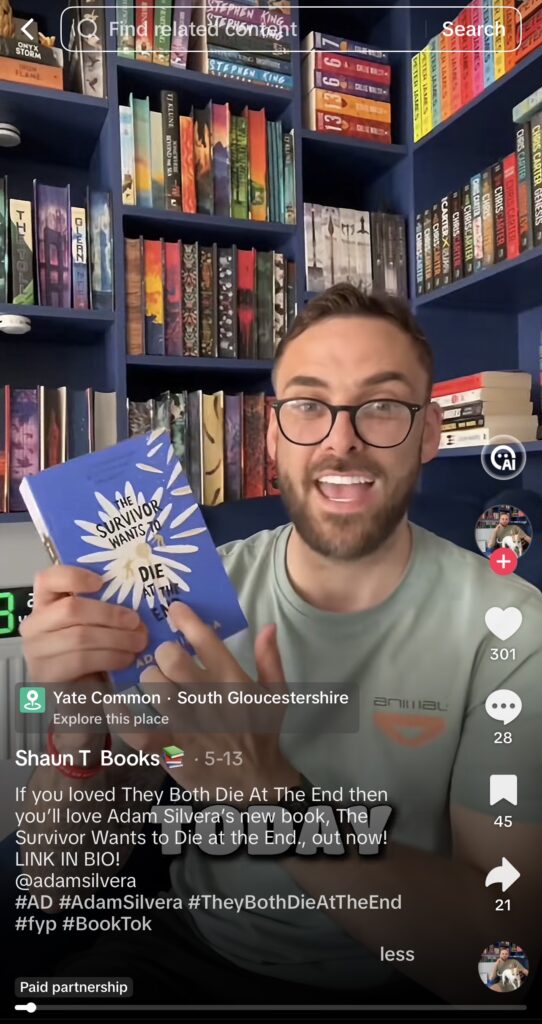
Sometimes the platform answers for you. One video from creator Shaun (@shauntbooks) promoting Adam Silvera’s new novel The Survivor Wants to Die at the End carries TikTok’s official “Paid Partnership” label, the hashtag #AD and a “link in bio” directing followers towards the author (shauntbooks, 2206). The recommendations are genuine; it is also unmistakably an advertisement. But when sponsored posts and personal recommendations sit side by side in the same feed, the difference can quietly disappear. The reality is more tangled than a story about influencers taking money. Jerasa and Jones (2026) found that BookTok recommendations are shaped by a wider network of forces, including other readers, comment sections, trending sounds and algorithmic suggestions. Commercial interest is part of the picture, but so is the platform itself.
Popularity Doesn’t Mean Quality.
A novel can sell thousands after going viral, but that doesn’t automatically mean it is well written or offers something meaningful to its readers. This becomes clear when looking at how books are reviewed on the platform. Creator @ashleykimchireads, for example, shares an emotional reaction to a novel that left her in tears, making that response the focus of the review (ashleykimchireads, 2026). The message is simple: the book made me feel something, so you should read it too.
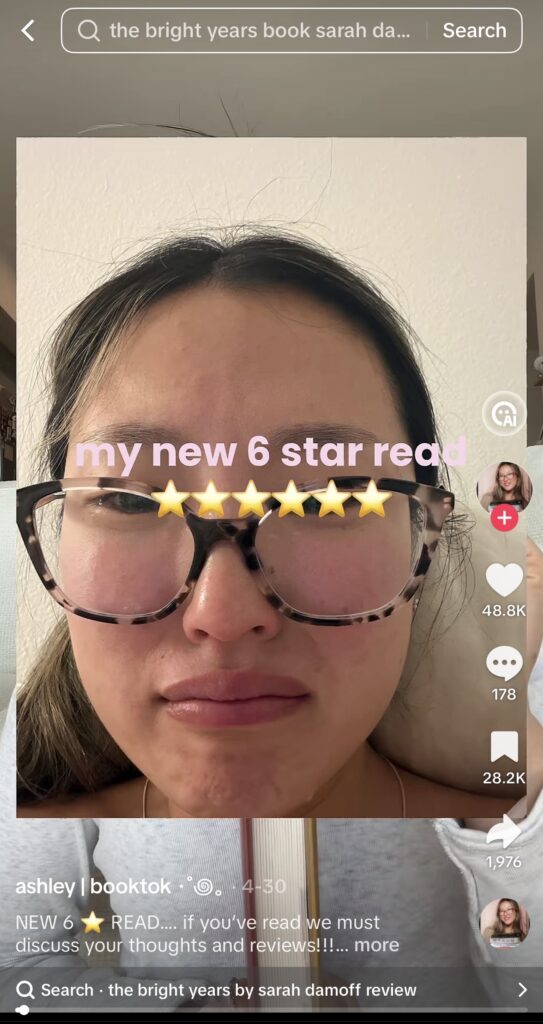
There is nothing wrong with emotional recommendations; connecting with a story is often what makes reading enjoyable. The problem is when emotional reactions become the main way books are judged, leaving little room to discuss the writing, structure and themes.
BookTok has introduced reading to people who might never have picked up book because of a traditional review. Dezuanni and Schoonens (2024) highlight how some creators go beyond recommendations by helping their audience develop reading habits and engage more thoughtfully with books.
Traditional reviews and BookTok recommendations do not need to compete. BookTok helps readers discover books they are excited about, while criticism offers a deeper look at what makes those books effective. One encourages people to pick up a book while the other encourages them to think critically about it.
The issues arise when popularity becomes the only measure of value. A viral romance novel can be enjoyable, but a quieter book receives less attention might offer just as much to think about.
A New Kind of Literacy Influence
BookTok has changed who gets to influence what people read. Recommendations that once relied on newspapers, professional reviewers and publishers now come from everyday readers, including teenagers sharing their favourite books from their bedrooms, its influence shows in publishing figures, bookstore displays and young people choosing to spend more time reading. That is worth celebrating. BookTok has helped make reading social and exciting for a new generation, while giving ordinary readers a chance to shape conversations once dominated by industry professionals.
However, this shift has not removed the influence of publishers or other powerful players. Their influence now operates alongside TikTok’s algorithm, which helps determine which books receive attention and which are left out of the conversation. Popularity is shaped not only by what readers enjoy but also by what the platform rewards and the industry chooses to promote.
BookTok has opened the door for more people to recommend books, but it has not changed what makes a book well written or meaningful. A viral recommendation can be a great starting point, but popularity alone does not guarantee quality.
Perhaps the real value of BookTok is that it gives readers more ways to discover their next favourite book. Readers can enjoy recommendations, join conversations and share their own opinions while still looking beyond what appears on their For You page. After all, the next book they fall in love might be the one the algorithm never thought to recommend.
 Megan Anne
 Yang Wu
 Liz Farnfield