
What if I told you a video game doesn’t have to be something you win, but somewhere you can go to relax, instead? There’s nothing like clicking ‘continue’ on your favourite game and loading into a colourful world with cute villagers, beautiful scenery, and a big, wide world at your feet, waiting to be explored. Games have offered these experiences for years, from The Sims (2000) to Nintendogs (2005), allowing players to inhabit a world with little focus on beating challenges. What’s new is that these gaming experiences have a collective label to slot under: ‘cosy gaming’.
The cosy game genre found a defining moment in the belly of the 2020 COVID-19 pandemic, as lockdowns disrupted everyday routines and social connections. Simultaneously, Animal Crossing: New Horizons (ACNH) was released on the Nintendo Switch in March 2020. A throwback to the original Animal Crossing (2001), the game let players move to an island village inhabited by anthropomorphic animals, where they could fish, catch insects, hunt fossils and decorate their homes. Whether due to nostalgia, loneliness, or a worldwide blight of abundant free time, ACNH became the fastest-selling Nintendo Switch game of all time and was only bumped down to No.2 six years later.
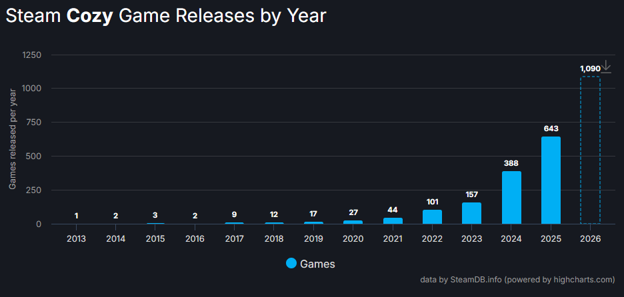
The rest, as they say, is history. The Guardian reported that Steam releases tagged as ‘cosy’ grew from 19 releases in 2020 to 643 in 2025. This hodgepodge of titles spans open-world RPGs like The Legend of Zelda, puzzle games like Unpacking (2021), farming life sims like Stardew Valley (2016) and even games with shooter elements, like Slime Rancher (2017). Despite the lack of a universally adopted definition of the genre, these games share characteristics such as low stakes, comfort, autonomy and reduced pressure.
Cosy gaming hasn’t replaced competitive play, but it has challenged the idea that games need to be about winning. While games have always offered more than challenges to overcome, cosy games put relaxation, creativity and connection front and centre. The point isn’t to conquer a world, but simply to have somewhere to belong. In a vicious productivity culture where even leisure can feel like something to optimise, there’s something quietly radical about slowing down and simply existing.
Achievement & Experience
So why do we play games? For a healthy dose of competition? To spend time with friends? Or to take a breather from the overstimulating world around us? Gaming research recognises that video game players seek more than a win, with motivations including enjoyment (duh), curiosity, exploration and social interaction. In other words, cosy gaming hasn’t invented new reasons to play. What it has done is bring some of those quieter pleasures into the foreground.
Part of this comes down to how cosy games are designed. Dr Rachel Kowert describes cosy game design through three recurring characteristics: safety, abundance and softness. In practice, this means less danger and urgency, basic needs that are easy to meet, and comforting sensory design. Developers interviewed by Tach at Epic Games similarly emphasise reduced time pressure, a slower pace and room for players to think, breathe and explore at their own speed. These aren’t just aesthetic choices; they change what the player is being asked to do. Rather than constantly reacting to threats or racing towards the next objective, players have more freedom to decide what they want to spend their time doing.
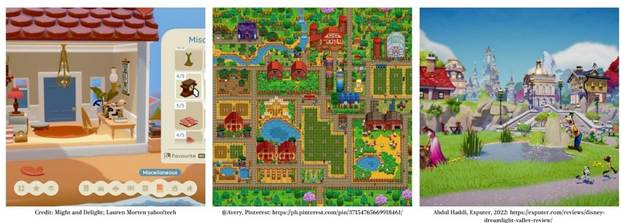
Consider decorating a house in Twinkleby (2025), tending a farm in Stardew Valley (2016), or customising an avatar and chatting with villagers in Disney Dreamlight Valley (2023). These games still have goals and progression, but the player doesn’t necessarily need to beat an opponent or optimise every decision to enjoy them. The activities themselves can be the reward. Often, instead of providing an obvious obstacle to overcome, cosy games focus on providing a world for players to shape.
This doesn’t mean competitive, action-based, or combat-heavy gaming has disappeared from the mainstream. Rather, cosy gaming is an alternative that makes it harder to overlook the satisfaction and value of playing for the experience itself, not just for what you might achieve in the end.
Activity & Place
Gaming elements like escapism, immersion in a beautiful and fascinating world, rich storytelling, and social connection through multiplayer, trading, sharing and chatting aren’t new or particular to cosy games. But when these elements are coupled with less emphasis on combat, heavy questing or optimisation, they can contribute to the feeling of a cosy game as a comforting world to escape to. Tach describes ACNH as “an island with cheerful neighbours and cosy connections, enabling a pastoral life”. Here, the appeal isn’t just in the activities available to the player, but in the world those activities allow them to inhabit.
Games can also offer a connection beyond the screen. A study of 15 Chinese students unable to return from America during COVID-19 due to international travel restrictions found that games helped participants maintain social connections, form new friendships and relieve stress. The study examined titles including Stardew Valley, Animal Crossing: New Horizons, and Genshin Impact. While this small study doesn’t establish that all cosy games are uniquely capable of providing these benefits, it illustrates how games can help people feel connected during periods of isolation. In a Rolling Stone interview, YouTube creator and streamer CozyK described how the growth of cosy gaming communities since 2020 has given players like her a shared label for games they already enjoy, a community to discuss them with, and a way to identify as gamers.
This matters because ideas about what makes a ‘real gamer’ or a ‘real game’ aren’t simply distinguished by ‘easy versus hard’ framing. Cosy games can combine familiar motivations like story, sociality, creativity and escapism in an environment that asks less of the player in terms of urgency or competition, while still being a valuable leisure activity. These games aren’t necessarily offering entirely new experiences; they’re bringing certain experiences into focus and making room for people to recognise themselves within them.
Part of this appeal might also stem from the sense that the digital world has become difficult to escape because of constant notifications and the expectation that being contactable means being available. Cosy games offer a virtual environment that asks the player to slow down, rather than constantly demanding their attention. This brings to mind parental anecdotes along the lines of: “On MySpace, you could log on, and log off, and then you were done with the internet for the day.” Usually, this sentiment is closely followed by the phrase: “kids and their damn phones,” but what if they’re right? The rise of cosy gaming communities and the demand for new titles might reflect a desire for digital spaces that feel more intentional, rather than another screen competing for our attention every spare moment. Or a text from that boss or acquaintance who quadruple-texts you. Whatever happened to messenger pigeons?
Regardless, a cosy game isn’t simply a less difficult game. It can be a world to inhabit, offering opportunities for connection, routine, identity, creativity and a temporary escape.
Productivity & Rest
It’s no coincidence that cosy gaming grew in prominence around the 2020 COVID-19 pandemic. Six years later, the world is still feeling the hardships of the resulting social, political and economic instability. Against this backdrop, hustle culture and productivity trends have poisoned social media feeds, particularly across Pinterest, TikTok, YouTube, and Instagram. The drive to achieve the most, become the best, and build a perfectly structured life centred around career, health and self-improvement sounds healthy until you attempt to live it.
Rest, care and slowness offer an alternative to these expectations, and cosy games are one way to experience them. Developers interviewed by Tach describe slower pacing, playing at one’s own speed, and taking pleasure in small things as deliberate design choices that support the cosy community’s desire for rest. In a playthrough of Wanderstop (2025), a teashop simulation about slowing down and healing from burnout, creator CozyK reflects on the game’s parallels to harsh internal narratives that treat rest as an undeserved luxury and failure as unacceptable, favouring discipline and self-bullying instead. The game makes space for a different possibility: that slowing down doesn’t have to mean giving up.
This alternative also appears in the cosy community’s language of care and wholesomeness. Australian culture critic and journalist, Mel Campbell, describes wholesomeness as “radical optimism” that opposes a culture dominated by loneliness and cynicism. Many players also describe gaming as a form of self-care, while American poet and activist Tricia Hersey argues that rest can help people reclaim imagination and hope. When parents or friends ask, in that lovely condescending tone, “Why do you game so much? What do you even get out of it?”, one might explain that they enjoy it, that it challenges them, or that it helps them unwind at the end of the day. Cosy gaming offers another answer: sometimes, a game is worthwhile simply because it brings “peace of mind”. That explanation, although hard for some to accept, is just as valuable as any other.
But is there a dark side to cosy gaming as a coping mechanism? Are we reproducing the capitalist and consumer-centric ideologies that keep us trapped in these exhausting cycles? Andiloro suggests that games can help people manage stress and explore creativity while remaining embedded in the systems that produce those pressures. Cosy games, then, might be understood as ‘utopian entertainment’: they offer an imagined alternative of pastoral living, close-knit communities and grounded hobbies without necessarily changing the real-world conditions that make these things appealing.
Cosy gaming may challenge productivity culture at the level of immediate experience: with the possibility of no leaderboard, no urgent deadline, and no requirement to optimise, creating a sense of relaxation and relief. While a need for relaxation is a valid reason to reach for the computer or gaming console, what happens when the world you needed to escape from is right there when you look away from the screen? Perhaps cosy gaming is more of a coping mechanism than a revolution. At least, in a culture where even hobbies can become productive projects, cosy gaming makes doing something for its own sake legitimate.
The rise of cosy gaming, both as a genre and a community, hasn’t invented any new motivations for playing video games. Instead, it has made relaxation, creativity, connection and low-pressure play more visible in our cultural understanding of what games can provide, making space for people who may not have felt welcomed in the mainstream gaming community. Have no fear: competitive games are still alive and well, but cosy games are on the up. This shift in popularity is accomplished by drawing attention away from what players can achieve and towards what a game lets them experience, inhabit and feel, offering a world players make their own.
Whether this amounts to resistance against productivity culture and capitalism is harder to say.
The major change isn’t that games have become less about winning, but that winning is no longer the only culturally recognisable reason for a game to be popular, fun, or worth playing. Similarly, quick reactions, strategic thinking and optimisation are no longer the only culturally recognisable criteria for being a gamer. Perhaps that’s what cosy gaming has changed most of all: the need to win, fix or improve something. Maybe now it’s enough just to be there.
 Megan Anne
 Yang Wu
 Liz Farnfield