

I think the lyrics of this song are not very good, but I still sent that Douyin video to my friends. In the video, the singer SKAI ISYOURGOD kept singing about Chinese people being able to fly (MEROS, 2026). My friends repeated the line and imitated the performance. We found it funny, but we also joined in. Half mocking, half playing along with the joke.
Figure 1
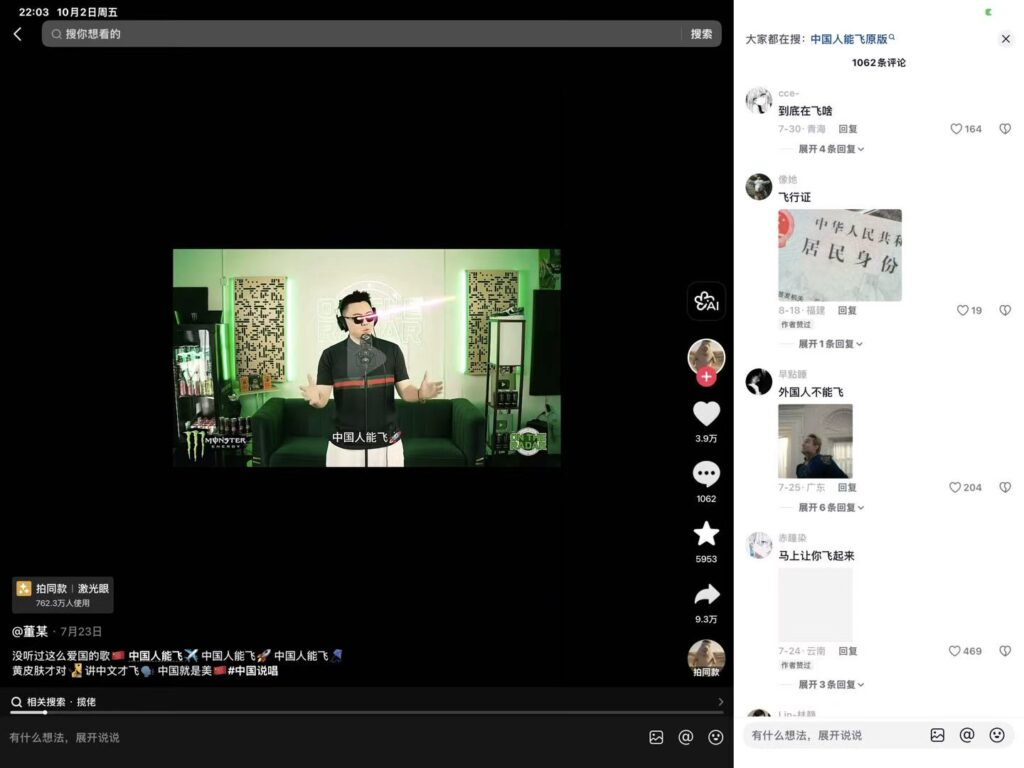
A Flying Licence in the Comments
Note. Screenshot from Mei tingguo zheme aiguo de ge… [Video], by Dong Mou (2026), Douyin. Comment by Xiangta (2026). Captured 2 October 2026; translated from Chinese.
Even when flying, you still need identification.
Some people take the joke a step further than we do. Under another performance video, Xiangta (2026) added a flying licence joke (Figure 1), with a picture of the back of a Chinese resident identity card. Since Chinese people can fly in the lyrics, the identity card is all you need to take off. Before anyone has even reached the sky, the paperwork is already done.
The originally ridiculous statement, combined with an even more ridiculous comment, becomes even funnier. People opening the video can see not only the performance itself but also the jokes added by the audience. At this point, the comment section also becomes part of the entertainment.
This is very similar to friends sharing jokes with each other. Once a line is recognised, others can follow along and imitate it. Some people add their own ideas, so the original material takes on a slightly different meaning. We don’t need to agree whether this song is good or bad. As long as the joke can continue, that’s fine. We cannot tell from this comment alone whether the netizen who posted the ID-card image actually likes the song. What we can see is that they have added something to the joke.
In a cultural commentary for Hǎi, Caiwei Chen placed this song within the discussion of “abstract” online culture, or chouxiang, a Chinese term used for absurd internet humour (Hǎi & Chen, 2026). Chen pointed out that sincerity and irony within it are often hard to distinguish. This helps explain the mixed attitude in the comments: taking an absurd idea seriously for a moment can be entertaining in itself.
If such interactions are simply classified as “like” or “dislike”, we may miss what the audience is doing. They have already joined the joke and started to entertain themselves.
It’s funny, but it might really sound good.
However, if we treat this song as just a meme, we might be a little unfair to the melody.
Under another related video, Lruri (2026) commented that, lyrics aside, the melody was actually quite good (Figure 2).
This listener focuses on the melody. They do not explain exactly what they think of the lyrics, so we do not need to add “the lyrics are terrible” for them. What the comment does make clear is that this song has something they enjoy.
I can fully relate. I think the lyrics of this song are weak, but the melody is very catchy. These two views don’t conflict. When friends imitate those lyrics, the melody also makes the line easier to remember and repeat. If it had no memorable parts at all, perhaps it would not spread so easily.
So, we should not assume that every positive comment about a mocked song is another joke. That assumption can overlook their real enjoyment.
When my friends imitate that line of lyrics, I also find it fun. While we are making fun of the performance, we are also playing along with the joke. So when I share this video, I’m also sharing something we can join in with. The sound and my friends’ responses are part of the same experience for me.
Figure 2
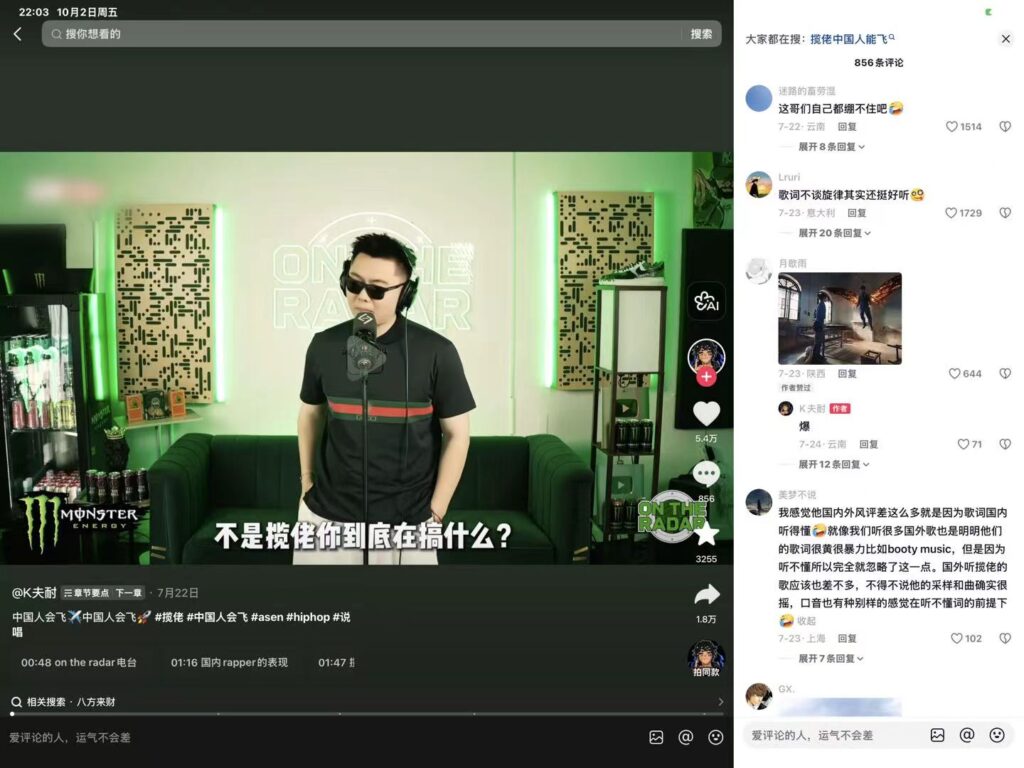
Enjoying the Melody
Note. Screenshot from Zhongguoren hui fei… [Video], by Kfunai (2026), Douyin. Comment by Lruri (2026). Captured 2 October 2026; translated from Chinese.
“I’m a bit tempted to see it. Someone talk me out of it.”
But when it comes to movies, things don’t seem so simple. It’s easy to repeat a line of lyrics, but when you actually sit down to watch a movie, it’s a completely different story.
Under a Douyin video discussing the animated film Niu Lai, Fengkuang de Xiaofengzi (2026) expressed interest in seeing it, but asked others to talk them out of it (Figure 3).
Figure 3
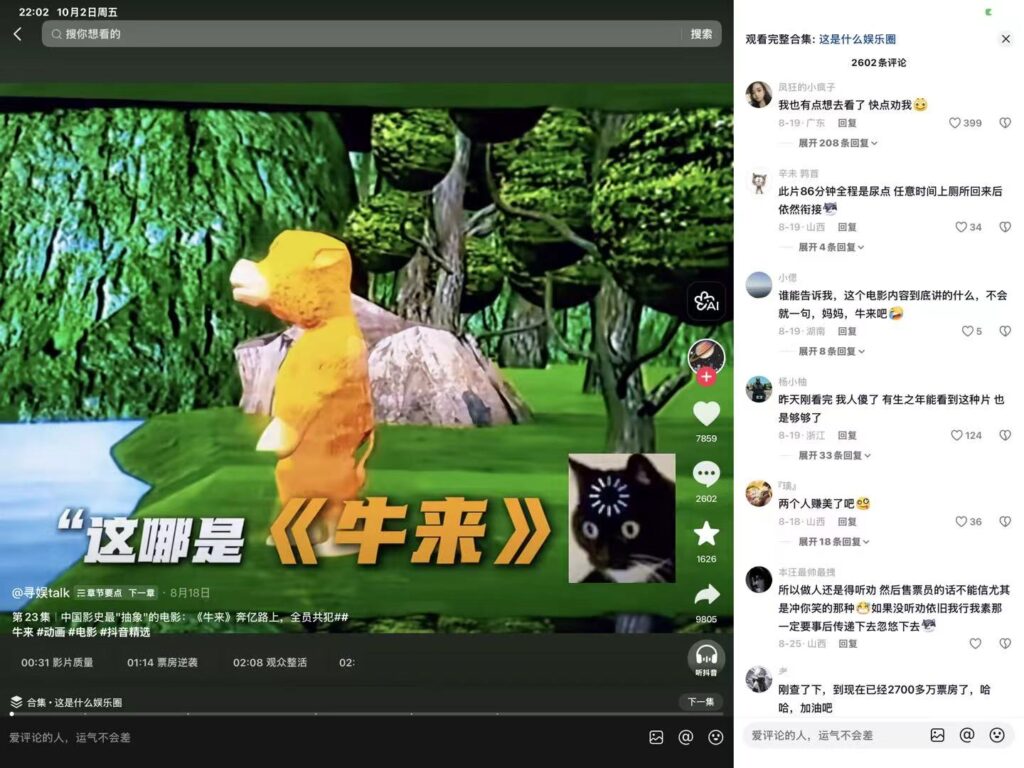
Tempted to Watch Niu Lai
Note. Screenshot from Zhongguo yingshi zui “chouxiang” de dianying… [Video], by Xunyu talk (2026), Douyin. Comment by Fengkuang de Xiaofengzi (2026). Captured 2 October 2026; translated from Chinese.
It leaves plenty of room for someone to respond. Some might try to talk them out of it, while others might encourage them to go. The comment already gives other people a joke to join in with.
In his review for Indy Film Library, film critic Jack Benjamin (2026) pointed out that Niu Lai has stiff animation, a slow pace and a repetitive plot. He also discussed the appeal of its clumsy human effort and the laughter it can bring. He even suggested watching it together. This is one critic’s judgement, but it raises a question: why do the shortcomings of a work sometimes become a reason for audiences to give it a chance?
Even if a film is not very good, some viewers may still enjoy it. Some people might want to see for themselves just how strange the film being mocked really is. And when watching it with friends, those absurd scenes can become material for jokes and imitations. Its flaws are still there, even if viewers find them funny.
Of course, we don’t know if that netizen really went to watch the film. What we can see is that interest in a movie has turned into a public joke. Someone can join this discussion without actually watching the whole film. Repeating a line from a song takes very little time, while a full film asks for much more. Being willing to join a joke does not necessarily mean being willing to watch the whole work.
Sarkhosh and Menninghaus (2016) analysed 342 questionnaires in a published study. Among frequent viewers of “trash films”, enjoyment was related to ironic viewing. This can include finding some of the film’s flaws funny and enjoying it for that reason. People who talked about their movie-watching experiences also reported more amusement and interest. These exchanges mainly happened before and after watching movies or in online forums. This does not prove that sharing caused the enjoyment. The participants were mostly German speakers, so the study offers clues about film audiences rather than a direct explanation of Chinese music listeners.
Without friends playing along, I usually would not seek out this kind of performance. When my friends imitate it, it becomes something I can respond to. The pleasure we get from these works also includes our reactions to each other.
Teasing also keeps the work spreading
Such participation can be interesting, but it does not mean we should stop criticising the work itself.
Just because a joke is fun doesn’t mean the lyrics are excellent. We can enjoy making jokes with friends without treating the flaws in a work as strengths. We can admit that we had a great time and still keep our judgement of the work itself. Otherwise, any flaw could be brushed off with “This is just a joke.” Serious criticism would then become difficult, because any objection could be treated as simply missing the fun.
Sharing may also bring a problem. The video can continue to circulate, but our attitude may not travel with it.
People who see the re-shared clips may have no idea about the sharer’s mood and tone. As a clip spreads, the context of the initial conversation can become less clear. If people’s attitudes are judged only by the number of shares, appreciation, curiosity and ridicule can be confused. More attention does not necessarily mean that a work gains more approval.
But complaining about the lyrics doesn’t change the fact that I also helped spread them. I shared the clip with my friends, and their imitation made that line part of our exchange. There’s no need to rush to defend myself. I can only say that I think the lyrics are weak, but I also found a lot of joy in sharing the video.
For me, this mixed feeling is worth keeping. My friends didn’t become loyal fans just because they imitated a line, and I didn’t stop criticising the lyrics just because I found the performance funny. Sometimes, having someone join in with the joke makes the performance more interesting to me and gives me a reason to share it.
Of course, the idea that Chinese people can fly has not taught me to fly, but it has given us a joke to share.
Cover image: Screenshot from On The Radar Radio’s video, 1:00.
 Megan Anne
 Yang Wu
 Liz Farnfield