
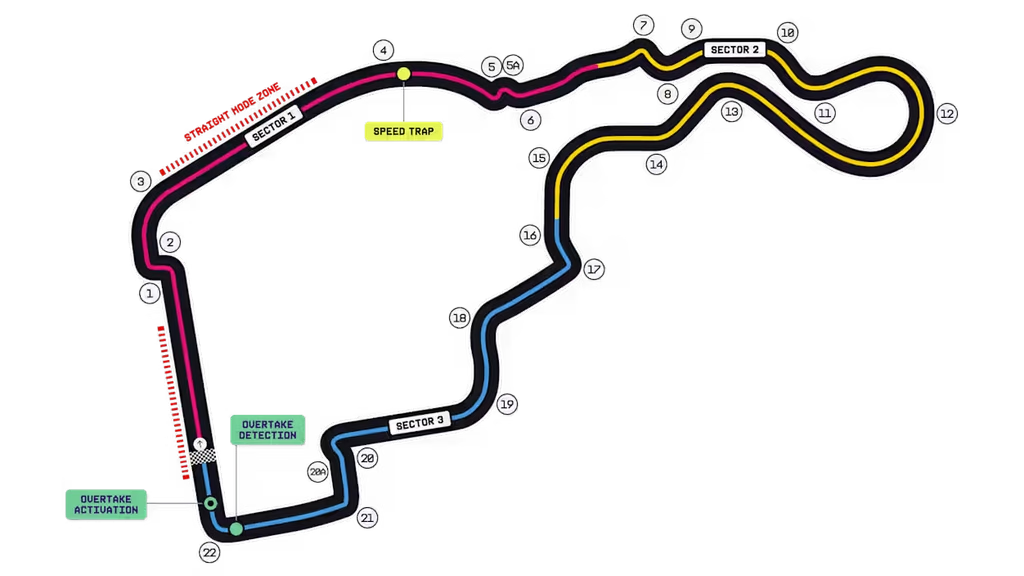
On 13 September 2026, Formula One raced for the first time at the Madring, a brand new circuit in Madrid built to host the Spanish Grand Prix. Over 57 laps there were only four on-track passes after the opening lap, and none at the front of the field — the fewest overtakes of any race so far this season, in a year that had been averaging 61 per race. For a series that sells itself as the pinnacle of motorsport, a race with almost no racing in it is a strange thing to launch.
It’s tempting to dismiss the Madring as a bad track that will be quietly fixed. But it raises a bigger question: what is Formula One being built for, and who is it for? This article argues that F1’s modern business model rewards spectacle and attendance over competitive racing, turning the sport into an event and leaving fans as the audience for it.
To argue that F1 has changed, it helps to be clear about what it was. Formula One is the highest class of single-seater racing, where the best drivers and the most advanced cars compete under rules set by the FIA — hence the word “formula”. Its identity rests on engineering, competition and driver skill. It’s worth noting that the old F1 was no golden age. Bernie Ecclestone controlled the sport for about forty years, and by the time Liberty Media bought it in 2017, racing had become predictable and short on wheel-to-wheel battles. The difference is what Liberty chose to do about it. Its new commercial chief, Sean Bratches, said F1 had been a motorsports company and he wanted to pivot towards an “entertainment company and brand”. One master’s thesis describes this as the repositioning of F1 from a motor sport company to a global entertainment brand. The shift isn’t a critic’s slur; it was the stated plan.
The Madring was sold on spectacle: a 340km/h straight and a 24-degree banked corner. Yet the banked corner, La Monumental, did nothing for the racing — Fernando Alonso joked that his press officer could have taken it flat, and nobody was close enough to the car ahead to use it as a launch pad for the next braking zone. Elsewhere, several corners forced drivers to brake and turn at the same time, leaving only one usable line that was easy to defend. Even the chicane billed as the main overtaking zone had an awkward entry that made attacking it hard. Reigning champion Lando Norris said he didn’t know how someone looks at the design and calls it “mint”, and Max Verstappen had warned before the weekend that the braking zones were the problem. The sport’s own drivers saw it coming.
Fairness matters here: the Madring was not a blank canvas. Roughly half of the lap uses existing roads around the IFEMA exhibition centre, and only the other half, in Valdebebas, was designed from scratch. But the warnings were not new either. The Race reported that revisions to three areas had already been proposed to the FIA before the race because of concerns that passing would be too difficult, and the circuit still debuted without them. Motor Sport’s Pablo Elizalde argued that the finances were the likeliest explanation: with a nine-figure construction cost and a new market the sport wanted to be seen in, whether the racing was any good mattered less — particularly when Spain already had Barcelona. Changes to the Turn 5/6 chicane, Turn 13 and Turn 20 are now being discussed for 2027, but the Madring has a ten-year contract regardless, so the sport is committed either way.
The Madring would be easier to write off as a one-off if it weren’t for the way F1’s other showpiece events behave. Miami is useful precisely because its racing isn’t the problem: the 2026 race produced 88 overtakes, the second most of the season at that point. What Miami shows is the other half of the pattern — who the event is for. A Miami local and twelve-year fan told F1 Chronicle that the Grand Prix had become influencer-heavy and not fan-focused, even as the weekend drew over 275,000 people and an estimated US$400 million boost to the local economy in 2024. Fans have complained for years about influencers being invited to the paddock without any interest in the sport. After the event’s second year, The Race described Miami as the prototype “Liberty F1” event and questioned whether someone outside F1’s inner circle, facing extortionate food and merchandise prices, is a fan or a customer. Different circuits, same priority: the weekend, not the race.
So why does it keep happening? Because Liberty’s growth is built on reach, and reach is built on spectacle. Netflix’s Drive to Survive and 2025’s F1: The Movie are media products as much as marketing. The film became Apple’s highest-grossing release and passed US$600 million at the box office, while F1’s revenue for the first half of 2025 rose 14 per cent to US$1.6 billion. A 2026 paper in Media, Culture & Society uses the film as a case study of Liberty Media’s media strategy and calls it a commercial media spectacle, and a 2024 University of Lille thesis asks the question in its very title: Sport or Spectacle? Each of these decisions makes sense on a balance sheet. The cost is paid by the racing, because a circuit that looks good on television and against a city skyline doesn’t need to produce overtakes to succeed commercially. Fans, in turn, become the audience for an event rather than the point of a sport.
There is a fair counterargument: spectacle has grown the sport. Shah and Williams interviewed twelve viewers of Drive to Survive and found that two thirds credited the series with their new or increased fandom. The same study also found that some viewers were frustrated by its overdramatised portrayal, which at times detracted from the authentic racing. And one race doesn’t prove a pattern. Alex Albon argued that it would only take two or three changes to fix the Madring, and Motor Sport has noted that judging such a complicated venue on one race may be premature. But growth that undermines the product it is selling isn’t sustainable. The drivers are raising the alarm, and even race winner Kimi Antonelli said more needs to be done to improve overtaking.
In the end, whether Formula One is listening is the real test of its values. The 2027 redesign of the Madring will show whether racing still wins when it clashes with the event. If a few corners are all it takes, that is a story about a sport correcting a mistake. But the warnings came before the race, and the race went ahead anyway — which suggests a sport that builds the event first and checks the racing later. Formula One can be both a sport and a brand, but when the two collide, the Madring and Miami suggest which one it chooses.
 Megan Anne
 Yang Wu
 Liz Farnfield