
Artificial intelligence promises to make content creation faster and more accessible. But as digital creators embrace new tools, questions about originality, copyright and job security are forcing the industry to reconsider who really benefits from the AI revolution.
A video can take hours to plan, film and edit, yet disappear into the social media feed within seconds. For content creators, the work does not end when the camera stops recording. Captions need writing, trends need monitoring, audiences need engaging and algorithms need satisfying. Now, artificial intelligence (AI) promises to make some of that work easier. But could the same technology that helps creators keep up with the content treadmill eventually make their work less valuable?
From AI-generated images and video to automated captions and writing assistants, generative AI is changing how digital content can be produced. For creators building careers on platforms such as TikTok, Instagram and YouTube, the technology presents an appealing contradiction: it could reduce the workload associated with producing content while threatening the originality, ownership and human connection that make that content valuable.
Research published in Convergence: The International Journal of Research into New Media Technologies explored how content creators perceive the opportunities and risks associated with generative AI. Are et al. (2025) found that creators’ attitudes were complex, reflecting both optimism about AI’s practical benefits and concerns about its potential effects on creative work.
Their findings challenge the assumption that creators simply welcome AI as a productivity tool or fear it as a replacement for human labour. Instead, creators expressed both optimism about its practical benefits and concern about what could be lost as AI becomes more integrated into creative work.
The question is no longer whether AI can create content. It is whether its growing role will strengthen the people behind that content or undermine the work, skills and livelihoods they have spent years developing.
A helping hand behind the screen
For many creators, the appeal of AI is straightforward: less time spent on repetitive tasks means more time to create.
Unlike traditional media professionals who may work within established production teams, independent creators frequently manage several responsibilities themselves. They might be the presenter, camera operator, editor, social media strategist, marketer and business manager all at once.
Maintaining a consistent online presence can therefore become a demanding cycle. Creators must produce enough material to remain visible while adapting to changing audience preferences and platform algorithms.
Are, Briggs and Brown’s 2025 study explored these pressures through two stages of research: an initial qualitative survey involving 100 content creators, followed by a quantitative survey involving 307 creators. Participants identified opportunities for generative AI to automate administrative work, assist with early drafts and support the promotion and distribution of content.
One writer, for example, described the potential value of an AI assistant that could produce initial article drafts from voice or text input, leaving more time for editing and refinement.
Such applications demonstrate that AI does not necessarily need to replace creative work to change it. It can instead become part of the process, helping creators manage the less rewarding responsibilities surrounding their work.
For smaller creators without the resources to hire editors, assistants or marketing professionals, these tools could lower some barriers to participation. A creator could use AI to organise content ideas, generate caption options, transcribe footage or develop a preliminary posting schedule without paying for additional services.
This is particularly relevant to creators attempting to balance content production with study, employment or other responsibilities. When time and resources are limited, even modest improvements in efficiency can make consistent publishing more manageable.
However, efficiency is not the same as creative improvement. Automating administrative tasks may give creators greater freedom to develop their ideas, but generating the ideas themselves raises a different question: where does assistance end and creative substitution begin? These findings suggest that creators may view AI as a tool for supporting existing creative processes rather than simply replacing human labour (Are et al., 2025).
When convenience comes at a creative cost
Creating content involves more than producing something that attracts attention. It also involves developing a recognisable style, experimenting with ideas and learning through experience.
For some creators, these processes are the most rewarding parts of their work. If AI increasingly performs these tasks, creators may become more productive while having fewer opportunities to develop the skills that distinguish their work.
Some participants feared losing the enjoyment, dedication and sense of achievement associated with learning their craft. These concerns demonstrate that the impact of AI extends beyond employment, raising questions about creative fulfilment and the value creators attach to developing their skills (Are et al., 2025).
This distinction matters because creativity cannot be measured entirely by speed or output. A tool that generates ten video concepts in seconds may be useful, but those concepts do not automatically reflect the creator’s experiences, personality or understanding of their audience.
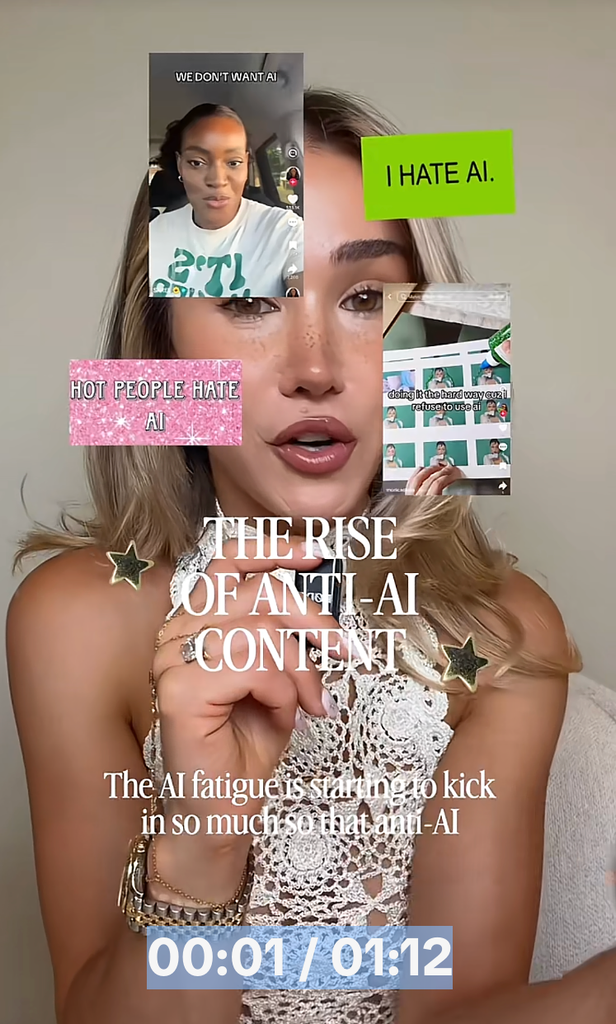
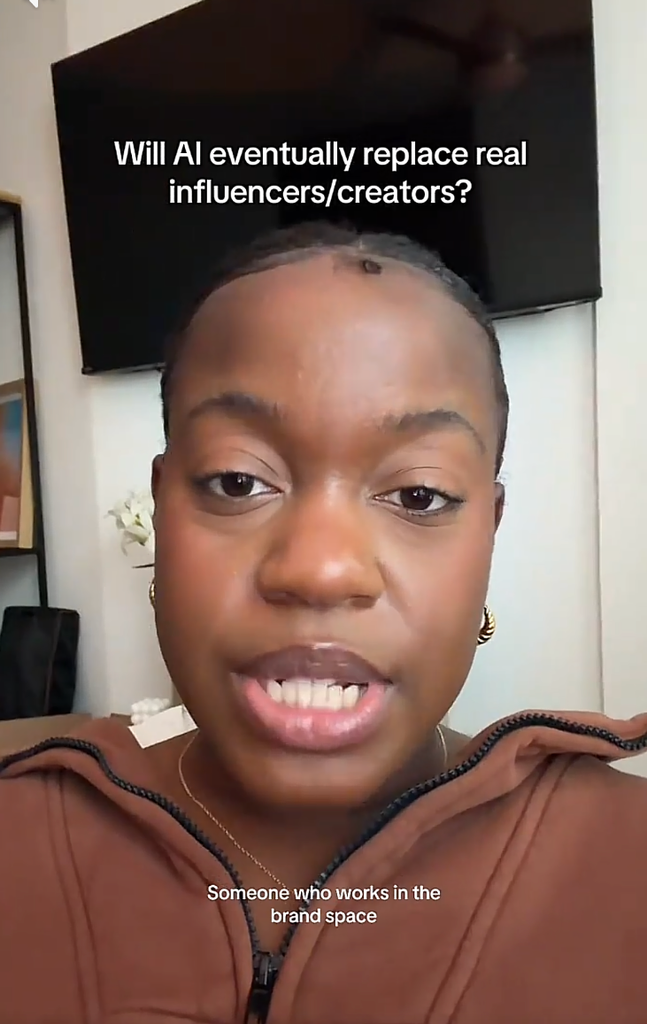
The growing conversation about AI and creativity is also visible within creator communities. TikTok posts by Julia Broome and SydTheCreative offer additional creator-led material to explore alongside academic research into AI’s effects on creative work.
Ultimately, the challenge is not simply to decide whether using AI makes someone less creative. It is to consider how creators use it, which decisions they retain and whether the technology supports their individual perspective or encourages increasingly standardised content.
AI can provide a starting point, but a starting point is not the finished product. Human judgement remains important in deciding what deserves to be developed, what should be discarded and what communicates something meaningful.
Who owns the work behind the algorithm? .
Generative AI systems can produce text, images, audio and video based on patterns learned from existing material. This creates concerns for creators whose work may be used in training datasets or imitated by AI-generated outputs without their knowledge or consent.
A creator might spend years developing a distinctive style, photography aesthetic or storytelling approach, only to find that similar-looking material can be generated quickly using AI tools. Even where the resulting work is not an exact copy, the creator may question whether their original labour has contributed to a system that competes with them.
Are et al., 2025 identify copyright infringement, privacy and control over creative identity among the concerns expressed by participants in their study. These issues highlight a fundamental imbalance: creators may contribute valuable material to the digital environment without having meaningful control over how that material is subsequently used.
Research by Stuart Cunningham and David Craig, published in Social Media + Society in 2019, offers a useful framework for understanding this imbalance. In Creator Governance in Social Media Entertainment, the authors argue that online creators have not been adequately recognised as stakeholders in debates about platform governance.
Without appropriate safeguards, the benefits of AI could be distributed unevenly: technology companies and businesses gain efficiency, while the people whose work helps make those systems valuable bear more of the risks.
The pressure to keep producing
The threat of AI cannot be separated from the existing conditions of the creator economy.

Content creation is often presented as an attractive career built around flexibility, independence and the freedom to turn personal interests into income. However, creators frequently operate in an uncertain environment where earnings, visibility and opportunities depend on changing audience behaviour and platform decisions.
Cunningham and Craig’s research describes the tensions between platforms and creators, including disputes over monetisation, content ownership and the conditions under which creators earn a living. They also examine how creators have organised collectively to advocate for their interests.
These concerns are important because AI is entering an industry where many workers already experience pressure to produce more content, maintain engagement and diversify their income.
A creator who uses AI to generate captions or edit footage may save time. But if that time is immediately redirected towards producing more posts to remain competitive, the technology may not reduce their workload in practice.
The challenge is to ensure that AI supports sustainable creative careers rather than making an already demanding industry more competitive and uncertain.
Keeping creators in the conversation
Addressing these concerns requires more than encouraging creators to learn new AI tools. It also requires platforms, technology developers, policymakers and businesses to consider the people whose work is affected by technological change.
First, creators need greater transparency about how their work is used. Second, platforms and businesses should establish clearer processes for addressing unauthorised uses of creators’ likenesses, voices and original material. Third, creators should be included in consultations about AI policies and the future of creative work. Are et al., 2025; Cunningham & Craig, 2019 argue that creators remain underrepresented in discussions about AI development and regulation, despite being among the workers likely to experience its consequences.
Cunningham and Craig’s work reinforces the importance of recognising creators as stakeholders rather than treating them simply as suppliers of content.
Finally, AI literacy should involve more than learning how to write effective prompts. Creators need opportunities to understand the limitations of AI, evaluate generated material, protect their work and make informed decisions about when not to use the technology.
These measures would not eliminate every risk, nor would they require creators to reject AI altogether. Instead, they would help ensure that technological innovation does not come at the expense of creative workers’ rights and interests.
The future is still being created
Artificial intelligence will continue to influence how digital content is produced, distributed and consumed. For creators, refusing to engage with it may not always be practical, particularly as businesses and platforms incorporate AI into their existing systems.
But embracing AI does not have to mean surrendering creative control.
Are et al., 2025 suggest that creators’ attitudes are more complicated than a simple choice between enthusiasm and fear. Many see genuine value in reducing repetitive work, while remaining concerned about copyright, privacy, fairness and the loss of creative fulfilment.
That tension deserves greater attention. The future of AI-assisted creativity should therefore be judged not only by how much content can be produced or how quickly it can be delivered, but also by whether creators retain meaningful control over their work and share in the benefits of technological progress.
The technology may be generating the next wave of digital content, but creators should still have a say in what that future looks like.
Sources
Are, C., Briggs, P., & Brown, R. (2025). Content creators’ hopes and fears about artificial intelligence. Convergence: The International Journal of Research into New Media Technologies, 31(6), 1901–1925. https://doi.org/10.1177/13548565251372830
Cunningham, S., & Craig, D. (2019). Creator governance in social media entertainment. Social Media + Society, 5(4), Article 2056305119883428. https://doi.org/10.1177/2056305119883428
julez | social media. (2026, June 17). Anti-AI comfort creators are hereee 👀🧸💖 #comfortcreator #contentideas #creatorfyp [Video]. TikTok. https://www.tiktok.com/@juliabroome/video/7652405993363557645
SydTheCreative. (2025, November 12). I havent seen too many people talking about AI taking the place of human influencers in UGC content. I geniunely [Video]. TikTok. https://www.tiktok.com/@sydthecreative/video/7571976478930259230
 Damien Humphrys
 Alessia Arcaro
 Victoria Katris