
In September, the (chronically online) world opened their socials to Sydney Sweeney asking, “So you think you know sports?”, clutching two NFL footballs to protect her modesty.
Why am I seeing this? and oh Sydney, not again… I thought. A little digging revealed it was an advertisement for Novig, a sports prediction market (essentially a gambling platform). Whether ‘sports prediction market’ reflects a meaningful difference in how the product works or simply gives the industry a moniker to distance itself from the baggage associated with gambling, is another question.
Novig – a company most people hadn’t heard about until Sydney Sweeney‘s near nudity put it on the map. But once the internet heard about it, they had plenty to say.
“Don’t people usually wear clothes when the play sports?”
– YOUTUBE USER
The backlash was swift. Critics questioned the ad’s need to sexualise women in sports and its all too familiar formula: here’s an attractive young woman in hardly any clothes promoting a product that does not require her to be doing all that. It even inspired a spin-off trend, with women sharing their own versions of what empowered women in sports look like.
It’s not the first time Sydney Sweeney has landed in hot water. In 2025, clothing brand American Eagle released its now-infamous campaign featuring the actress in double denim, with a tagline built around a play on the double entendre of great jeans/genes. In one ad, she leads with a monologue on DNA before delivering the punchline, “My jeans are blue”. It concludes with “Sydney Sweeney has great jeans”.
The internet had a field day, particularly her breathy, forced-sultry delivery, being parodied by many. Jokes aside, it was also felt that there was something rather sinister in the ad’s packaging. Critics argued that pairing a blonde, blue-eyed white woman with language about genetics echoed eugenicist undertones. Others saw the campaign as pandering to the male gaze. Some said the negative reaction was out of proportion. Reliably, US President Donald Trump weighed in.
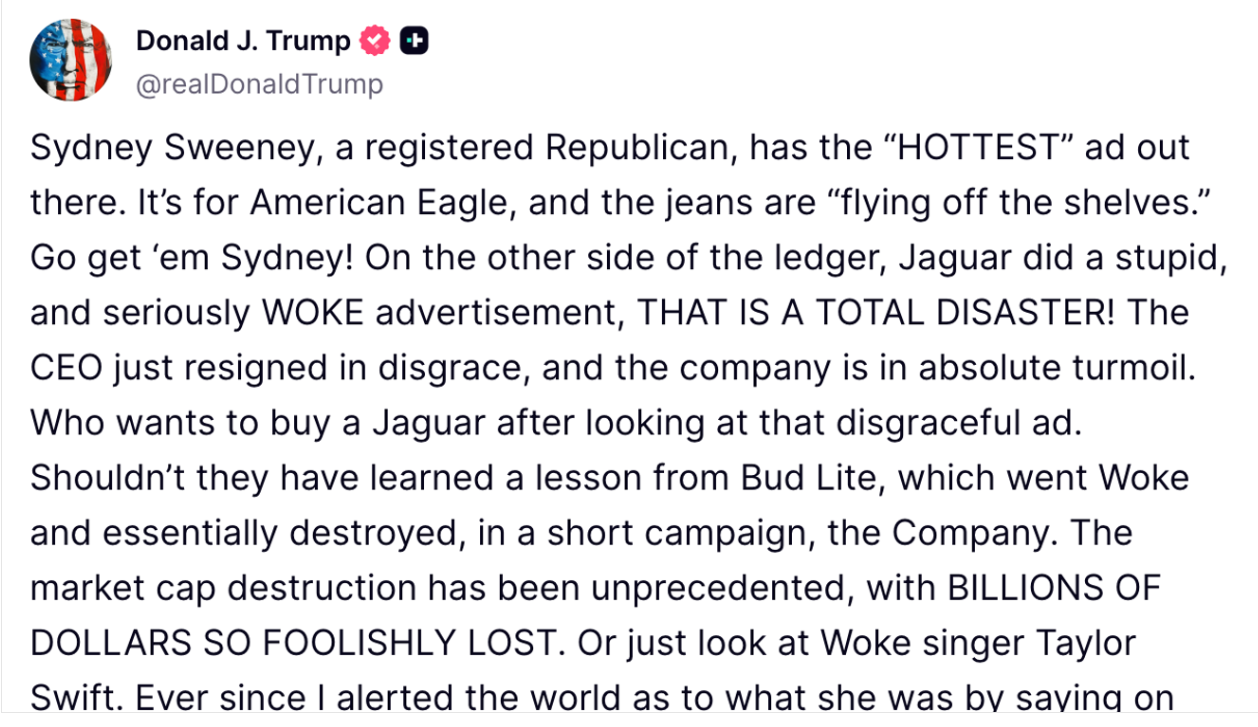
Ultimately American Eagle treated the issue with levity and defended the campaign. Not to mention, the time Sweeney sold soap infused with her own bathwater. In view of all these escapades, Sweeney has become the poster girl for provocative and shocking advertising.
However, to dwell on passing moral judgement of Sweeney is to digress from the central question of what these campaigns reveal about the machinery of online attention. Instead, I’ll leave the words of Marina Hyde here, an ever-reliable contrarian and co-host of The Rest Is Entertainment podcast.
“I don’t think this has anything to do with female sports… the idea that it matters one way or another to women’s sport if she does this, sorry, I just don’t buy that. None of which is to denigrate the achievements of all these great women athletes, it just seems to me a category mistake….Why should women feel ashamed for promoting brands? People are always wanting to tear her down. I can assure you that for her entire thirties and forties, there will be people interviewing her, trying to get her to feel retrospective shame about stuff she’s done in her twenties, and I’m not here for it.”
Marina Hyde co host of The Rest is Entertainment Podcast
Is provocative advertising new, or newly amplified?
Shock advertising is not a burgeoning phenomenon. Referred to as ‘shockvertising’ by those in the biz, it disrupts shared social norms and values, and exploits taboos. It aims to elicit strong emotions, increase awareness and sometimes even, bring about behavioural change. Think of the grotesque images on cigarette packaging or road safety campaigns illustrating the potential consequences of drink-driving. Studies have shown that shockvertising stimulates parts of the brain related to memory. The messaging embedded in the ad is designed to stay with the viewer. Not-for-profits or government sponsored ads commonly seek to evoke fear or sadness to catalyse tangible behavioural change.
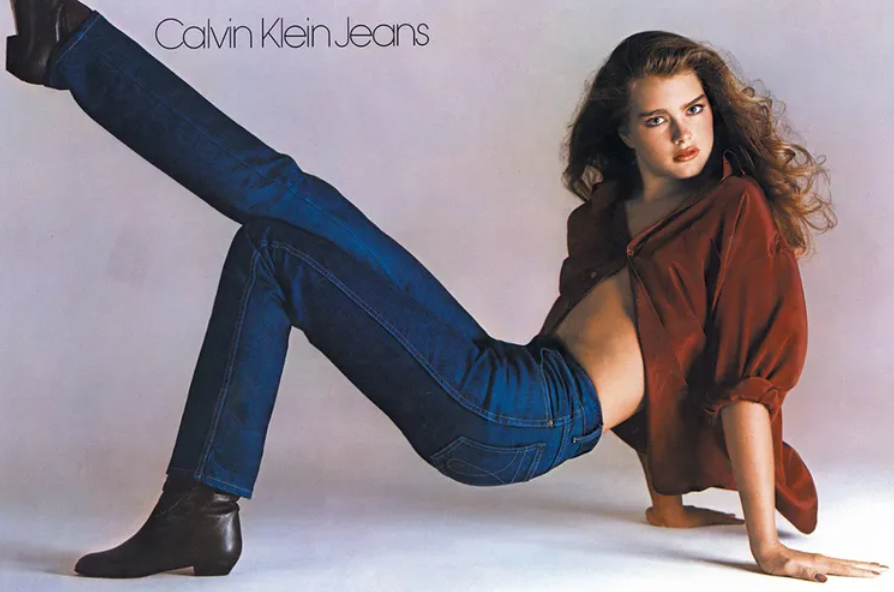
On the business side of things and at the intersection of celebrity, sexualisation and shock, I’m reminded of a 1980 Calvin Klein jeans campaign starring a 15 year old Brooke Shields. She’s writhing on the floor whilst pulling on some skinny jeans, giving an almost identical spiel to Sweeney’s outlining how genes are passed down between generations. In one line, Shields says, “You want to know what comes between me and my Calvins? Nothing.” The television commercial was banned from airing on major US networks. Both campaigns wade through similar territory, yet were conceived almost 50 years apart. Their difference lies in the mechanisms through which they were deployed.
In the contemporary digital age, each individual harnesses an “instantaneous power of expressive dissemination“. The audience becomes the distributor with each repost, comment, like, and share having a compounding effect. As illustrated by a user’s comment under the Novig’s Youtube post, “It’s funny how I would’ve never seen this ad if it wasn’t for the controversy”. The cycle is self-reinforcing: outrage turns into engagement turns into broader media coverage generating further reach and more opportunities to spread. The shock tactic may be old, but the audience’s role in amplifying it has undoubtedly changed.
Why outrage the aim
Michael H. Goldhaber explored the concept of the ‘attention economy‘. It is predicated on the idea that attention is a scarce resource, increasingly so as the information competing for it continues to grow. Distinctly different from material commodities, attention cannot simply be manufactured. It is ephemeral and difficult to capture, therefore securing it at scale is valuable. In her research, Janice Winship argued that shocking imagery assures public visibility at little cost. Publicity generated with each additional impression beyond the scope advertisers initially paid for is this concept of ‘earned media‘. Furthermore, through the power of the algorithm, engagement signals can influence recommendations and boost distribution.
Perhaps increasingly the name of the game in the digital space, shockvertising remains frowned upon in some quarters of advertising and marketing. It stays out of traditional advertising, for the most part, because broadcasting and publishing codes impose restrictions on what is acceptable. Shockvertising pairs well with social media where policies are enforced less and boundaries of what is acceptable are blurred. In the case of Novig’s campaign with Sydney Sweeney, it is difficult to believe that an entire team of marketing professionals could develop it without foreseeing the consequences of the predictable reactions it would provoke. Therefore, shock becomes the strategy itself, rather than an unintended by-product.
Demography of gambling ads
Novig’s ad does not stand alone in the prediction market sphere. An appetite for its kind of format already exists among its target audience. When identifying the demographic for prediction markets, Jonathan Cohen, head of sports betting policy at the AIBM puts it plainly “The vibes are young male vibes”. An article from the BBC explains how prediction markets are part of a broader tapestry of male-dominated online cultures including ‘finance bro’ culture, sports, cryptocurrency, and streaming. Research suggests that celebrities and social media influencers are increasingly used in promotional material in the gambling industry. With participants reporting that it made them pay more attention to the ad than perhaps they ordinarily would have. A familiar face engenders a sense of trust and therefore a preparedness to actually engage in gambling. The appeal to young men, through celebrity endorsement, is not without commercial logic.
On the sexualised imagery front, of 85 wagering advertisements analysed in an Australian study, a quarter contained sexualised imagery. And in a separate experiment, an attractive female presenter drew more attention than a match commentator or betting operator. The construction of Novig’s ad uses the recipe of celebrity and sexualisation to specifically capture the attention of young men. Working alongside this, the outrage generated by the people who are not necessarily the intended users of the product, helps to amplify an ad’s reach. Even so, a campaigns pervasiveness and visibility does not guarantee a brand’s commercial success.
All publicity is good publicity: how true is this?
That shockvertising generates attention is an immutable fact. However, attention is not indicative of approval, nor does it guarantee sales. A viral campaign can reach millions of people who have no intention of buying the product, and negative comments can generate the same visibility as praise. Brand trust and integrity, purchase intent, and customer retention are a whole different can of worms. The commercial value of outrage therefore depends not only on how far a campaign travels, but who it reaches and what they do next. Research suggests that shockvertising runs the risk of producing negative attitudes towards advertisements and the associated brands. Its effects also appear to plateau in the long run, with changes in customer behaviour short-lived.
However, the controversy appears to be paying off for Novig. On Instagram where the ad was originally posted, it amassed tens of millions of views while Novig’s following grew three-fold in the weeks following its release. The company recently boasted a $2 billion valuation and a 260.9 per cent rise in app downloads following the campaign. In comparison, using Sydney Sweeney’s Instagram follower count as a non-definitive metric of her reputation, she lost more than 200,000 followers. As the face of the brand, she acts as the scapegoat to take the brunt of negative criticism whilst the brand quietly amasses followers, users and secures investment.
American Eagle on the other hand, saw a drop in store foot traffic despite the campaign generating some 40 billion impressions. The correlation complicates any claim that publicity intuitively translates into commercial success. The art of shockvertising is in treading the line between what is acceptable and what isn’t, without crossing it. Victoria Barry says, “Where a powerful brand may be able to weather the storm, or even enjoy the notoriety that comes with shock, the lasting connection between a product and a barrage of complaints… may be too much for others”. Maxi Heitmayer says the recourse to a shockvertising strategy needs to be balanced with the risk of the brand being boycotted or cancelled. Controversy today may be forgotten tomorrow, but its important to not leave a customer behind in the process.
Looking ahead
Outrage is a powerful emotion and attention is the most valuable currency online. It extends an ad’s reach beyond its paid placement and can translate into commercial success. Sydney Sweeney’s stake in Novig transcends her beyond simply being the face of the brand. Together they appear to be doubling down in another provocative ad titled “No BS”. If this is the new normal, at what point will “shock fatigue” take hold and the tactic lose its efficacy? With an infinite amount of information competing for visibility, the boundaries will likely continue to be pushed until shock stops paying off. In an increasingly fragmented digital landscape, advertisers will undoubtedly continue to evolve, finding new ways to hold the fleeting attention of online audiences.
 Damien Humphrys
 Alessia Arcaro
 Victoria Katris