

Figure 1. All Girls Padel Community in Jakarta, Indonesia via PBPI
Anyone who has tried to book a prime-time Padel court in Jakarta on a Friday evening knows how hard it can be to find a free slot. Ask what the same court looks like at two o’clock on a Tuesday afternoon, however, and the answer becomes harder to pin down. There are no public, nationwide occupancy figures for Indonesian padel venues, and that gap in the data is part of the story. What the available evidence does show is a sport that has built courts at extraordinary speed, a business model that depends on those courts being almost permanently busy, and a cautionary tale from Sweden that industry watchers are beginning to take seriously.
Courts first, players later?
Padel arrived in Indonesia late and then spread quickly. According to Growell data reported by Good News From Indonesia, the number of padel courts in the country rose from 240 in 2024 to 947 in 2025, an increase of roughly 435 per cent in a single year. The same report cites projections of 2,527 courts in 2026, 4,693 in 2027 and 5,573 in 2028. The data site GoodStats summarised the forecast in a vivid way: about 3.8 new courts opening every single day.
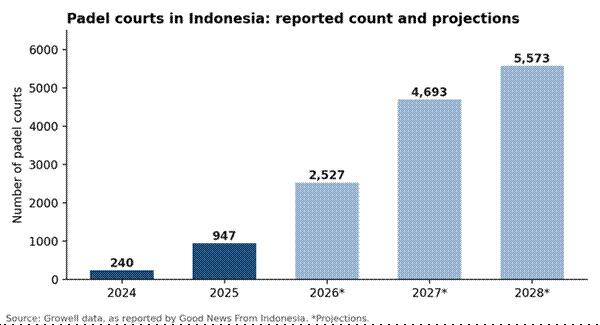
Figure 2. Reported number of padel courts in Indonesia and projections to 2028. Data: Growell, via Good News From Indonesia.
Not every count agrees, however. The Indonesian Padel Association (PBPI) recorded only 133 permanent courts as of June 2025, according to Fortune Indonesia. The gap between 133 and 947 may reflect different definitions, such as permanent versus converted or temporary courts, but it points to a real problem: an industry is making large investment decisions on numbers that nobody can fully verify.
Demand, to be fair, has been real. The Global Padel Report 2025, summarised by Good News From Indonesia, found that an average Indonesian court generated more than €6,000 in gross merchandise value each month, about Rp110 million, up 173 per cent between 2023 and 2024. CNA Indonesia reported in 2025 that some Jakarta courts were booked weeks ahead, and that in parts of the capital covered venues were being converted into padel courts almost every month.
When a full court is the business plan
The difficulty is that most Indonesian padel venues earn money in one main way: renting courts by the hour at premium rates. Fortune Indonesia reports that, to recover their investment, such venues need occupancy of around 60 to 70 per cent during peak hours. If enthusiasm cools, the outlet warns, rent, maintenance and staff costs stay the same while income falls.
There are signs that competition is already changing prices. In July 2026, while hosting a padel tournament series in Tangerang, Andre Rosiade, deputy chair of the House of Representatives’ Commission VI, told Metro TV that court hire used to be limited and expensive but is now getting cheaper, close to the price of a badminton court. For players, falling prices are good news. For operators with loans to repay, they raise the number of bookings needed to break even.
A quiet court is therefore not proof that padel has failed. It is a warning that supply may be running ahead of the habits of regular players, which is a different and more fixable problem.
A warning from Sweden
Sweden shows how quickly the story can turn. Once hailed as the country that took padel to its heart, it saw its market expand so fast that supply overtook demand. Katadata, drawing on a Bloomberg investigation, reports that Sweden went from about 300 courts to 3,500, and that operators were hit by rising competition, inflation and fading interest from the middle class. One Swedish industry veteran told Bloomberg that this kind of growth could not be sustained. In Uppsala, a city of roughly 200,000 people, the number of courts jumped from 14 to 100, in a place he judged had room for no more than 20.
The consequences were severe. Good News From Indonesia notes that We Are Padel, Sweden’s biggest padel company, restructured and closed about half of its facilities in 2022, while Detik Finance reports that many owners shut their businesses because of a lack of customers. Crucially, the problem was not that Swedes stopped playing. The industry simply grew faster than its player base could follow.
Fortune Indonesia argues that parts of Indonesia show a similar pattern of over-investment and over-capacity, with many investors building courts without in-depth research into long-term demand. That is one outlet’s analysis rather than a verdict, and Sweden’s experience is not evidence of what will happen here. But it explains why the word “quiet” has started to appear next to the word “boom”.
Friction beyond the court
Noise is a problem in another sense too. In February 2026, residents of Pulo Mas in East Jakarta protested against a commercial padel court built among homes, saying they had not been told it would be commercial and complaining of constant traffic and long opening hours, according to Metro TV. Days later, Fourthwall Padel in Cilandak, South Jakarta, suspended operations to install soundproofing after mediation with neighbours. Jakarta’s city government has since stopped issuing new permits for courts in residential zones, with Governor Pramono Anung saying that new facilities must be located in commercial areas.
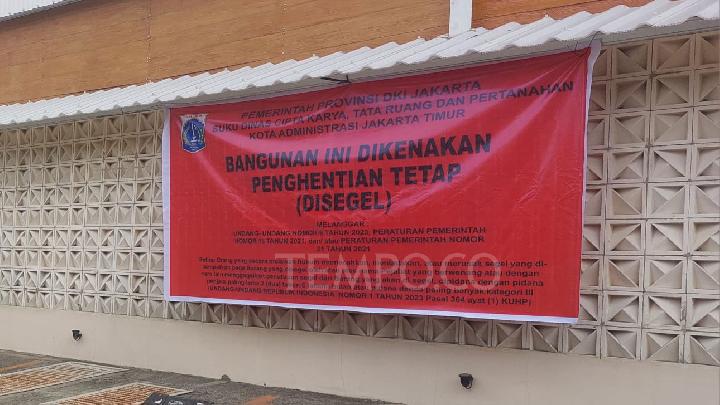
Figure 3. Forcing to sealed a Padel court due to no permissions with the local residents via Tempo.com
Community resistance has also reached the grassroots. CNA Indonesia reported that a plan to turn a village’s only football pitch into a paid padel court was cancelled after public pressure. Taken together, these cases suggest that new courts will increasingly be pushed into commercial districts, where rents are higher and operators compete for the same customers. That is an inference rather than a documented trend, but it is one that investors would be wise to consider.
The optimists’ case
Not everyone accepts the pessimistic reading. Galih Kartasasmita, chairman of PBPI, argued in December 2025 that Indonesian padel has at least five more years of rapid growth. Speaking at the Indonesia Sports Summit, he pointed out that Spain has about 17,000 courts and Argentina about 12,000, and described Indonesia’s industry as “sunrise” rather than “sunset”, as Good News From Indonesia reported.
Recent events lend him some support. Padel made its debut as an official sport at the 2026 Asian Games in Nagoya, and Indonesia won a medal. A new professional competition, the Indonesian Padel League, is running from August 2026 to February 2027 across five cities, with its organisers hoping to build club culture, fan engagement and a wider sports industry. Rosiade, meanwhile, describes padel as a family sport in which grandparents and grandchildren can play together on a weekend.
These developments matter because they give people reasons to play beyond novelty. Elite success creates role models, leagues create supporters, and families create regular bookings. Those are the kinds of habits a court needs if it is to stay busy on an ordinary Tuesday.
What will decide whether courts fill up
The evidence points to three questions. The first is whether players form lasting communities. German professional Denise Hofer, quoted by Good News From Indonesia, said that without community, padel will not develop, and Sweden’s experience suggests that fashion alone is a fragile foundation. The second is whether operators can fill off-peak hours through coaching, junior programmes, corporate sessions and leagues rather than relying on evening rentals. The third is whether investors and regulators will start measuring demand honestly, with real occupancy data instead of optimistic projections.
Courts that answer these questions well will probably survive any slowdown. Courts that depend on a constant stream of first-time players may find that stream thinning once the novelty fades.

Quiet is not the same as over
It would be wrong to say that Indonesia’s padel boom has collapsed. The Asian Games medal, the new league and the continued appetite for the sport all suggest otherwise. But it would be equally wrong to treat 5,573 courts as a guaranteed outcome. A court is only worth what happens on it, and the real test of padel in Indonesia will not be how many glass walls go up, but how many people are still hitting the ball once the excitement of the boom has passed.
Sources and further reading
1. Good News From Indonesia: Orang Indonesia Main Padel, Bukan Sekadar Fomo. https://www.goodnewsfromindonesia.id/indonesiana/olahraga/orang-indonesia-main-padel-bukan-sekadar-fomo-tapi-memang-betulan-jago
2. Good News From Indonesia: Indonesia Dilanda Demam Padel, Apa Saja Dampak Positifnya? (23 Feb 2026). https://www.goodnewsfromindonesia.id/2026/02/23/indonesia-dilanda-demam-padel-apa-saja-dampak-positifnya
3. Good News From Indonesia: Demam Padel di Indonesia Mulai Surut Seperti di Swedia, Masa Sih? (8 Dec 2025). https://www.goodnewsfromindonesia.id/indonesiana/olahraga/demam-padel-di-indonesia-mulai-surut-seperti-di-swedia-masa-sih
4. GoodStats: Indonesia Kedatangan 3,8 Lapangan Padel Baru per Hari. https://data.goodstats.id/statistic/indonesia-kedatangan-38-lapangan-padel-baru-per-hari-WdInr
5. Fortune Indonesia: Pasar Padel di Swedia Runtuh, Akankah di Indonesia Bisa Bertahan?. https://www.fortuneidn.com/luxury/pasar-padel-di-swedia-runtuh-akankah-di-indonesia-bisa-bertahan-00-4vfn9-cz5vy6
6. Katadata: Popularitas Padel Melejit di Indonesia, Bangkrut di Swedia. https://katadata.co.id/amp/berita/nasional/68d366ad1e1dd/popularitas-padel-melejit-di-indonesia-bangkrut-di-swedia
7. Bloomberg: Sweden Holds Grim Warning for the $4 Billion Padel Craze (2023). https://www.bloomberg.com/news/features/2023-09-16/sweden-holds-warning-for-potential-crash-of-the-the-4-billion-padel-craze
8. Detik Finance: Demam Padel Mulai Surut, Industri Terancam Bangkrut. https://finance.detik.com/berita-ekonomi-bisnis/d-8128337/demam-padel-mulai-surut-industri-terancam-bangkrut/amp
9. Metro TV: Upaya Siapkan Bibit Atlet Padel Menuju Ajang Internasional (4 Jul 2026). https://www.metrotvnews.com/read/k8oCQ8O4-upaya-siapkan-bibit-atlet-padel-menuju-ajang-internasional
10. Metro TV: Lapangan Padel Pulomas Jakarta Timur Ganggu Ketenangan Warga (21 Feb 2026). https://www.metrotvnews.com/play/koGCaGpm-lapangan-padel-pulomas-jakarta-timur-ganggu-ketenangan-warga
11. Metro TV: Lapangan Padel di Cilandak Tutup Sementara (25 Feb 2026). https://www.metrotvnews.com/read/bVDCPOj5-lapangan-padel-di-cilandak-tutup-sementara
12. Asia News Network: Jakarta padel boom rattles residential areas. https://asianews.network/?p=259902
13. CNA Indonesia: Demam Padel Landa Jakarta, Tapi Tak Semua Orang Terpincut. https://www.cna.id/lifestyle/demam-padel-landa-jakarta-tapi-tak-semua-orang-terpincut-40521
14. RRI: Indonesia Builds Padel into Professional Sports Industry (15 Sep 2026). https://rri.co.id/en/sport/2728227/indonesia-builds-padel-into-professional-sports-industry
 Damien Humphrys
 Alessia Arcaro
 Victoria Katris