
The adaptation and oversaturation of user-generated content by beauty brands as a marketing strategy on social media platforms has subsequently diminished consumer trust in brands and their products, in turn, negatively impacting their willingness to purchase products and long-term brand sustainability as consumers become more digitally literate in identifying the commercialisation of content. The changing attitudes of consumers are a direct response to the occurrence of perceived dishonesty and lack of transparency of influencers in promotional collaborations with brands. An exploration into consumer perception of the digital marketing efforts by the brand L’Oréal Paris, drawing comparative parallels to the brand The Ordinary, will be made to illustrate this, suggesting that transparency is becoming increasingly essential to brands participating in influencer collaborations. It is detrimental to brands within the beauty industry to adopt marketing practices that mitigate the occurrence and impact of displaced trust.
Influencer marketing and its impacts on consumer perception and brand sustainability
The growth of social media platforms has prompted a shift away from traditional advertising towards the emergence of digital marketing, subsequently also prompting the rise of the creator economy (Research & Markets Ltd, 2026). Influencer marketing is a commercial concept that pertains to the use of content creators for advertising and marketing purposes, with the ultimate objective of leveraging audience reach and associated credibility that comes with organically produced content (Research & Markets Ltd, 2026).
Influencers are content creators who have cultivated their own brand on social media (Ünalmış et al., 2024). Influencer marketing specifically entails the paid partnership between content creators with a cult following and brands offering products and services, with the objective of expanding market share (Ünalmış et al., 2024). The nature of influencer agreements differs between dialogue control and content format; for example, an influencer may be paid to voice specific dialogue.
Influencer marketing has undoubtedly and significantly impacted brand growth metrics, with statistics indicating that 74% of online purchases are a direct result of creator recommendations (Kakkar, 2026). While this statistic holds weight for the opposing position that this argument takes, being that influencer marketing is entirely of absolute benefit to commercial organisations, it can be argued that the same power of influence can manifest into negative brand associations, resulting in implications regarding the loss of consumers and revenue. Alipour et al. (2024) support’ the notion of influencer marketing as becoming a potential liability for brands by outlining emerging concerns surrounding the association between the degree of brand control in external brand representation, conveying an accurate brand image and upholding reputable perceptions. Additionally, influencer authenticity and sustainable alignment with brand image are threats to an organisation’s long-term sustainability (Alipour et al., 2024). In correlation to the threats associated with influencer marketing, users are additionally becoming more digitally literate toward detecting commercial content online (Liu & Zhao, 2024). Giuffredi-Kähr et al. (2022) suggest that as users become more aware of the motivations behind influencer brand sponsorship, they are simultaneously becoming more sceptical of the authenticity of the recommendation.
Consumers are becoming increasing sceptical of influencer authenticity, impacting trust in brand products within the beauty industry.
Influencer marketing within the beauty industry has been adapted to showcase product quality and function in a favourable light to position a product at the forefront of consumers’ minds (reference). Influencer marketing within the beauty industry generally involves the creation of content such as makeup tutorials, product reviews and skincare routines (Rathi & Jain, 2023).
The concern of authenticity and credibility becomes particularly problematic as the paid nature of influencer marketing requires influencers to communicate a specific narrative, regardless of whether it is genuine or not (reference). This poses a concern regarding the ethical responsibility of influencers and brands as it pertains to the marketing industry (Ünalmış et al., 2024). As stated, users are becoming more digitally literate in detecting sponsored content, which is provoking misplaced trust in influencers and brands. Ünalmış et al. (2024) affirms this with specific reference to the beauty industry, noting that consumers will not perceive commercial influencer content as genuine and honest, as they recognise commercial collaborations and recall a sense of deception due to the financial motives that are attached to promotional partnerships. Research suggests that consumers are less likely to purchase products when content is perceived as commercial and overtly promotional (Rathi & Jain, 2023).
An analytical study determined the impact of influencer marketing on consumer behaviour and purchase intention within the beauty industry (Rathi & Jain,2023). Findings suggested that consumers are less likely to purchase products when content is perceived as commercially motivated.
- A study of 25 consumers indicated a correlation between low purchase intention and sponsored posts. The average response indicated a score of 2.48 on a scale out of 5 measuring likelihood to purchase after determining a post to be sponsored.
- Sponsored posts with overly commercial elements, such as paid sponsorships and obviously staged promotional elements, produce minimal engagement metrics.
- Undisclosed sponsorships with objectively obvious commercial motives damage brand reputation.
A separate study conducted by Business Insider highlights the impact of undisclosed promotional context on the undermining of brand trust. The study also found that 18% of 365 surveyed creators reported being asked to conceal paid partnerships (Moses & O’Reilly, 2026). This statistic reinforces and validates users’ misplaced trust in brands through the occurrence of intentional deception.
Influencer Credibility Comes into Question: The collaboration between L’Oréal Paris and beauty influencer Mikayla Nogueira
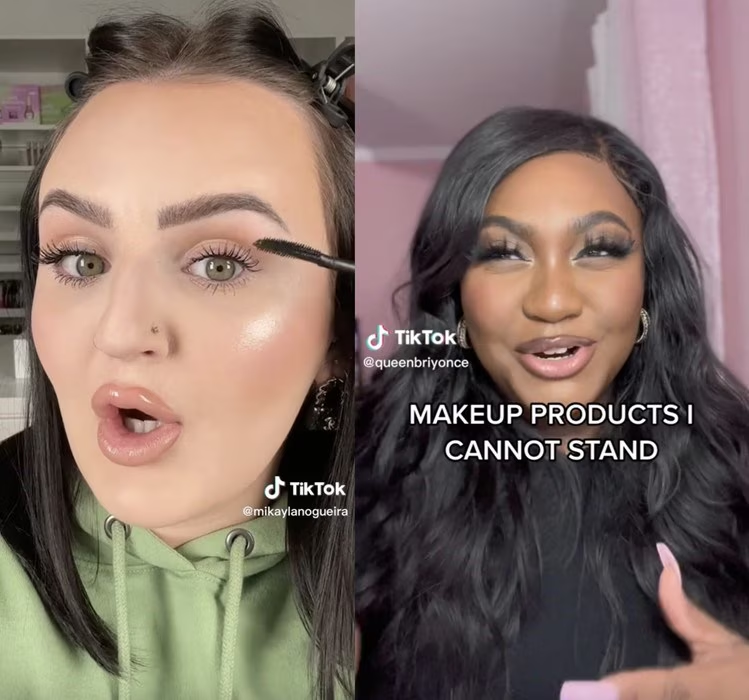
To exemplify these findings, an exploration into the brand L’Oréal Paris beauty and its controversial influencer marketing efforts can be illustrated, with parallels to the digital marketing efforts of the competing brand, The Ordinary.
L’Oréal Paris found itself at the centre of a viral TikTok controversy. The incident entailed a promotional collaboration with TikTok celebrity Mikayla Nogueira, wherein the influencer was required to recommend the brand’s telescopic lift mascara (Sandler, 2023).
In the promotional video, Nogueira praises the product to her 14.4 million followers, demonstrating the application of two coats of the product to an undone eye; the video then cuts to a final shot that showcases lengthened eyelashes. The video generated 34 million views within just days of its upload. The controversy emerged as millions of viewers congregated to allege Nogueira has misled the audience through deception about product capabilities by applying false lashes (Sandler, 2023).
Along with the misleading nature of the video in promoting deceptive product expectations, the influencer also failed to declare that the recommendation was facilitated through a paid partnership (Mendez, 2023). Mendez (2023) refers to the controversy as an example of the shift within the beauty world, as beauty influencers continue to betray their followers’ trust.
A publication by the media publication ‘Dazed Digital‘ associated the mascara scandal with the emerging de-influencer movement, implying that the oversaturation of sponsorships and occurrence of undisclosed advertising is enforcing distrust towards beauty recommendations and the brands associated (Dazed, 2023).
In the scenario relating to L’Oréal Paris, while it cannot explicitly be stated that the misleading promotional video, along with the failure to disclose its promotional nature, impacted purchase intention for the product itself, it can be suggested that the controversy altered user perception and attitudes towards the brand, based on earlier findings that suggest disingenuous influencer endorsement leads to scepticism, which ultimately declines user intention to purchase (Rathi & Jain, 2023).
The Anti-Influencer Approach: marketing approach built on authenticity and transparency
The L’Oréal Paris influencer scandal illustrated the brand’s digital marketing approach as being primarily driven by the objective to obtain market reach. We can compare L’Oréal Paris’ marketing strategy to The Ordinary, and how consumers perceive the brand as a result of their transparent approach to digital advertising.
The Ordinary have established a marketing approach that strategically positions itself against conventional influencer marketing, to appear transparent through avoidance of pretentious advertising, instead emphasising the scientific credibility of its product ingredients (Coates, 2020).
A Vogue article written about the brand, The Ordinary, ‘Anything but Ordinary: The Budget Skincare Brand That Punches Way Above Its Weight’, highlights the brand’s approach to positioning the formulation and ingredients of products as the core of marketing communication, as a means of enforcing transparency and consumer trust (Coates, 2020).
Through psychological consumer analysis, Ingredient transparency has been found to enhance consumer confidence in brands and their products, while driving long-term loyalty, which ultimately entails positive purchase intention (Zhang, 2026).
Van Driel & Dumitrica (2021) implies that marketing strategies must change to keep up with growing consumer scepticism towards influencer marketing, recommending that brands must be highly selective when collaborating with influencers and that product recommendations must appear subtle and genuine.
The adaptation of influencer marketing within the beauty industry has diminished consumer trust in brands due to the perception of dishonesty and failure to provide transparency regarding financial motivations. Despite these threats, digital advertising and influencer marketing provide strengths to brands that outweigh the perceived risks, with the influencer industry increasing by 35% in 2025 alone (Statista, 2024).
Considering this, it can be suggested that brands operating within the beauty industry prioritise a shift towards influencer collaborations that explicitly entail honest recommendations, with transparent disclosure of the promotional nature, focusing on credible product insights, such as ingredient information. This proposed shift in marketing approach ensures that beauty brands maintain communication efforts that adapt to the changing expectations and attitudes of their consumers.
Reference list
Alipour, S. M., Ghaffari, M., & Zare, H. (2024). Influencer marketing research: A systematic literature review to identify influencer marketing threats. Management Review Quarterly. https://doi.org/10.1007/s11301-024-00412-5
Coates, H. (2020, September 28). Anything but ordinary: The Budget Skincare brand that punches way above its weight. British Vogue. https://www.vogue.co.uk/beauty/article/the-ordinary-skincare-interview
Dazed. (2023, February 13). Deinfluencing: Is the end nigh for beauty influencers? Dazed. https://www.dazeddigital.com/beauty/article/58131/1/is-the-end-nigh-for-beauty-influencers-deinfluencing-mascaragate
Giuffredi-Kähr, A., Petrova, A., & Malär, L. (2022). Sponsorship disclosure of influencers – a curse or a blessing? Journal of Interactive Marketing, 57(1), 18–34. https://doi.org/10.1177/10949968221075686
Kakkar, V. (2026, February 9). How influencer marketing is moving into scalable performance channels. Forbes. https://www.forbes.com/councils/forbesagencycouncil/2026/02/09/beyond-the-feed-the-evolution-of-influencer-marketing-into-scalable-performance-channels/
Kampus Production. (2021, April 15). A woman using a smartphone in blogging · free stock photo. Pexels. https://www.pexels.com/photo/a-woman-using-a-smartphone-in-blogging-7514828/
Liu, X., & Zhao, H. (2024). A meta-analysis of the effects of sponsorship disclosure in influencer marketing. Marketing Letters, 36(3), 519–532. https://doi.org/10.1007/s11002-024-09757-z
Mendez, M. (2023, January 27). A mascara drama unfolding on TikTok raises questions about authenticity. Time. https://time.com/6250881/mikayla-nogueira-mascara-fake-eyelashes/
Moses, L., & O’Reilly, L. (2026, September 9). Brands are asking creators not to disclose paid partnerships: Study. Business Insider. https://www.businessinsider.com/brands-asking-creators-not-disclose-paid-partnerships-influencer-marketing-study-2026-9
Rathi, N., & Jain, P. (2023). Impact of meme marketing on consumer purchase intention: Examining the mediating role of consumer engagement. Innovative Marketing, 20(1), 1–16. https://doi.org/10.21511/im.20(1).2024.01
Research and Markets ltd. (2026). Research and Markets. Researchmarkets. https://www.researchandmarkets.com/report/influencer-marketing
Sandler, E. (2023, January 27). What’s behind the Mikayla Nogueira mascara controversy. Glossy. https://www.glossy.co/beauty/understanding-whats-behind-the-mikayla-nogueira-mascara-controversy/
Statista. (2024). Influence marketing. Statista. Www.Statista.Com. https://www.statista.com/topics/2496/influence-marketing/
Van Driel, L., & Dumitrica, D. (2021). Selling brands while staying “authentic”: The professionalization of instagram influencers. Convergence: The International Journal of Research into New Media Technologies, 27(1), 66–84. https://doi.org/10.1177/1354856520902136
Zhang, Y. (2026). Ingredient transparency and aesthetic experience: A comparative study of the ordinary and Rhode in medical-aesthetic skincare marketing. Advances in Economics, Management and Political Sciences, 261(1), 183–187. https://doi.org/10.54254/2754-1169/2026.ld32216
Ünalmış, E., Dirsehan, T., & Erdoğmuş, İ. E. (2024). Consequences of influencer-created content on influencers’ authenticity in the beauty and personal care industry. Journal of Marketing Communications, 1–27. https://doi.org/10.1080/13527266.2024.2371833
 somewhatdamaged
 Fynn Thompson
 C.L.Southall