

A 10-step program in creating a surveillance state in 2026 according to George Orwell’s 1984.
With recent headlines announcing the introduction of live facial-recognition technology, by the WA Police, one has to wonder if the dystopian future once considered impossible, has become our current reality. In George Orwell’s 1984, citizens live under a totalitarian government that watches every cough, scratch and sniff occurring within their population.
In 2026, we have smartphones, artificial intelligence and facial recognition, progress apparently.WA Police’s facial-recognition trial allows cameras to scan faces in public and compare them against a list of people of intrest. Police argue that technology can improve public safety, while privacy advocates have raised concerns about its implications.
Fortunately, you don’t need a ministry of truth, a secret police force, or even a particularly imaginative dictator to get you started. You’ll need a little technology, a convincing justification and population willing to click “I agree” without reading the terms and conditions.
So welcome, to your ten-step guide to domination, let’s tick them off together shall we?

Step 1. Install Your Telescreens.
In 1984, a telescreen is a two-way audio-visual device that broadcasts propaganda while monitoring citizens. They’re installed throughout homes, public and private spaces, allowing the party to observe its citizens. Sound familiar?
Today’s equivalent doesn’t need to a be a giant screen in your living-room, or a secret device the governments planted in your walls, we have CCTV cameras, facial-recognition systems, smartphones and smart devices capable of collecting information about our daily lives.
So congratulations! You have successfully installed your telescreens but don’t worry, they’re here to protect you.
Now smile, you’re on camera 🙂

Step 2. Make Big Brother Your Brand Ambassador.
Big brother is the ever-present face of the party in 1984. His image appears on posters and public displays always accompanied by the reminder that he is always watching. Weather big brother is an actual person, or a carefully constructed symbol of authority, it matters less than the message itself:
In 2026, we achieve something similar without plastering the face of a moustached man across every street corner. Governments and corporations can collect enormous quantities of information through digital services, online accounts, mobile applications and connected devices. Your location, browsing habits, purchases and interactions can all become data points, depending on the services you use and the permissions you grant.
Step 3. Introduce Thoughtcrime
In 1984, thoughtcrime means entertaining thoughts that contradict government ideology. You don’t need to organise a rebellion or publish a manifesto. Thinking critically about the government is dangerous enough. And fortunately, modern governments don’t need to read minds to raise questions about freedom of expression. They monitor public activity, regulate forms of speech and use digital technologies to gather information about people’s behaviour.

Consider Queenslands 2026 hate-speech legislation. In March, police arrested protestors over the use of the phrase “from the river to the sea,” which was prohibited under the state’s new laws. The legislation and its application to public demonstrations sparked debate over freedom of expression and the limits of the government’s power.
After all, what better way to encourage independent thought than to make people wonder if expressing it could get them aressted?
Step 4. Rename Survelliance as Something More Reassuring
Newspeak, the party’s restricted language, reduces the vocabulary available for independent thought. By narrowing language, the party makes it harder to express ideas that challenge its authority. In the real world, you don’t need to invent an entirely new language, you just need a good marketing team. Surveillance becomes “public safety,” data collection becomes “personalisation,” and tracking becomes “improving your algorithm.”
Take facial recognition, WA Police describe its technology as a tool for crime prevention, locating people and protecting the public. Those are ligitemate objectives, and potential benifitis deserve consideration. But the reassuring language of safety should not prevent us from asking what information is collected, who can access it and what safeguards apply.
The trick is not to ban the word surveillance, that would be too obvious.
Simply make sure the alternative sounds nicer.

Step 5. Master the Art of Doublethink
Doublethink is the party’s ability to accept contradictory beliefs. In 1984, citizens are expected to accept that freedoms are slavery and that ignorance is strength, even when these ideas contradict their lived experience.
In the twenty-first century, we have developed our own version: demanding privacy while enthusiastically sharing out lives with digital platforms. We want personalised recommendations, instant navigation, smart assistants and seamless online services. We also want our personal information to remain private, but unfortunately, these desires conflict when the services we use depend on collecting our data.
Fortunately, there is a simple solution: accept the cookies agree to the terms and conditions and never think about it again.
Step 6. Establish Your Very Own Ministry of Truth.
The ministry of truth in controls information by rewriting historical records, manipulating news, and ensuring the party’s version of reality is the only version available. In 2026, we have artificial intelligence, deepfakes and an endless supply of online misinformation, we no longer need a government employee’s rewriting newspapers when digital content can be generated, edited and distributed at a remarkable speed.
AI-generated images, fabricated audio and manipulated videos can make false information appear convincing. Social media then circulates content before audiences have had time to establish if it’s genuine. The ministers of truth don’t even need to convince everyone that they’re version of events are correct, they only need to make everyone is sufficiently uncertain about what is real.

Step 7. Create a Digital Memory Hole.
In Orwells novel, the memory hole is used to destroy documents that contradict the party’s current version of history. Once the evidence disappears, the offical account can be presented as though it has always been true.
Today’s digital equivalent is more complicated. Online content can be detected, edited, removed from search results and made inaccessible. Social media posts disappear, websites change, and digital records may be lost when services close or accounts are suspended. The ability to alter or remove digital records raises questions about who controls the information we rely on to understand the past. If public statement disappears from website, or an old webpage is quietly rewritten how easily can an ordinary person recover the original?
Unlike the main character Winston Smith, we may have screenshots, archives and independent records available to challenge an official accounts, but those safeguards are only useful if someone without agenda or bias preserves the evidence correctly first.
Step 8. Schedule Your Two Minutes of Hate
In 1984, citizens participate in the two minute hate, a ritual designed to direct public anger towards party enemies, which encourages emotional conformity and discourages independent judgment. In 2026, you can achieve a comparable effect without organising a compulsory public gathering. Simply open social media.
Algorithms can recommend content based on engagement, and emotional provocative posts can attract considerable attention. A controversial statement appears, the comments begin, and within minutes thousands of strangers are arguing about a topic they barley understand. The problem is not disagreement itself, but the way outrage can be rewarded with attention, amplified by platforms, and detached from the context that originally produced it.
Why spend several hours reading a complicated policy proposal when you could watch a thirty second clip, and immediately share it with everyone you know? For maximum efficiency, make sure your audience is angry before they have all the facts.
Step 9. Turn People into Unpersons
In 1984, an unperson is someone erased from official history. Their records disappear, their existence is denied, and it becomes dangerous to acknowledge that they ever existed. The digital age offers a more complicated version of this idea. Online identities can be suspended, accounts deleted, search results removed and personal information made difficult to find. Entire online communities and archives can also disappear when platforms shut down.
Of course, deleting a social media account is no the same as being erase by a totalitarian government but consider what happens when digital identity becomes essential to everyday life. If access to a platform, account or online service is suddenly withdrawn, what happens to the information, connections and records that exist there?
Our lives are documented digitally, yet we do not always control how long those records remain available or what happens to them when a service changes rules.
Congratulations, you have now created a world in which a persona can be highly visible online and still have very little control over their digital existence.

Step 10. Take control of Reality Itself
The final step is to make truth difficult to distinguish from fiction. In 1984, the party demands that citizens accept its version of reality even when it contradicts the evidence before them. The ultimate power lies in both controlling information, but also in trying to control what people believe is real.
Today deepfakes and sophisticated AI-generated content makes this problem complicated. A convincing video depicts someone saying something they never said, an artificial voice imitates a real person, while an edited image can circulate without its original context.
We need reliable journalism, transparent information practises, independent verification, and the ability to question powerful institutions without consequence. Because a society that cannot distinguish reliable evidence from fabricated content is easier to mislead, regardless of who is doing the leading.
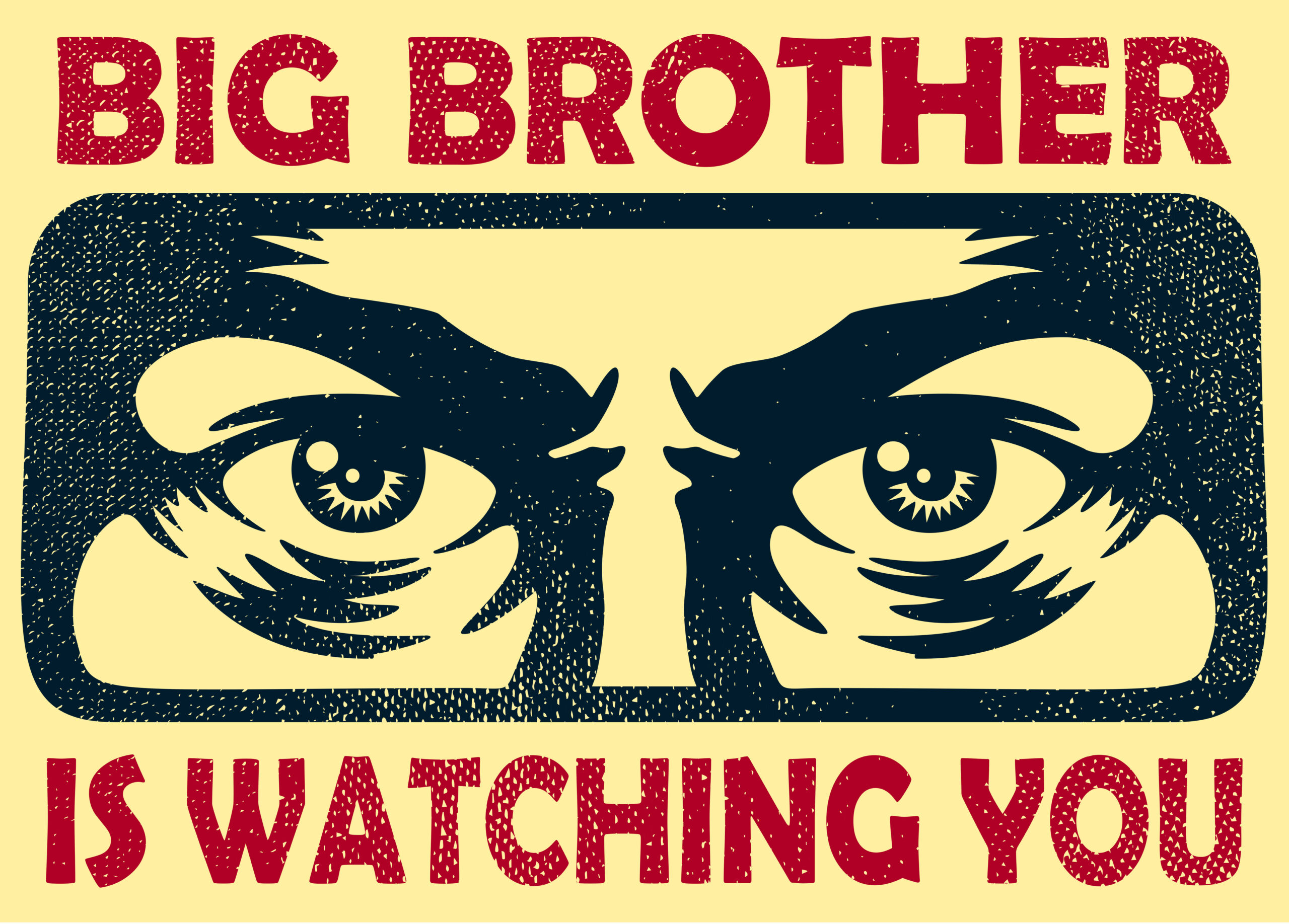
Your surveillance state is now complete. You have monitoring, data collection, information control, manufactured outrage and a population that has been encouraged to never question its own understanding of reality.
All that remains now is to convince everyone that it was all in the name of “progress.”
Proudly powered by WordPress
 Jessica Goff
 somewhatdamaged
 Fynn Thompson