
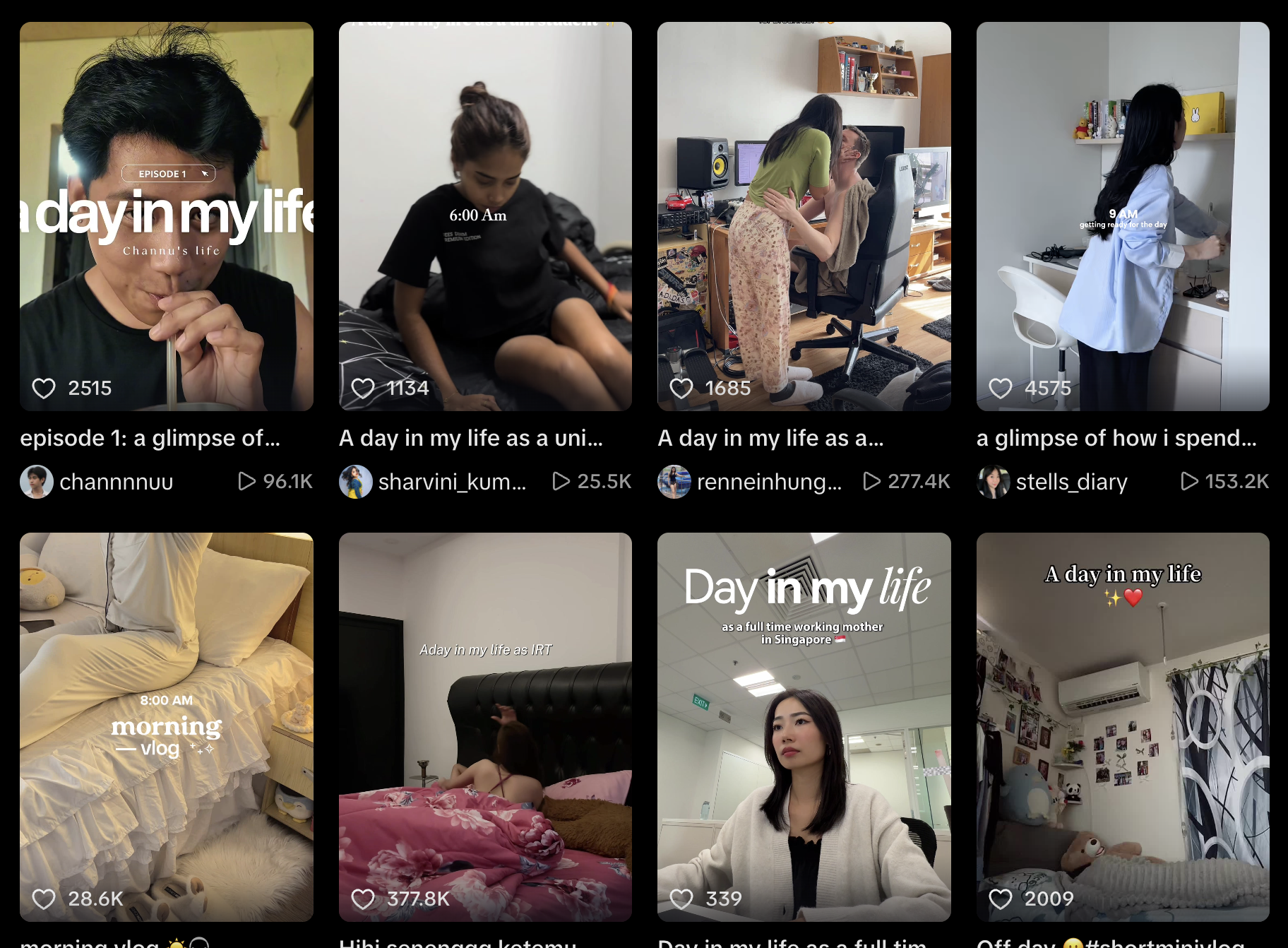
At one o’clock in the morning, a “day in my life” video appeared on TikTok. There is no exquisite breakfast, no perfect makeup, and no clean bedroom like the advertisement in the camera. The creator sat by the unmade bed, with a bare face and a little tired voice. She said that she was in a bad state today, and there was still a cup of unfinished coffee on the table. This video looks very authenticity. It is not as distant as the traditional influencer content, nor as deliberate as advertising. It even comforts people: it turns out that other people’s lives can also be messy, depressed and imperfect.
However, after continuing to scroll, the problem arose. Why do these “imperfect” videos look so similar? Messy rooms, low-definition pictures, makeup-free selfies, casual vlogs – they all oppose excessive exquisiteness, but form another recognizable format.
What I’m discussing this time is not whether people on the social media are all fake. Such a question is too simple and not accurate enough. The more important question is: how does social media change the way it is really displayed, judged and used? This article believes that social media does not eliminate authenticity, but reorganizes it.
The platform design allows the sense of authenticity to have a fixed format; the audience expects the realness to become a managed self-presentation; creators marketing transforms the authenticity into trust and commercial value. As a result, “being yourself” on the social media is no longer just a personal quality, but has become a public performance influenced by visibility, evaluation and profit logic.
Authenticity Has Not Disappeared. It Has Been Designed.
BeReal used to be popular precisely because it promised a kind of anti-Instagram authenticity. It does not allow users to choose the most beautiful angle at any time, but sends a notification at a random time, asking users to take pictures of the moment with the front and rear cameras. This design looks very simple: less filters, less decoration, more instant life.
Kim et al. (2024) pointed out that this design does encourage users to share a more spontaneous daily life and can also reduce some self-presentation pressure in traditional social media.1 However, this does not mean that the performance has disappeared. Research also shows that users will still consider who can see them, still manage the audience, and may still feel pressured by “whether their current self is suitable for display”.
This explains a key problem: the platform cannot make authenticity appear completely naturally. The platform can only design a way of “how the authenticity should appear”. BeReal does not cancel the performance, but changes the performance rules. The rules of Instagram may be beautiful, exquisite and aesthetic; the rules of BeReal are instant, ordinary and seemingly unmodified. Both are shaping how users show themselves.
The same logic also appears on TikTok and Xiaohongshu. If a “realistic morning routine” video wants to be real, it is usually not very perfect. The camera can be a little shaky, the bed can be unmade, the face can be without makeup, and the tone is most like a friend chatting. These elements look natural, but when they are repeated, they become “realistic” visual language.
Therefore, the first change in the authenticity of the network is that it has been formatted. authenticity is no longer just whether a person is honest in his heart, but becomes a set of external symbols. When the audience sees the messy room, bare face, natural light, hand-held camera, they will automatically understand: this content wants to express “I am very real”.
This does not mean that these contents must be fake. A crying selfie video may really come from sadness, and a messy room may also be really messy. The problem is that when these real things are filmed, edited, subtitled and released to the platform, they enter a space for viewing, evaluation and dissemination. Real emotions still exist, but they also become content.
Audiences Are Not Just Viewers. They Are Part of the Rules.
If the platform design determines the real appearance, the audience’s expectations determine the real boundary.
Marwick and boyd (2011) proposed the concept of “imagined audience”2, which shows that social media users do not speak to blank spaces when they publish content. People will imagine who will see themselves, who will understand themselves, and who will evaluate themselves. More complicatedly, social media often brings context collapse: friends, classmates, strangers, future employers and brands may all see the same version of you on the same platform.
This means that the true expression on the social media is rarely completely free. Users may want to be honest, but they also want to be accepted; they want to show vulnerability, but they can’t seem out of control; they want to be messy, but this mess should still have a little beauty; they want to say that they are anxious, but this anxiety should resonate with the audience.
Therefore, social media now not only rewards perfection, but also rewards “looking imperfect”. An overly exquisite influencer may be envied, but a creator who says “I’m really not good today” is more likely to make people stop. Because she looks closer to ordinary people, more like a friend, and more trustworthy.
Abidin (2016)’s theory “visibility labour”3 can explain how this seemingly natural sense of closeness is produced. The author pointed out that social media visibility does not occur automatically, but is maintained through continuous interaction, visual narrative and daily life display. In other words, there may be emotional labor and creative labor behind a casual vlog, a sincere caption, and a video of “I’m not feeling well today”.
“GRWM” is a good example. On the surface, the creator is just putting on makeup, choosing clothes and chatting. But this format is very effective: it combines ordinary action, private emotions and watchable video structure. The audience didn’t feel that they were watching an official program, but as if they were preparing to go out with a friend.
Duffy (2015) calls this continuous investment “aspirational labor”4. In the digital culture industry, many creators invest time, emotion and creativity in online image management, hoping to get attention, opportunities or income in the future. This logic is not only for professional influencer. Ordinary users are also learning similar rules: how to speak sincerely, how to shoot naturally, and how to share pain without making the content too heavy.
Therefore, authenticity has become a skill. Instead of simply expressing themselves, people are learning how to express themselves in a credible, close and communicable way.
When Authenticity Starts to Sell
The most complicated part of authenticity is that it not only brings attention, but also trust. And on social media, trust is very valuable.
Traditional advertising is easy to make people alert, because the audience knows that the brand wants to sell something. But influencer recommendations are different. A creator can just sit on the bed and say to the camera, “I actually use this” or “This is my honest review”. The power of these rhetoric lies in the fact that they are not like advertisements, but more like friends’ suggestions. Because of this, they may become more convincing forms of advertising.
In influencer marketing, message value and source credibility will affect consumers’ trust in branded content (Lou & Yuan, 2019).5 That is to say, whether the audience believes in a recommendation depends not only on the product itself, but also on whether the recommender is credible.
In addition, influencers are often between commerciality and authenticity (Arriagada & Bishop, 2021).6 They need to cooperate with brands and participate in the platform economy, but at the same time, they must maintain an ordinary, close and authentic image. This contradiction is not a defect of influencer marketing, but its core.
Shtern, Hill and Chan (2019) call this phenomenon “performative authenticity”7. They found that social media influencers would maintain a relationship with the audience through the authenticity of performance and turn this relationship into commercial value. Simply put, authenticity is not only a personal quality, but also a kind of relational labor that can be commercialized.
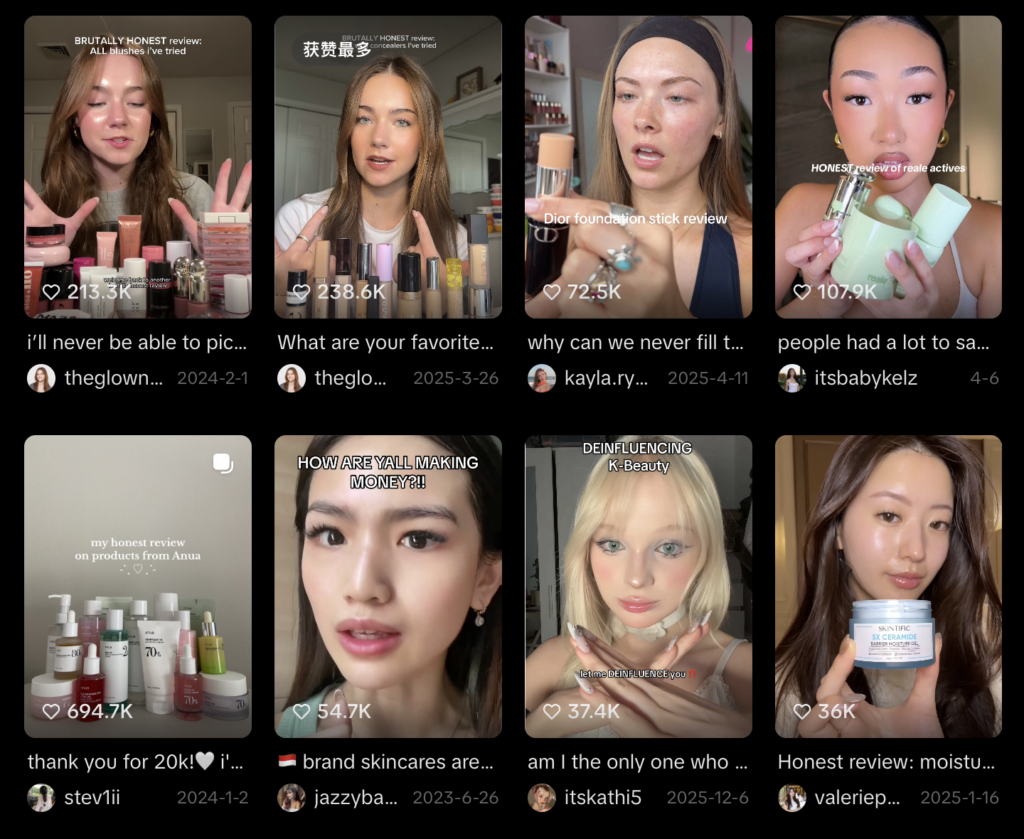
However that doesn’t mean that all influencers are lying. Many creators really like the products they recommend and are indeed sharing real experiences. The problem is not that simple. The real problem is that when “real experience” becomes the most convincing sales method on the platform, the boundary between authenticity and marketing begins to blur.
A skin care evaluation can be a honest review or a subtle advertisement. A crying video about the pressure of life can reveal the authenticity or deepen the audience’s trust in the creator. Even a sentence “I really don’t want to sell something” may make the next recommendation more credible.
Gilpin, Palazzolo and Brody (2010) proposed “socially mediated authenticity”8, which shows that authenticity is not a fixed attribute. It is jointly constructed in media expression, audience understanding and social interaction. In other words, the creator cannot unilaterally decide whether he is real or not, and the audience also participates in this judgment process.
This explains why some people make us feel “real”. It’s not because they didn’t perform, but because their performance meets our real expectations: not perfect, a little fragile, natural tone, like ordinary people, but enough to attract people to continue watching.
It is not accurate to simply say that “people on the social media are very fake”. More importantly, the platform makes some types of authenticity easier to see: with clear titles, emotions and visual formats, it is easier to get attention and traffic. On the contrary, it may be difficult to get attention from the authenticity that is quiet, complex and not suitable for short video dissemination.
Therefore, social media does not eliminate authenticity, but screens authenticity. It rewards those who are natural enough, close enough, narrative enough, and enough to be consumed. This phenomenon makes people begin to worry that they are not natural enough. This is the most ironic part of online authenticity: when “being yourself” becomes something that must be shown to others, it is no longer just being yourself. It turned into a delicate performance, a performance whose goal is “not like a performance”.
This also links to The Digital Tourist: Social Media, Authenticity, which discusses how influencer culture affects trust. In both cases, the key issue is that social media trust can quickly become commercial value.
Authenticity Still Matters, But It Is No Longer Pure
The online authenticity will not disappear, and we don’t need to reject it completely. Real vlogs, honest evaluations, and fragile sharing can indeed make people feel connected. Sometimes they are warmer than the perfect content, and they are also closer to the life of ordinary people.
But we need to realize that online authenticity does not appear naturally. It is shaped by the platform design, influenced by the audience’s expectations, and also used by the business system. BeReal’s random notification, TikTok’s daily vlog, Xiaohongshu’s real evaluation, and Instagram’s photo dump all point to the same fact: authenticity has become a media form that can be packaged, shared, and commercialised.
Therefore, the next time we see a “day in my life” video, we may not have to immediately judge whether it is true or false. The more important question is: why is this authenticity seen? Why is this imperfection just suitable for the platform? Why can “honesty” also be a marketing language?
Perhaps, on today’s social media, the most real thing is not to constantly prove that “I am very real”. Instead, we admit that we have lived in an environment where even authenticity needs to be performed, released and rewarded.
Sources
- Kim, J., Wolfe, R., Chordia, I., Davis, K., & Hiniker, A. (2024). “Sharing, not showing off”: How BeReal approaches authentic self-presentation on social media through its design. Proceedings of the ACM on Human-Computer Interaction, 8(CSCW2), Article 370. https://dl.acm.org/doi/epdf/10.1145/3686909 ↩︎
- Marwick, A. E., & boyd, d. (2011). I tweet honestly, I tweet passionately: Twitter users, context collapse, and the imagined audience. New Media & Society, 13(1), 114–133.https://tiara.org/wp-content/uploads/2018/05/Marwick_boyd_TweetHonestly.pdf ↩︎
- Abidin, C. (2016). Visibility labour: Engaging with influencers’ fashion brands and #OOTD advertorial campaigns on Instagram. Media International Australia, 161(1), 86–100.https://wishcrys.com/wp-content/uploads/2019/03/abidin-2016-visibility-labour-engaging-with-influencers-fashion-brands-and-ootd-advertorial-campaigns-on-instagram.pdf ↩︎
- Duffy, B. E. (2015). The romance of work: Gender and aspirational labour in the digital culture industries. International Journal of Cultural Studies, 19(4), 441–457.https://www.researchgate.net/publication/276384749_The_Romance_of_Work_Gender_and_Aspirational_Labour_in_the_Digital_Culture_Industries ↩︎
- Lou, C., & Yuan, S. (2019). Influencer marketing: How message value and credibility affect consumer trust of branded content on social media. Journal of Interactive Advertising, 19(1), 58–73. https://doi.org/10.1080/15252019.2018.1533501 ↩︎
- Arriagada, A., & Bishop, S. (2021). Between commerciality and authenticity: The imaginary of social media influencers in the platform economy. Communication, Culture & Critique, 14(4), 568–586. https://eprints.whiterose.ac.uk/id/eprint/212229/1/Between_Commerciality_and_Authenticity_T.pdf ↩︎
- Shtern, J., Hill, S., & Chan, D. (2019). Social media influence: Performative authenticity and the relational work of audience commodification in the Philippines. International Journal of Communication, 13, 1939–1958. https://ijoc.org/index.php/ijoc/article/view/9615/2634 ↩︎
- Gilpin, D. R., Palazzolo, E. T., & Brody, N. (2010). Socially mediated authenticity. Journal of Communication Management, 14(3), 258–278. https://www.researchgate.net/publication/216393889_Socially_mediated_authenticity ↩︎
 TianYuran
  Lu Yunyan
  Pauleen