

BTS has emerged as the most influential global music figure of the twenty-first century – going beyond their humble origins in South Korea to reach audiences across continents. What began as 7 young boys with a dream to make music – RM, Jin, SUGA, J-Hope, V, Jimin, Jungkook – became into a worldwide global cultural force who possess millions of strong and dedicated fans called the ARMY. Their rice to fame is particularly significant within the music industry as fame and success has always been traditionally measured by an artist’s ability to break into the Western market – especially the United States and/or United Kingdom. For decades, the Western markets have been regarded as the ultimate benchmark for international recognition and success (Verboord & Brandellero, 2016, p. 621). It was where artists all over the world often yearn and work towards obtaining approval from Western media record labels and award systems to be considered globally successful. However, with the rapid evolution of social media and streaming platforms, it has created new pathways for artists to reach global recognition without relying on traditional Western gatekeeping systems. This reshaped how music is being consumed and distributed worldwide by giving way to streaming platforms such as Youtube, Spotify and Sound Cloud to allow uploaded music to circulate instantly across borders. This also allowed listeners to discover artists based on algorithmic recommendations and fan-driven sharing rather than industry-controlled promotions. With this change, there is a shift of dynamics of global pop culture that decentralizes the influences from Western labels, and more towards participatory networks.
Within this changing landscape, BTS is a key example of how global success can be achieved outside the traditional Western validation systems. Instead of corporate institutional endorsements, their popularity is largely driven by a highly active global fan base that is dedicated to them. Known as the BTS ARMY, they are behind majority, if not all, of BTS’s international and online success in the entertainment industry. The popularity and dominance of this group pose as a threat and challenge to long-standing assumptions about success in the music industry. This article discusses about how BTS were able to achieve success by challenging the Western gatekeeping systems and the role of digital platforms and a global fandom.
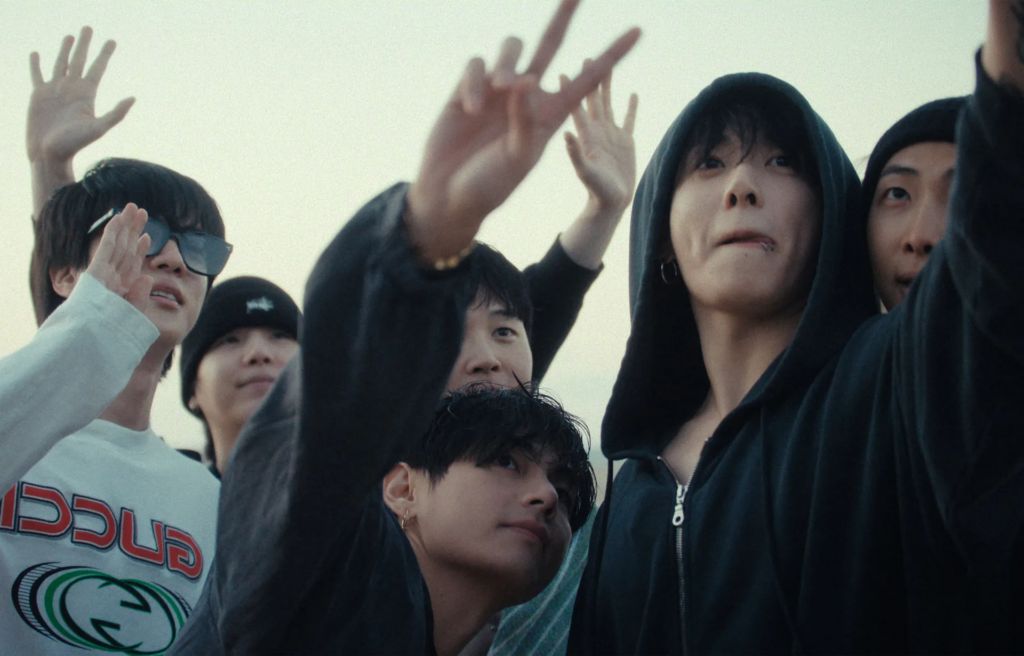
A scene from the documentary “BTS: The Return.” By Netflix, via Associated Press – The New York Times
Challenging Western Gatekeeping of the Music Industry
Before everything else, there is a need to understand how the Western Music industry is relevant to this article. For many years, the global music industry has been heavily shaped by the Western gatekeeping systems that determine which artists gain international visibility and commercial success. Large record labels, media corporations and promotion are primarily based in the United States and the United Kingdom and historically have been the ones controlling the global flow of popular music. According to Negus (1999, p. 47), music corporations strategically organize and market artists in ways that maximize profit and control what the audience consumes. Negus (1999, p. 48) further elaborates that the media corporations frequently prioritize profitability and marketability of an artist over cultural diversity or artistic originality. Rather than the artist’s success being based on artistic talent, they are often filtered through corporate systems that decide which genre, language and/or performers are commercially viable. These structure put in place resulted in a music artist’s success being traditionally dependent on gaining approval from Western record labels, radio stations, award shows and media networks that act as cultural gatekeepers. Non-Western artists have historically faced significant barriers to achieving worldwide recognition. One major barrier is language. The English language in music has been long dominating the global chats, thus creating an assumption that artists should, too, perform their songs fully in English to achieve mainstream global success. Geography also plays an important role as artists outside major Western entertainment areas often lack access to influential industrial connections for their artists.
“There’s no takeover, the Korean invasion is like the British Invasion if the Beatles showed up, the few hundred girls screaming at the airport were the only people who bought their music, everyone considered those girls weird nerds, and no other British bands ever reached the same level of popularity as American groups.” – Adam Buckly, 21 June 2018
Coming back to BTS, since they came from a relatively small entertainment company in South Korea – meaning that they lacked the financial resources and institutional support available to artists that were signed under larger entertainment groups that were backed by the Western industry. Adding on, K-Pop was frequently dismissed by the Western media as a temporary trend or a niche genre, thus limiting the legitimacy of Korean artists within mainstream music spaces. Asian artists, in general, have historically been underrepresented and underappreciated in Western pop culture which were translated over to how BTS had to face Western Asian stereotypes and dismissive attitudes from media outlets that viewed non-Western music as inferior to Western pop.
Youtube Video on BTS’s Hardships by @xCeleste
Despite these barriers, BTS challenged the traditional gatekeeping systems of the Western industry by building popularity outside of the conventional Western-controlled pathways. Instead of relying on approval and visibility on radio stations, television networks or big Western record labels, BTS strategically used digital platforms such as Youtube, Twitter(X), VLIVE and Sound Cloud to directly communicate to their audiences around the world. By using unconventional methods to connect with their audiences and grow their online presence, they were able to bypass traditional promotional systems and become self-reliant from the Western music industry standards.
The Role of Digital Platforms and A Global Fandom
The digital platforms that were being used by BTS and the participatory fan culture of the ARMYs have altered the dependance of the Western media systems. With the growth of social media and emergence of streaming platforms around the years of 2016-2018, BTS engagement on these platforms allows them to directly communicate with the ARMYs across languages and borders. Henry Jenkins (2006, p. 3) describes this shift through the concept of participatory culture. He highlights how audiences are no longer passive consumers of media but active participants who contribute to content creation, circulation and the promotion of content. This concept this perfectly reflected in BTS’s global rise to fame where the ARMY’s participation became one of the group’s greatest strengths. BTS members also have consistently communicated with ARMYs through livestreams, behind-the-scenes videos, tweets(X) and online interactions. This constant and easy accessibility of communication created a sense of intimacy and authenticity between the artists and ARMYs. This ultimately strengthened fan loyalty and engagement. A key feature of the digital ecosystem is the rise of reaction videos and fan-made commentary content on platforms such as Youtube.
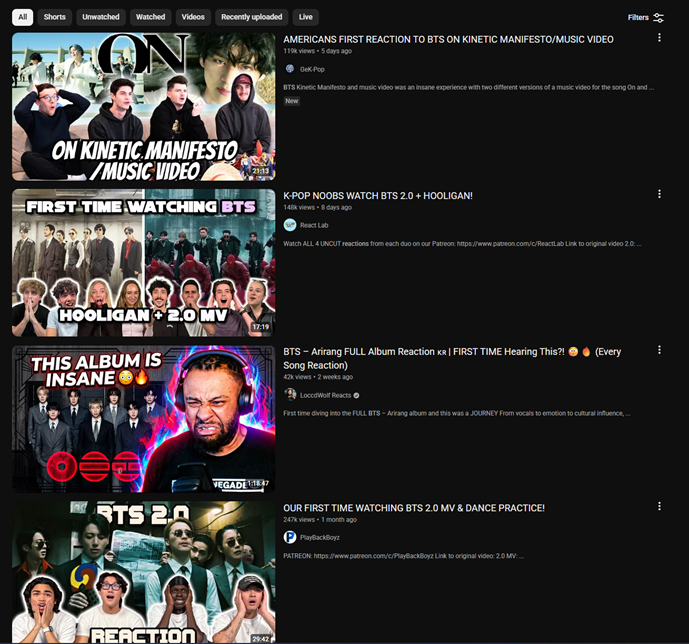
Screenshot of Youtube Search “BTS reaction”
These videos play an important role in promoting BTS globally as these creators introduce the group’s music to new audiences while expressing authentic, real-time responses. This user-generated content functions as a form of digital word-of-mouth promotion and allows BTS to reach audiences beyond traditional advertising and media channels. Viewers of these video reactors who may not have known about BTS are introduced to their music through trusted creators that they already follow. At the same time, they encourage discussion within online communities and create spaces where ARMYs and non-ARMYs can engage with BTS related content together. Notably, BTS’s management – HYBE/Bighit Entertainment – is known for being relatively open with content usage during the earlier years of their career, often allowing full reaction videos and fan edits with their content and/or music with proper credit. This approach encourages organic promotion and supports the participatory nature of fan culture. In contrast to this, many Western music companies and record labels enforce stricter copyright systems that frequently limit the use of music videos or performance clips, making it harder for creators to legally incorporate content into reaction or commentary content. This difference in copyright flexibility has contributed to BTS’s strong presence on online media platforms where these reaction videos significantly boost visibility and engagement.
Youtube Video about the BTS ARMY: Inside the World’s Most Powerful Fandom by MTV News
The fans behind these engagements and BTS’s success are the ARMY. They are a highly organized and participatory online community that would support BTS in any of their endeavors. Rather than just simply consuming content, ARMYs actively contributes to BTS’s global presence through fan edits, translations, subtitles, fan art etc. They frequently translate interviews, livestreams and lyrics into multiple languages, making BTS’s content accessible to international audiences who are not well versed in the Korean language. Arguably, the ARMY fandom would be the highest embodiment of participatory culture that Henry Jenkins (2013) has envisioned. This collaborative effort significantly expands the group’s global reach while strengthening connections among other ARMYs with different cultures and backgrounds. In many ways, the ARMY operates as both a fandom and global promotional network that helps to maintain BTS’s relevance and visibility on digital platforms without depending solely on Western corporate advertising and mainstream media support. Ultimately, the strong participatory culture of ARMYs allowed BTS to benefit in many ways such as having one of the strongest – if not, the strongest – fanbase that transcends national and cultural borders. Their success illustrates how social media and streaming technologies are reshaping the global music industry by giving the audiences greater power in determining cultural influence and popularity.
Tiktok Interview of RM by BTS by Rolling Stone
In conclusion, BTS’s rise to global relevance and popularity represents a significant transformation of the structure in the international music industry. It also demonstrates that Western approval is no longer the sole pathway to worldwide success. For many years, the Western markets – United States and Europe – were viewed as the ultimate benchmark for international recognition and success. Artists seeking global influence need validation through Western media institutions and/or major record labels to establish legitimacy. However, BTS has challenged this long-standing power structure by proving that global popularity can, and is possible, to be achieved through alternative pathways that are driven by digital connectivity, strong fan communities and cultural authenticity. Unlike the mentioned traditional approaches to international expansion, BTS have cultivated a strong and dedicated global audience while still maintaining their Korean identity, language and artistic direction. By strategically uploading content and songs on platforms such as SoundCloud and Twitter(X), BTS fans are able to directly communicate and easily access their music without the need of going through complicated procedures. ARMYs also has a huge role in contributing to the massive success of BTS by being highly participative and creating content that drives the group’s visibility across multiple platforms. Fan translations, fan art, reaction videos etc, are some of the many content that have contributed to their success worldwide. Overall, BTS represents more than just a successful music group. Their journey illustrates that the global entertainment industry and systems will continue to evolve and are living proof that long-standing “rules” are not set in stone.
Verboord, M. & Brandellero, A. (2018). The Globalization of Popular Music, 1960-2010: A Multilevel Analysis of Music Flows. Communication Research, 45(4), 603-627. https://journals.sagepub.com/doi/10.1177/0093650215623834
Negus, K. (1999). Music Genres and Corporate Cultures. Routledge. https://www.amherst.edu/system/files/media/1328/Negus%20-%20Corporate%20Strategy%20-%20Applying%20Order%20and%20Enforcing%20Accountability.pdf
Jenkins, H. (2006). Convergence Culture: Where Old and New Media Collide. New York University Press. https://www.dhi.ac.uk/san/waysofbeing/data/communication-zangana-jenkins-2006.pdf
 TianYuran
  Lu Yunyan
  Lu Ching-Cheng