
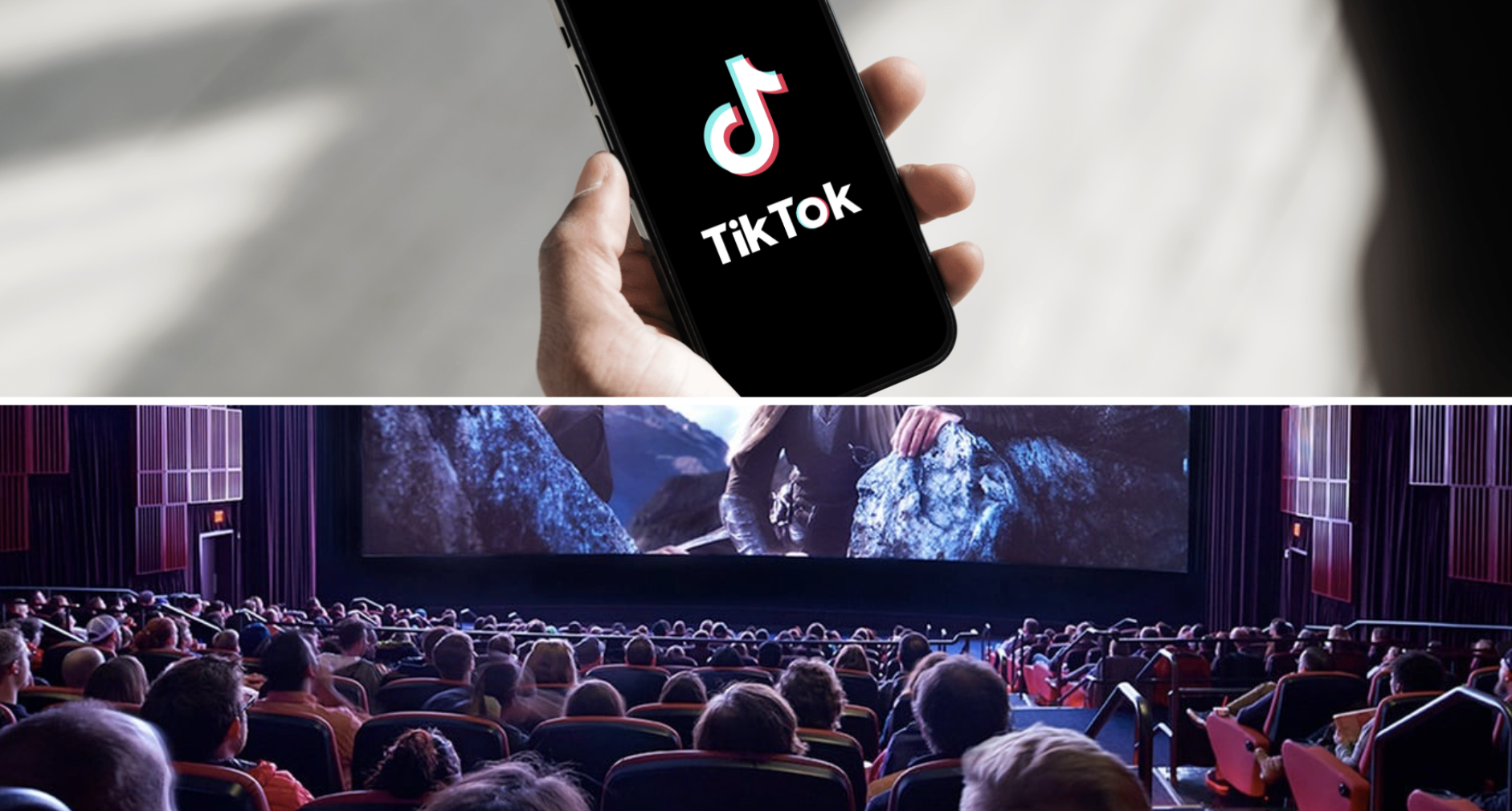
People who grew up with movies are now watching them in clips shorter than a minute. Many viewers get their first taste of movies not through full features, but through TikTok edits, sped-up movie summaries, or “best scene” compilations designed for the endless scroll. Emotional moments, shocking twists, and visually aesthetic shots are extracted from their original context and repackaged into bite-sized entertainment. For many young viewers, their first encounter with a film is no longer the film itself, but fragments of it online.
Platforms such as TikTok have changed how films are discovered, discussed and consumed. What used to be considered a slow, immersive experience is increasingly battling against an algorithm built for speed, stimulation and endless scrolling. While TikTok have viral edits and “movie in 60 seconds” videos, it made cinema more accessible and visible than ever before, particularly among younger audiences. However, this change also raises an important question: are audiences still experiencing films as they were originally intended?
TikTok has made films more accessible and widely discussed, but it is also changing cinema culture by encouraging fragmented viewing, shortening audience attention spans, and focusing on fast-paced, decontextualised storytelling over a deeper appreciation cinema.
“Cinema is a matter of what’s in the frame and what’s out.” — Martin Scorsese1
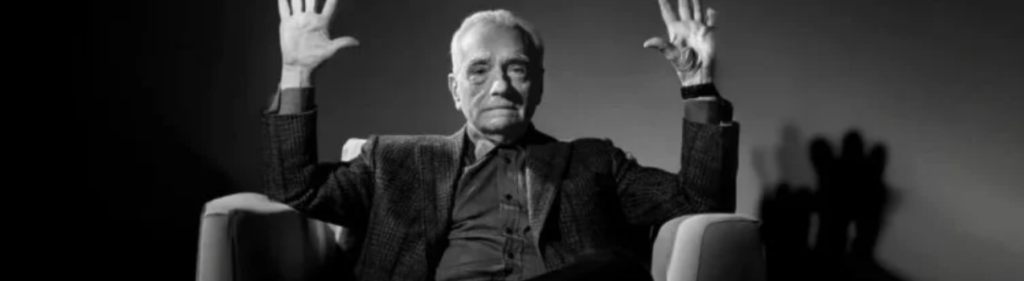
Cinema has traditionally been designed as a complete narrative experience where pacing, cinematography, sound design, and character development work together to create meaning. Even though, TikTok’s short-form structure challenges this experience by encouraging fragmented viewing experience. A lot of people now discover movies through isolated clips uploaded on their TikTok “For You Page.” Rather than watching an entire whole movie, audience are starting to be forced to see a few dramatic or visually captivating moments.
In some cases, users consume films through sped up movie recap videos that summarise two-hour narratives in just a few minutes. The videos are about efficiency and stimulation over than depth, reducing complex stories to simplified plot points. This change has been described by Nguyen, Veer, and Ballantine (2025) as part of a larger “snack culture,” where viewers transition from full-length viewing to shorter, more easily shareable content. This kind of fragmented style of viewing changes the way audiences invlove with storytelling. Emotional scenes are being impactful because of the context that is surrounding them. Without the slow development of character relationships, tension, or atmosphere, a sort of scene loses much of their orignial purpose of the movie. Some dramatic confession scene might appear emotional online, but the significance of the movie loses when separated from the plot journey that originally gave it emotional weight, and scenes risk becoming moments of quick reaction rather than deeper understanding.
This issue is especially noticeable through “movie in 60 seconds” or “ending explained” videos. While those formats are maybe convenient, but they often make cinema lost more than plot summary. The audience can quickly understand what happened, but not feel how the film created emotion, suspense or meaning. Thus, films become less and less like artistic experiences and more like information to be consumed efficiently. This does not mean that short-form content has no value though. TikTok can also help introduce users to films they might not otherwise be discover. A good and powerful edit might just be a key to encourage someone to search for the full movie later. However, when clips replace rather than support full viewing, the audience’s relationship with cinema shifts. Viewers might not appreciate films as a whole work, but rather value only the scenes that are intense enough to keep up with the scroll.
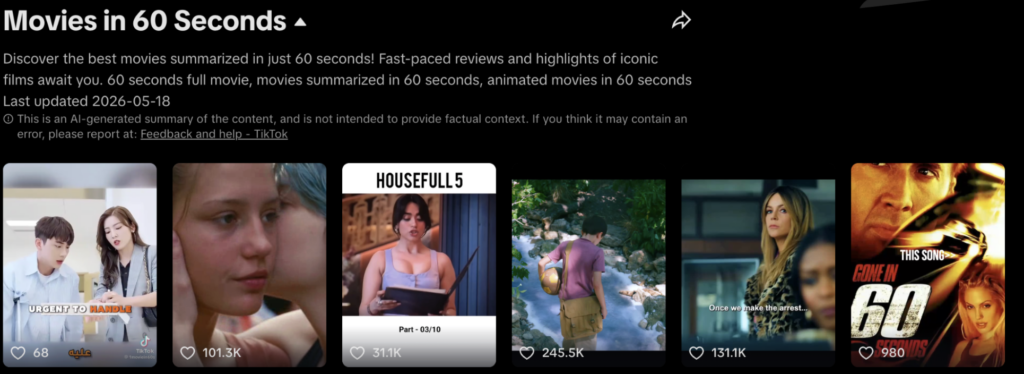
TikTok is changing not only the structure of film consumption but also audience habits. The platform is based design around fast movement, constant stimulation and immediate choice. If a video doesn’t grab their attention in the first few seconds user can immediately swipe away. Over some time, this rhythm shapes what audiences expect from the entertainment. Zhang (2022) argues that short-form video platforms affect popular culture by changing entertainment styles and encouraging more fragmented media habits. This is important matter for cinema because films often require patience. Long dialogue scenes, quiet transitions, slow camera movements or moments of silence are not “empty” parts of a film. It often where mood, character and meaning are constructed. Yet for viewer whos used to rapid short-form content, these slower moments may feel boring or unnecessary.
The popularity of sped-up film clips reflects this shift. On TikTok, scenes are oftentimes rushed in order to keep the audience engaged and leave out gaps and emotions. One of the most critical tools in cinema for storytelling is pacing. Timing is used by the director to establish suspense, intimacy, discomfort or realism. For instance, Wong Kar-wai’s films have a lot of atmosphere, mood and lingering images. It’s hard to see these design in a film cut into short snippets for quick hits.
This shift also impacts on the viewing of full-length movies. Some people watch movies while checking their phones, notifications, or doing other tasks with the media. The main point of the film is no longer always the main focus. It turns into just one of the many screens. In this world, cinema has to battle not just with other films but with the fact that there’s always something quicker and more rewarding out there!
However, it would be too simple to blame TikTok alone. Ever since the appearance of television, cinema has always been able to adjust to new media technologies, like streaming. People have always been looking for new ways to see, stop, rewind and discuss movies. It’s not that audiences are changing how they watch; it’s that the pace of short-form platforms might be introducing audiences to the idea that all forms of storytelling can be consumed at the same pace. It’s important to recognise that not every TikTok viewer was deeply interested in cinema to begin with. Some audiences who consume movie recaps or short clips may never have intended to watch full-length films in the first place. In this sense, TikTok may not always be replacing traditional cinema viewing, but instead creating a different form of casual media consumption. For some users, condensed movie content functions more as quick entertainment than as a substitute for cinematic experience. Nevertheless, even if TikTok is not directly “ruining” cinema, its growing influence still shapes how audiences understand storytelling, pacing, and media engagement overall. In the world of cinema, this forms a cultural tension. Movies require the audience to take time out of their lives and immerse themselves in them for a long time. TikTok encourages its viewers to keep scrolling. The first experience can start to feel demanding when audiences get more familiar with the second experience.
TikTok also changes what movies are still culturally relevant. It’s not just about what users see posted by their friends; the platform’s algorithm works on that. Suggests content based on behaviour, interest, and engagement. However, as Gerbaudo (2026) mentioned, TikTok is a newer type of social media that is based on algorithmically “clustered publics” rather than only personal connections. This is important for a film’s popularity, which is increasingly based on individual viral moments. A romantic confession, dramatic monologue, dancing scenes, or other visually aesthetic shots can go viral among users who haven’t seen the movie. Popular movies like La La Land, Fight Club, or even American Psycho are often identified online by their edits of iconic scenes or simply a beautiful fragment. From these examples, viewers can know the tone or temper of a film prior to figuring out what the narrative is.
TikTok is a technology platform that is algorithmically filtered, as described by Firth and Marinelli (2025). This is one of the reasons that some movie scenes get spread around the internet very quickly. The algorithm can promote clips if they invoke strong emotion, nostalgia, humour, or visual pleasure. The cultural visibility of a film may be more dependent on whether the film has moments that can be easily edited, shared and repeated. This has also influenced the film marketing as well. Studios and distributors are beginning to realise how TikTok can create buzz, from trends to sounds, edits to fan involvement. A viral scene can serve as a form of free marketing for the film, prompting viewers to look up the movie or get involved in the discussion. On this matter, TikTok offers an opportunity for renewal for movies, especially older movies or smaller production films that may not get the attention from mainstream marketing.
Nevertheless, there is a downside to this benefit. Films can be robbed when they are popularised through viral scenes. A complicated and deep film can be boiled down to an aesthetic, from a sound or a meme. Online critics tend to be more interested in talking about themes, cinematography, or character development than other things. The algorithm is based on what is engaging right now, not necessarily what is the most thoughtful or artistically meaningful. This reflects a broader digital media culture where algorithms increasingly shape visibility, engagement, and audience behaviour — an issue also explored in earlier Hot Take, Influencers Don’t Influence — Algorithms Do3. Hence, there is no only good or bad side to TikTok’s influence on cinema culture. It brings discovery, participation, and renewed interest, and it also alters the value system with regard to film. “Algorithmic culture” also means that a film’s relevance is more and more based on its ability to be broken into moments that travel fast and well online.
As can be seen from the video at the top, TikTok film edits often transform complex films into short, aesthetic or emotionally charged fragments designed for viral circulation. In many cases, audiences become familiar with iconic scenes or characters before experiencing the full narrative itself.
TikTok surely has an undeniable impact on contemporary cinema culture. In a society saturated with short-form videos, algorithmic visibility, and quick engagement, films are now being discovered, discussed, and watched in this new digital landscape. TikTok has been a portal to filmmaking for many viewers, especially among younger generations. But this gateway alters the experience that it brings. Clips can be broken up and turn a complex story into a series of emotional moments. With short-form of viewing, slower film pacing might not seem as familiar. Algorithmic culture can help popularise films with viral scenes instead of the whole movie. All these changes indicate that TikTok is not just selling movies — it’s also influencing how audiences think about watching a movie.
This does not mean cinema is disappearing. TikTok makes film culture more accessible, participatory and vibrant in a lot of ways. However, accessibility shouldn’t replace deeper attention and thoughts. A film is not defined by the so-called “most viral moment”, the most aesthetic shot or the fastest summary. It’s an experience that has been developed over time. Ultimately, it is not a matter of whether TikTok is good or bad for cinema. The real issue is whether audiences are still willing to slow down long enough to let films work on them. With a world of infinite scroll, viewing a movie could turn into a decision rather than a press of the play button.
- https://www.goodreads.com/quotes/67414-cinema-is-a-matter-of-what-s-in-the-frame-and ↩︎
- https://www.tiktok.com/discover/movies-in-60-seconds ↩︎
- https://wotw.netstudies.org/2026/04/15/influencer-dont-influence-algorithms-do/ ↩︎
- https://www.youtube.com/watch?v=3VtxSpkxzZE ↩︎
 TianYuran
  Lu Yunyan
  Pauleen