
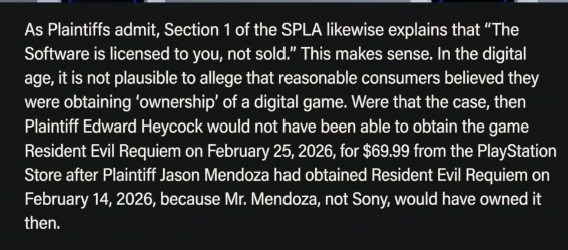
This statement by Sony’s legal team makes the claim that you cannot own a digital game, because only 1 entity can own the game at a time. This was accepted by the courts, and if you consider ownership as having all rights and full control, then they make a valid point. Section 1.4 of the EULA does say “1.4 The License to you: The Software is licensed to you, not sold.” But this is not really what anyone is arguing when they discuss ownership of digital media, and does not excuse their ability to remove access to said media at their whim.
Unfortunately, reselling digital copies was struck down in a 2013 lawsuit. The ReDigi case fundamentally weighed the claim of whether people had the right to resell digital music they had purchased. The case relied on the question of whether or not the owner of the intellectal property has the right to control the re-sale of their intellectual property, known as the first-sale doctrine. Judge Richard J. Sullivan ruled in favour of Capitol Records on 30th March, 2013. He based his ruling on the idea that “the transfer of digital data from one storage medium to another constituted a violation of copyright”. Whilst this is obviously the case if the seller keeps the original copy, I don’t think this is relevant if there is a way to remove the original purchasers access.
Much of the problem comes from the misrepresentation of having a button saying “Buy” but Sony claim everyone knew it was a limited access license. This isn’t just the case for games, it is all digital media. In Australia at least, this appears to be attracting the attention of the Australian Competition and Consumer Commission who have said “Businesses should avoid the use of words like ‘purchase’ or ‘buy’ when in fact they are only supplying a licence to access a service”, noting that such phrasing could be considered misleading under Australian law. Whilst this seems better than nothing, I suspect that at most it will force PlayStation to change the wording to be more accurately descriptive of the transaction.
Recently Sony announced that they will be ending production of physical discs for their games by January 2028. This creates an even more dire situation for PlayStation customers. Removing the second hand market allows PlayStation to keep the prices high for old games, because there is no longer any competition. This exacerbates the already existing issue of dynamic pricing on PlayStation games by removing the competition that is currently provided by the second hand market. Either way, this could move towards individualised dynamic pricing at all times.
All of this combined leaves the consumer in quite a position. The only direct power they have would be to vote with their dollars and not purchase anything from PlayStation until they have made the terms more reasonable to the consumer. Personally, I think a satisfactory solution would be for PlayStation to guarantee access ‘for life’, and that guarantee would need to be baked into their licencing agreements with the IP holders, such that whatever access they sell cannot be revoked, even if their licence to sell new access can be revoked. I think they should also provide a method for the end user to be able to sell the digital media on a second-hand marketplace such that they sellers access is revoked and the buyer takes over that access. Unfortunately, the most that appears to be able to be force on PlayStation is likely to be to change the word on the marketplace to say something that does not indicate ownership. Ultimately, the consumer needs to push for reasonable terms and their only real power is whether or not they buy the product. I would urge everyone to closely evaluate the TOS and not buy if they are not happy with those terms.
 Tilly Bunnage
  Josh
Josh  Idea Phochaiya