
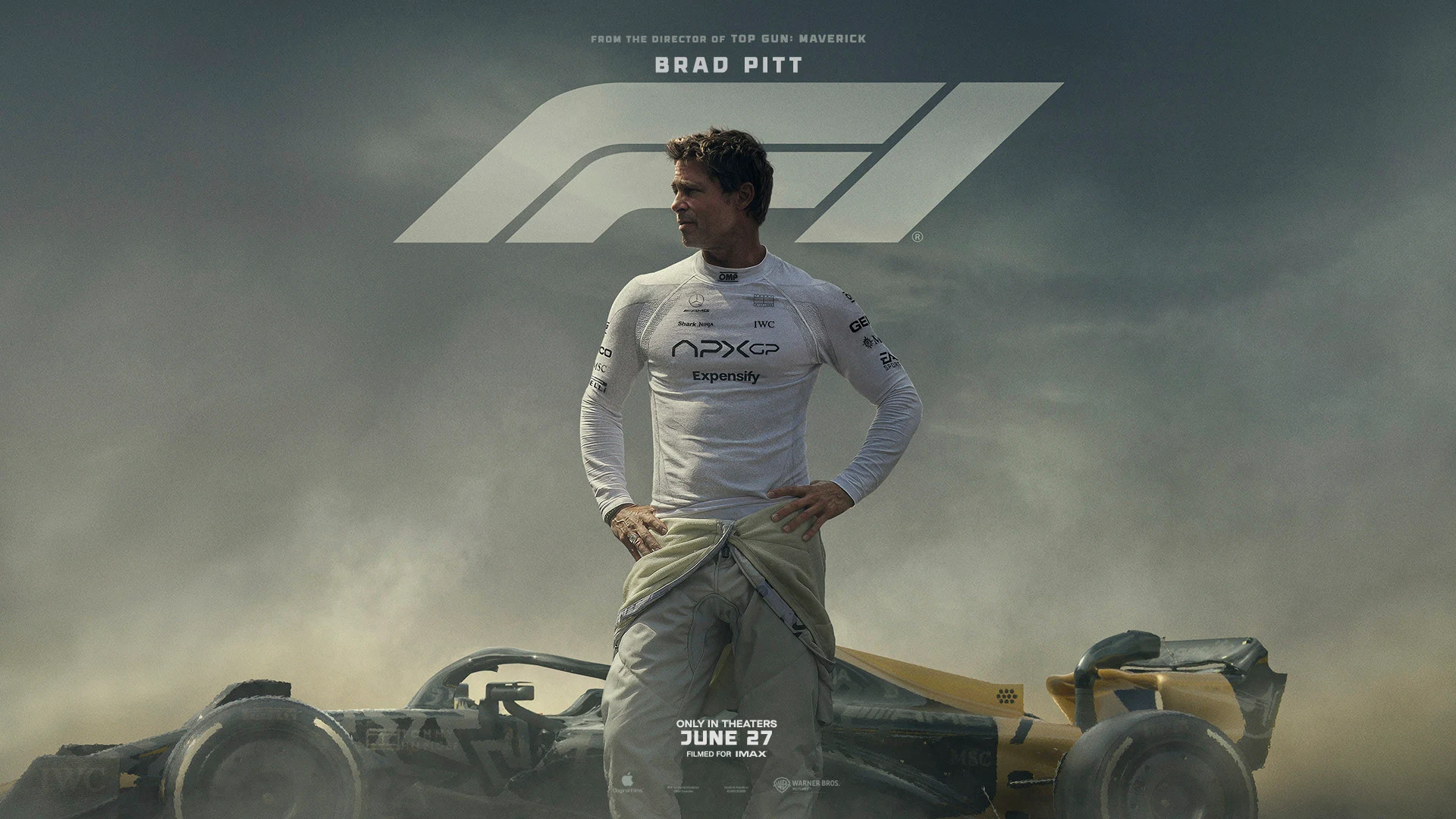
Formula One is more than just a sport. It is a global spectacle composed of speed, danger, technology, money and star power, and F1 is obviously very clear about this. Directed by Joseph Kosinski and released in June 2025, the film does not spend much time explaining why the sport is so appealing. Instead, it directly pushes the audience into the roar of engines, the pressure of high-speed cornering and the intensity of the track. Official marketing and F1 related information have also constantly emphasized that this film is deeply combined with the real racing environment and advanced filming techniques. In addition, the purpose is to bring the intensity and immersion on the track to the big screen as realistically as possible.

The most successful part of F1 is that it has made Formula One into a smooth, intense and highly commercially entertaining film experience. However, what is most impressive about this movie is how it captures the experience of racing, rather than how original its story is. That means F1 may not be the most profound sports movie, but it is indeed a blockbuster that knows how to create a sense of speed and screen spectacle.
F1 does not just regard racing as the background of the plot, but really turns Formula One into a cinematic experience with a sense of intensity and immediacy. As soon as the movie enters the track scene, what the audience feels is not a simple sense of speed, but a physical impact created by the lens, sound and rhythm. Not only the friction and impact of racing, but also the angle of shooting from the driver’s seat in the movie, as well as the breathing and strain heard from inside the helmet.These make the race no longer just a visual stimulation, but an immersive experience.

This strong sense of immersion largely comes from the film’s pursuit of “realism”. F1 does not make racing an empty commercial spectacle, but strives to make the speed, risk and technical details credible. The film is deeply rooted in the real Formula One environment, allowing the audience to see not only exaggerated chase, but a world based on the logic of real competition.
“Lewis was instrumental in not only the technical aspects obviously, but in the real kind of formulative stage of the movie, formulating this narrative,” —— Director Joseph Kosinski
To achieve this “realism”, in addition to the high standard of filmmaking techniques, the efforts of the actors are also an important part.Instead of depending on green-screen effects, Brad Pitt and Damson Idris have undergone many months of professional training. In addition, the film also invited many real-life Formula One drivers, such as Lewis Hamilton, Lando Norris, Charles Leclerc, etc. In other words, the shock of F1 does not only come from “fast”, but also comes from making that speed feel weighty, dangerous and believable
“So much research and technology and development went into just being able to roll a frame of footage, in addition to the training for the actors and the logistics of shooting at a real race, so it was a lot of prep to be able to pull this off.” —— Director Joseph Kosinski
At the same time, the processing of the film at the audio-visual level has further amplified this effect.The rapid editing tightens the rhythm of the race, the camera work close to the racing car makes the sense of speed more direct, and the sound design constantly strengthens the audience’s perception of danger and impact. These elements are combined to make F1 not only a film about racing, but more like a precisely designed sensory experience. Even if some audiences may not be familiar with the rules or background of Formula One, they can still quickly understand the charm of the sport through the image and sound. It is also at this point that F1 shows its most mature side as a commercial blockbuster: it knows how to transform a highly professional sport into immediate, exciting and accessible.
However, F1 is not a film without flaws. Compared with its strong performance in the racing scene, the film is less impressive in its story and characterisation. Its narrative still has a familiar sports-movie formula:an older driver with a troubled past, young drivers who need to prove themselves, storylines centred on race, cooperation and redemption. This structure is not ineffective, but it feels overly familiar, so it lacks some real freshness and complexity.
That’s why the most impressive part of the film is more about how it films racing cars than the story it tells. Character relationships and emotional beats can play a fundamental role, but rarely really exceed the audience’s expectations. In other words, F1 is successful as a commercial blockbuster because it is smooth, exciting and emotionally effective. But under closer critical scrutiny, it is still safe and conservative in terms of theme and character depth. This also makes the film more like a carefully designed thrill ride than a particularly original sports drama.
Overall, F1 may not be a sports film that is deep or fresh enough in terms of story, but it does succeed in transforming the speed, risk and spectacle of Formula One into apowerful and polished cinematic experience. What impresses the audience most is not necessarily the plot itself, but the way it makes audiences feel why the sport is so fascinating.
 Shoujie Wang
  Yinan Zhou
  SUN Yinchen