

Higgsfield Global Film Festival web page screenshot of submissions
From August 10 to September 16, 67,223 submissions poured in for a $1,000,000 cash competition, the Higgsfield Global Film Festival. Now, the judges have reviewed the finalised shortlist, among whom is the industry legend and Pixar co-founder, Edwin Catmull. Any day now, the jury will finalise the results, and the winners will be announced.
“Enjoy your slop Mr Catmull, you couldn’t pay me to watch that”
The film festival attracted controversy early on, with the announcement of Catmull’s participation. Cartoon Brew reported on the matter, noting that the move connects the ground-breaking work of Pixar with Higgsfield’s AI capabilities. Depending on one’s own views on generative AI, Higgsfield either did this in poor taste, or it was a welcome move to legitimise synthography as an art form. Though, one commenter on the article said, “Enjoy your slop Mr Catmull, you couldn’t pay me to watch that”.
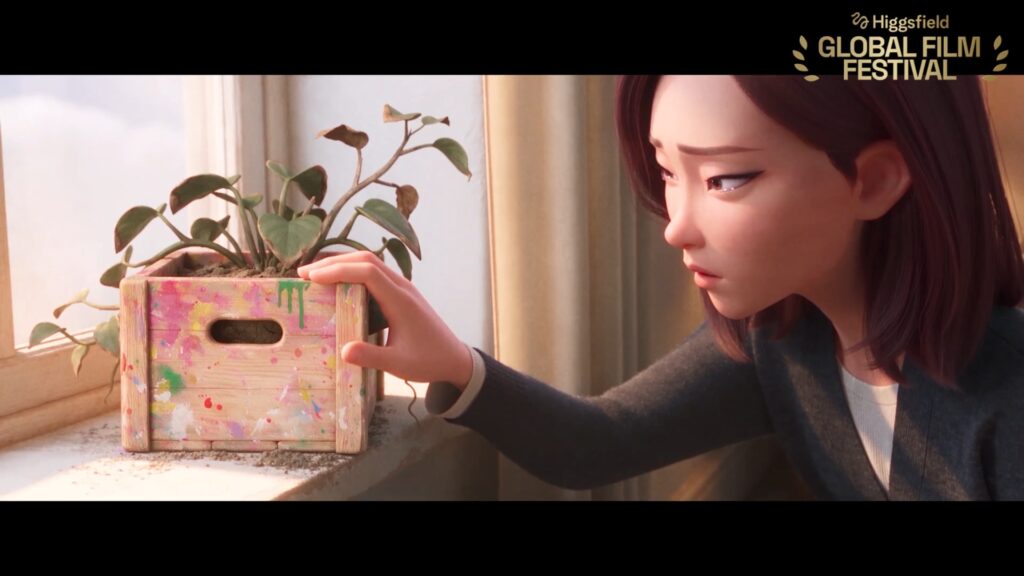
Such sentiment may indeed be justified, but it is not Catmull’s fame alone that legitimises the Higgsfield festival, but the films themselves. For example, Don’t Poison Ivy is a submission that looks at first glance as though it is simply generated based on Pixar training data, but it has all the originality and emotional gravitas that Pixar is known for. Yes, it still has the hallmarks of AI-generated video—continuity errors, visual glitches, and out-of-place details—but those are few and far between, and seem to elude the attention of most commenters:
“This is the #1 proof that the difference between slop and awesome is fantastic storytelling. This is fantastic storytelling!!!!!”
Still is another, and is an example of a completely different style: stop motion, in a similar vein to 2015’s Anomalisa. It is another contained and intimate story that is convincing as a piece of professional media. Again, it is far from perfect, and there are jarring moments that only make sense when keeping in mind that it is an AI-generated film. That said, even with “AI” noted in the video’s title, channel name, description, and YouTube’s AI badge, viewers seem unaware of the AI nature of Still. One such commenter said:
“Very touching , human story and love the animation style . Something in between stop motion and cgi ?”
Finally, perhaps one of the more conceptually provocative entries is The Prompter, a live-action style film that makes a meta commentary on the film festival itself; that it is essentially participants prompting and creating stories for the sake of compiling monetisable data. Yes, the synthographer(s) of the film seemingly makes this critique, yet still participates in the competition. This is the point. Generative AI as a means of film production is not an inevitability, it is a reality. Not only so, but it is also one that may be very soon taken for granted, as one commenter admitted:
“This is the first AI movie where I forgot halfway that I’m actually watching an AI generated movie. Very impressive.”
Higgsfield imposed strict rules for the competition, limiting the creative ability of entrants primarily to the Higgsfield AI suite of tools. If this is the quality of AI-generated films in 2026, without the aid of human performances, consider the future. This AI film festival marks the dawn of a new era of AI-assisted filmmaking, and a time of displacement, uncertainty, and democratisation.
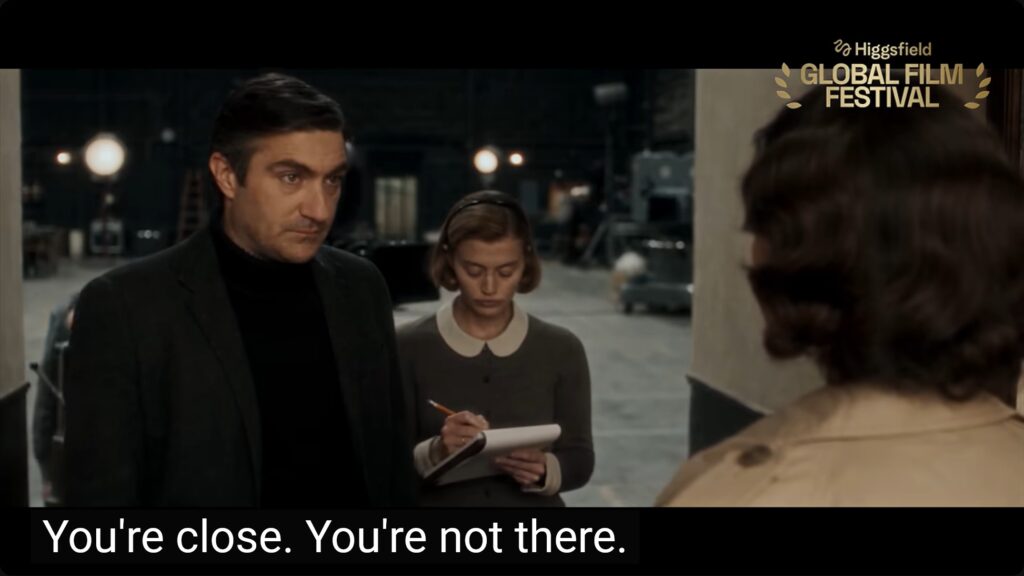
The quality of these AI films is not quite there, but it is only early in the day. They will get better. As one character in The Prompter warned:
“Don’t give me a performance, give me the truth. You’re close. You’re not there.”
 Michael Chiodo
 Bryana McGowan
 Audrey James