
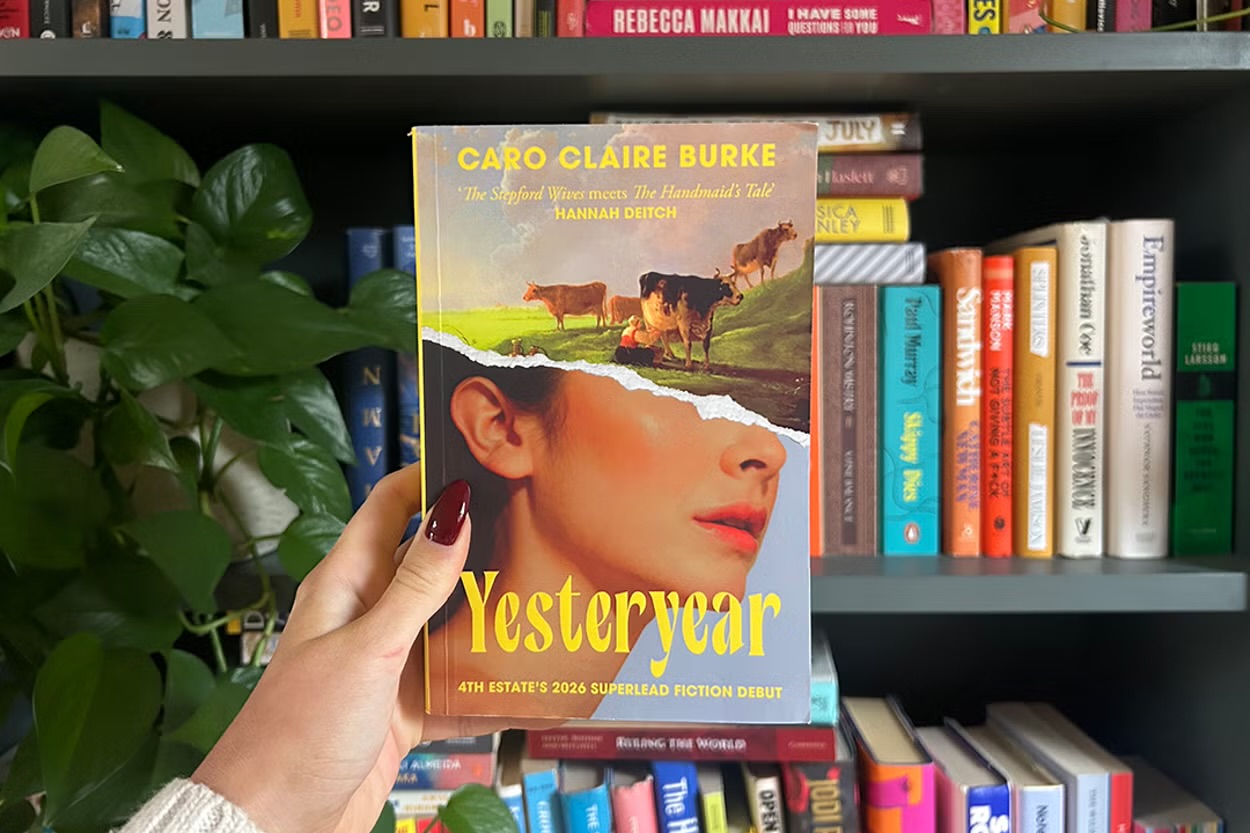
What happens when the woman selling a fantasy of traditional domesticity is forced to live it? In her provocative debut, Caro Claire Burke’s Yesteryear turns the tradwife aesthetic into a disturbing examination of motherhood, online identity, and the price of performing perfection.
There is something seductive about a woman who appears to have everything figured out. The immaculate farmhouse, the homemade sourdough, the well-behaved children, and the husband who seems to belong in a country-living catalogue: on social media, the traditional wife, or “tradwife”, offers an escape from the messiness of contemporary life.
Published in April 2026, this darkly comic thriller follows Natalie Heller Mills, a Christian “tradwife” influencer whose idyllic ranch life conceals nannies, producers, and considerable wealth. When she wakes in what appears to be a version of 19th century America, without modern conveniences or an audience, her carefully curated identity begins to collapse.
The fantasy has a following
Natalie’s brand is built on an alluring contradiction. She champions old-fashioned self-sufficiency while relying on the technologies, money and invisible workers that make her performance possible. Her bread is content; her children are supporting characters. Even her marriage functions as part of the set.
It is difficult to read Burke’s satire without thinking of Hannah Neeleman, the former ballerina behind Ballerina Farm. Neeleman’s videos of farm life, cooking and motherhood have made her a prominent figure in conversations about the tradwife aesthetic. But the comparison needs care: Neeleman has resisted the label, and Natalie is not a fictional biography of her.

In a Vogue interview, Burke describes drawing on patterns across multiple influencers rather than copying one woman. That distinction matters. The novel targets an online economy that turns femininity into an aspirational product, not simply an individual mother with a camera.
The cost of being watched
Burke’s strongest achievement is Natalie herself: funny, calculating, cruel and intermittently vulnerable. Her voice is entertaining precisely because she understands the market for authenticity while remaining spectacularly dishonest about her own life. The reader becomes another spectator, simultaneously repelled by and hungry for the next revelation.
There is a sharper ethical question beneath the jokes. Natalie’s children cannot meaningfully consent to becoming material for her brand. Their innocence is a selling point, yet their private lives are packaged for strangers. Burke exposes how easily the language of family devotion can obscure the commercial use of family members.
The novel also punctures nostalgia. In the “past” world, domestic work is not a sunlit montage of kneading dough. It is relentless physical effort, with fewer choices and considerably greater risks. Natalie wants the aesthetic of history without its constraints. Her predicament makes the distance between those desires impossible to ignore.
A twist too far?
For all its bite, Yesteryear sometimes mistakes escalation for depth. Its central mystery is propulsive, but the historical sections could have offered a richer exploration of women’s work and survival. Instead, the novel often hurries back to Natalie’s manufactured celebrity.

More troubling is its treatment of motherhood and disability. As Rhiannon Lucy Cosslett argues in The Guardian, a significant plot development risks reducing a child’s experience to a narrative device. The criticism is persuasive: a novel so alert to the exploitation of children should examine their humanity with equal care.
Burke also gestures towards the politics surrounding idealised femininity without always interrogating them. Tradwife content is not politically uniform, as The Guardian’s reporting makes clear. Nevertheless, nostalgia for rigid gender roles can carry implications beyond personal lifestyle choices. The satire occasionally chooses shock over sustained examination.
Why it matters now
The novel’s popularity is itself part of the story. Selected for Good Morning America’s book club and slated for a screen adaptation starring Anne Hathaway, Yesteryear has travelled through the same attention economy it critiques.
Burke told The New Yorker that her interests extend beyond tradwives to misinformation and distorted ideas about the past. That ambition explains the novel’s most unsettling insight: nostalgia becomes dangerous when a polished image is mistaken for historical truth.
Yesteryear is not a flawless feminist satire. Its uneven treatment of serious subjects prevents its clever premise from reaching its full potential. Yet it is difficult to dismiss a book that makes the machinery of online aspiration so visible.
Ballerina Farm may offer viewers the pleasure of watching domestic perfection unfold. Burke asks what happens when the camera stops, the helpers disappear and the fantasy becomes compulsory. The answer is uncomfortable, occasionally outrageous and worth reading.
For readers accustomed to scrolling past spotless kitchens and smiling families, that recognition is the novel’s real sting: the performance is not confined to the screen, because audiences help decide which performances become profitable.
Verdict: A sharp, compulsively readable but imperfect novel about selling a past nobody would willingly inhabit.

 Michael Chiodo
 Audrey James
 Adam O'Neill