
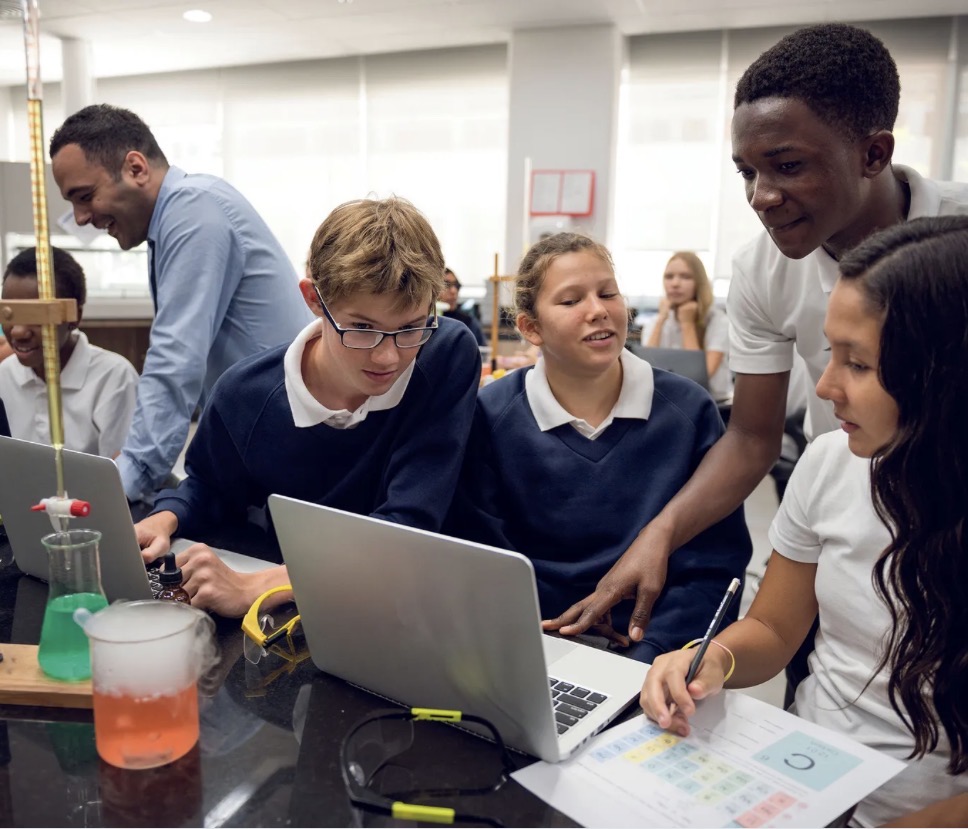
Picture this. You’re 12 years old, sitting in your year 6 math class. The teacher is explaining fractions at the front of the class, something your little mind just can’t seem to concentrate on. Luckily, there’s a window beside you which is the perfect vice for having a sneaky day dream, a zone out, a brain fart some might say. You might stare out the window for a period of time, draw a few doodles on your workbook, or play a few self versed games of notts and crosses. You know you should be paying attention, but for most kids this is a relatable experience in the classroom, at one time or another. Eventually, you’ve become bored of the doodles and the glass pane window, and before you know it, you’ve snapped back into focus— now starting to understand these confusing numbers on the whiteboard.
Now, imagine this situation again. This time, instead of a pen and pencil at your desk, you’ve got a laptop open in front of you; filled with endless possibilities and streams of stimulus. Within seconds of your little mind wondering from your school work, you find yourself indulging in any of the hundreds of distraction induced stimulations at offer on your device, right at your fingertips. For the rest of class, time unknowingly slips by as you endlessly scroll or play video games. Do you picture yourself having any chance of snapping back into concentration?
For as long as schools have been around, students have surely always found ways to distract themselves during class. Daydreaming or passing notes are hardly a new revelation, however, today’s digital age faces these environments with an entirely new obstacle. Digital distractions.
Students are no longer limited to scribbles and whispering conversations in class, but are now made acquainted with a device containing seemingly endless amount of entertainment, forms of communication and information; all just behind one screen.
Australian classrooms have embraced the use of digital devices in education over the past decade or so, increasingly integrating digital learning platforms and assistance into everyday learning. However, as technology becomes more and more embedded into Australian education, an uncomfortable question rears its head; is this actually beneficial for our students, or is it affecting them for the worse?

Picture being in class again, you’ve just thought of something that is quite frankly hilarious, something you just can’t wait to share with your friends at lunch time. You have to wait, though, making sure to remember it for after class. Now, imagine this same situation, except this time you have a device in front of you which allows you to send that hilarious thought directly to your friend, instantly. No waiting till lunch. No need to remember.
Do you see yourself holding out?
A quick message becomes a conversation, a conversation becomes a lengthy distraction, and before you know it your teacher’s on to the next topic. Now, you’re lost, confused and scrabbling to make sense of what you missed.
For students of today’s digital age, this isn’t a hypothetical scenario. Recent research has shown that digital distractions are in fact an increasingly common obstacle in education. The Organisation for Economic Co-operation (OECD) and Development’s Programme for International Student Assessment (PISA) has recently found from survey results of 2025 that 39% of Australian students reported that their peers were often distracted by digital devices during most of all of their science lessons. The survey found that students weren’t only directly distracted by their own digital use, but also by the digital use of their classmates as well.
Teachers have reported similar situations, with research from Macquarie University finding that more than half of surveyed teachers said that students are ‘frequently distracted by unrelated content on digital devices, and half of their students weren’t only directly regularly distracted by classmates using screens’. (5). Between 10 and 30% of school teachers reported that students are able to self regulate their use of technology when learning, with one teacher going as far as to describe the situation like ‘jack-in-the-boxes’, as students repeatedly pop back onto to their devices as they seemingly can’t resist them. The thing is, even while teachers might think that kids are working on their devices, they actually tend to be shopping online, playing games or messaging other classmates, rather than staying on task.

To be fair, as a student, how could you not resist? Teachers have always competed with wandering minds, but today the competition is much larger than ever seen before. The juxtaposition of having a device that can facilitate your learning, whilst also providing an immediate escape from it is frankly quite jarring. No wonder we’re seeing a reduced willingness in students to follow teachers instructions (5).
Think back to a random Wednesday afternoon, schools just finished on a beautiful sunny day. You’ve been given some Year 9 history homework, but your mates have invited you to come play at the local park down the road. You know that you should probably get these history notes done instead, and then maybe consider going to the park once your homework is done.
Now, imagine this same situation, but you’ve got access to an AI chatbot that can take those same history readings and create the notes for you! In a matter of seconds!
Do you picture yourself staying at home doing the grunt work, or choosing to go play at the playground down the road with your friends for the afternoon?
Such a temptation, in such a defining time of education.
Well, this is a situation students are actually facing today, and it’s clear which option they are choosing. A recent study reported by the ABC examined more than 26,000 students from grade 7 to 12, finding that 78% of Australian children use an AI assistant. With this, researchers found that generative AI use was associated with an 18% increase in homework scores, a 30% improvement in completion times; however, monthly in class examination scores fell by 20% (4).
These findings have lead to raising concerns about what happens when students offload hard mental work to AI, with students not being forced to develop or use their deeper cognitive thinking skills in the same way that previous generations have. Homework generally gives students the opportunity to practice recall, problem solve and recognise what they don’t understand.
When students use an AI chatbot to do these hard yards, students might read the AI-generated answers and understand what it says, but they aren’t going through the struggle of working through the problem themselves. This has lead neuroscientists to worry that there may be an affect on the development of critical thinking skills as students rely on AI to perform difficult tasks, and that development of some intricate neural connections usually developed during education may be challenged due to this issue. (4).

What’s concerning is whether these digital affordances are really supporting students learning, or replacing it. Without the struggle of learning, how are students really accomplishing anything?
I remember as a student experiencing the natural anxieties felt during the preparations of an upcoming test. NAPLAN, for one, will always be remembered by me as a big deal. As kids, we’d be handed practice workbook after practice workbook, filled with practice questions and related content with the expectation that you would practice, revise and demonstrate what you had learnt on the big day.
Now days, imagine this same situation with the digital affordances we’ve spoken about. Maybe I wouldn’t have been so motivated to learn the material, if I knew I could get the answers from a device.
Seemingly, students of today have probably had this same exact thought, as recent NAPLAN results have raised concerned about whether Australia’s growing reliance on learning is appearing to be beneficial or not.
In August of this year, The Guardian reported that national reading and writing results have gone backwards in almost every age group in these national standardised tests, and that 1 in 3 students are failing to meet NAPLAN benchmarks. With more students requiring additional support in both reading and writing, numeracy scores in lower primary school grades have also dropped. (1). On top of this, its also found that scores in subject areas are radically down since the early 2000s, as teachers battle concerns around behaviour, classroom distractions and disruptions; with Survey data showing that Australia has amongst the worst experiences of classroom discipline and classroom disruptions, particularly in relation to noise and distraction from digital devices (2).
These findings really do work to challenge the assumption that increased digital access will automatically produce better educational outcomes. If students have so much available at their fingertips, why are they seemingly dropping in foundational learning expectations?
Ultimately, its easy to agree that technology should be serving the learning of our modern classrooms, not robbing from it. Maybe the combination of such temptations, instant stimulus and instant answers is something that may not be genuinely improving students education.
So the question still stands; are digital devices really helping in the classroom?
Only time will tell.
 Hayley Primmer
 Flynn McQuade
 soraya