
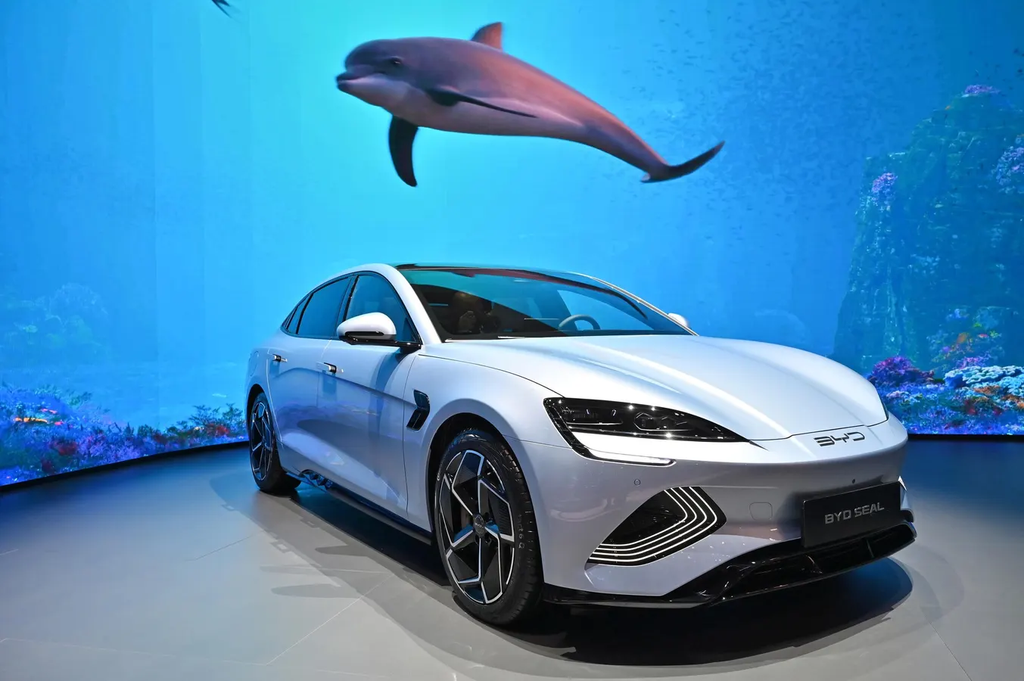
Chinese cars are becoming a normal sight on Australian roads. But depending on what you read, the same car can be presented as either a great-value new competitor or something Australians should be worried about.
Open a few Australian stories about Chinese cars and you can walk away with completely different impressions. In one article, a BYD might be praised for its price, technology and equipment, compared with brands such as Tesla, Toyota or Kia and treated like any other car a buyer might be considering. In another, that same kind of vehicle becomes part of a much bigger discussion about data collection, cybersecurity, surveillance and Australia’s relationship with China.
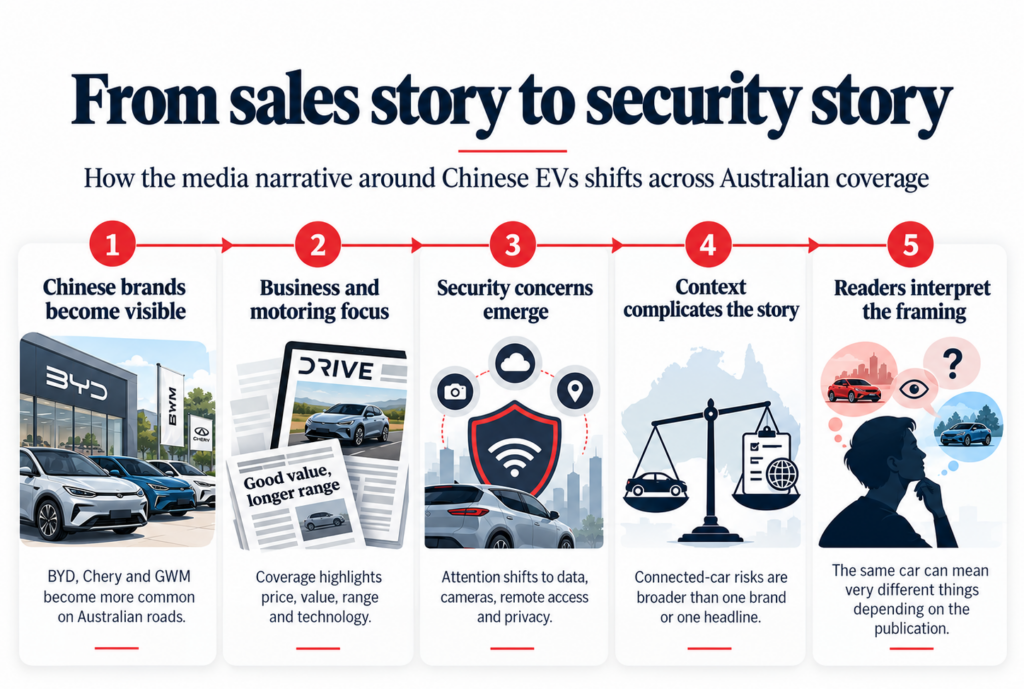
That difference matters more now because brands such as BYD, GWM, Chery and Geely are becoming harder to ignore. Chinese cars are appearing more often in Australian showrooms, on sales charts and on the road. Unsurprisingly, they are also appearing more often in the media. What stood out to me when comparing this coverage was that there is no single media image of the “Chinese EV”. Business and motoring coverage often presents these cars as affordable, advanced and increasingly competitive, while investigative reporting can present the same technology much more cautiously, focusing on privacy, cybersecurity and national security.
Both versions can be based on genuine evidence. A low price or strong sales growth does not make privacy concerns disappear, just as cybersecurity concerns do not automatically mean every Chinese vehicle is unsafe or untrustworthy. What changes between stories is often which facts are pushed to the front and which are left in the background.
Cheap, high-tech and becoming hard to ignore
For a long time, “Made in China” was not exactly a selling point in the Australian car market. Chinese vehicles were often seen as cheaper alternatives that still had some catching up to do in areas such as quality, safety and reputation. That image is changing quickly as the cars improve and Australian buyers become more familiar with brands that barely registered in the local market only a few years ago.
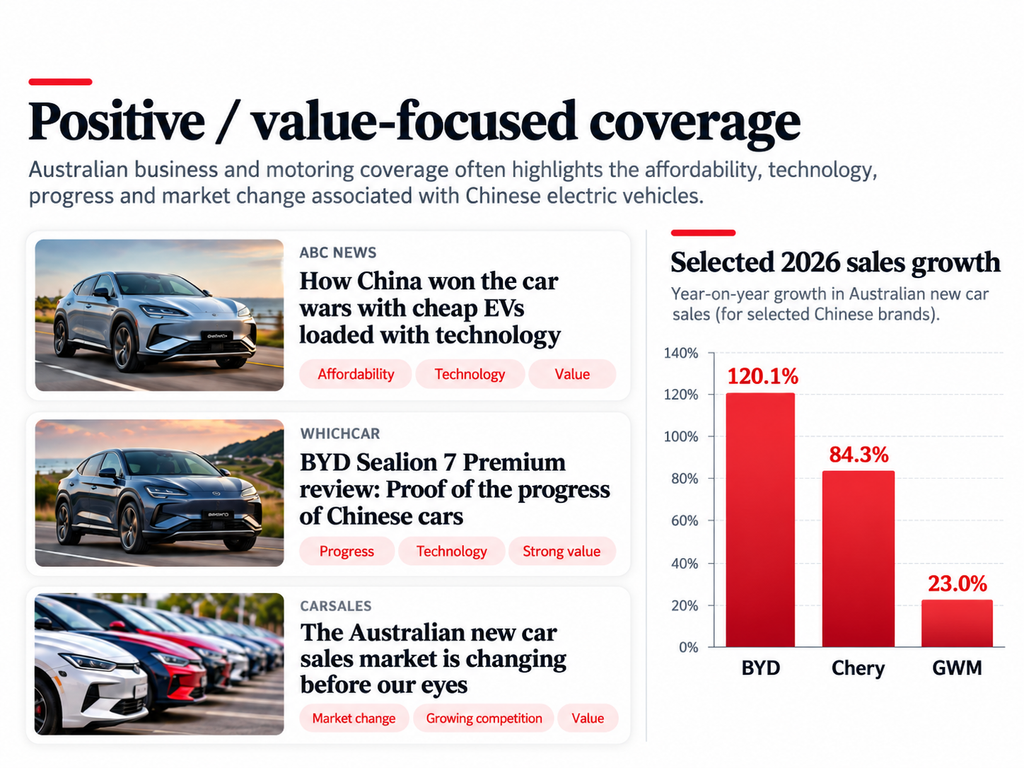
In July, ABC chief business correspondent Ian Verrender used the arrival of the BYD Zhengzhou at the Port of Melbourne, carrying thousands of electric cars, as an example of how much the global car industry has changed. His ABC analysis focused on falling prices, improving vehicles, battery production and rapid sales growth from Chinese manufacturers. Rather than mainly presenting China as a geopolitical concern, the article presents it as a serious industrial competitor that has become very good at making electric vehicles and is forcing established manufacturers to respond.
That idea comes through even more clearly in specialist motoring media. A July WhichCar review of the BYD Sealion 7 described the SUV as “proof of the progress of Chinese cars”. It scored 8/10 and was judged on the same things most buyers care about: price, range, equipment, comfort and how it drives. Even the criticisms were fairly normal ones for a car review, including too many controls being hidden in the touchscreen and some noticeable road noise.
That is important because the review does not treat the BYD as something completely separate from the rest of the market. It places the Sealion 7 alongside established competitors and asks whether it stacks up. Its price is compared with the Tesla Model Y, while its range, features and comfort are assessed in the same way as any other mainstream SUV. The main question is not whether Australia should trust China. It is much simpler: is this a good car for the money?
Carsales takes a similar approach when looking at the market as a whole. Its June analysis described a major shift in Australian new-car sales as Chinese manufacturers moved further into the mainstream. The explanation centred on value, quality and choice. Chinese brands now offer electric, plug-in hybrid, regular hybrid and conventional vehicles at prices that put pressure on established manufacturers. Brands that once seemed unfamiliar are increasingly ending up on the same shopping lists as Toyota, Mazda, Kia, Hyundai and Tesla.
Taken together, these stories create a fairly clear picture. The Chinese car is becoming the affordable, technology-heavy challenger. Its country of origin still matters, but mainly because it represents how quickly China’s automotive industry has improved and how much pressure it is now placing on older manufacturers. In this kind of coverage, “Chinese” is increasingly associated with competition and rapid progress rather than simply cheapness or poor quality.
When the car becomes a security story
There is, however, another version of the Chinese EV. On September 21, ABC’s Four Corners published an investigation with a headline that immediately changed the tone of the discussion: “We got a cybersecurity expert to hack this BYD. It was too easy.”
The things that mattered in this story were completely different. Price, range and comfort moved to the side. Cameras, microphones, location information, software and remote access became the focus instead. The program showed cybersecurity expert Dan Hreszczuk remotely interacting with a BYD Shark 6 before moving into wider questions about what information connected vehicles collect, where that information can go and whether Australia’s regulations are keeping up with cars that increasingly operate like computers on wheels.
The contrast is interesting because some of the same technology can look completely different depending on the type of story being told. Connected features can be useful selling points in a car review. Controlling parts of a vehicle through an app, receiving software updates or using built-in cameras can all be presented as convenient technology. Put those same features inside a cybersecurity investigation, however, and they can start to look like possible vulnerabilities.
Australia’s Department of Infrastructure acknowledges that connected vehicles can collect and exchange information through cameras, microphones and other sensors. It also identifies privacy and cybersecurity risks. That means the basic issue raised by Four Corners is not imaginary. Modern cars rely on much more software and collect much more information than cars of the past, raising obvious questions about who can access that information and how securely it is stored.
The Four Corners investigation also brings Australia’s relationship with China into the story. Former national cyber security adviser Alastair MacGibbon argued that Australia needed stronger protections around information collected by connected vehicles and raised particular concerns about Chinese-made cars. BYD, meanwhile, told the ABC that Australian customer data is stored in Australia and that it had not provided Australian data to Chinese authorities.
By that point, the conversation has moved a long way from whether the Shark 6 is good value. The car is no longer just a product. It has become part of a much wider political and security debate.
But the security story is more complicated
A dramatic hacking demonstration is memorable, which is exactly why the details around it matter. Earlier this week, the story gained another layer when the ABC Ombudsman’s Office published its findings after receiving 50 complaints about the Four Corners episode and its online reporting.
Some of those complaints argued that the report encouraged anti-Chinese sentiment, did not properly explain how the hacking demonstration worked and focused too heavily on Chinese vehicles when data and cybersecurity issues also exist across connected cars more generally. The Ombudsman ultimately found no breach of the ABC’s accuracy or due-impartiality standards. At the same time, the findings added some useful context to what viewers had actually seen.
The BYD used in the demonstration had been physically accessed beforehand. Software had been installed and a connection was made to the vehicle’s CAN bus. In other words, the demonstration did not prove that a random stranger could simply take control of an untouched Shark 6 from anywhere. Instead, the setup was intended to simulate the kind of remote access that could potentially exist through a manufacturer.
That does not make the cybersecurity concern disappear. It does mean the demonstration needs to be understood in context. This is where the issue becomes more interesting than simply deciding whether the Four Corners story was “right” or “wrong”. The investigation raised a legitimate concern, but the later Ombudsman findings also show how much context matters when one dramatic example is used to represent a broader issue.
Australia-China Relations Institute researcher Marina Zhang has made a similar point from another angle. Connected vehicles create genuine questions around data and cybersecurity, but those questions are not unique to Chinese brands. A Tesla, BMW, Kia or Toyota does not stop being connected simply because it comes from somewhere other than China. Modern cars increasingly collect information, communicate with outside systems and depend on software.
The bigger question, then, may be how Australia regulates connected vehicles as a whole while still recognising that different manufacturers, ownership structures and countries can create different levels of risk. That is less dramatic than saying a Chinese car can be “hacked”, but it is probably a more useful way of thinking about the issue.
Same car, different story
So why does the coverage look so different? The easy answer would be bias, but that explanation does not really account for what is happening. Different publications are writing for different audiences and trying to answer different questions. Naturally, that changes which information becomes important.
Someone reading a WhichCar review is probably interested in buying a car or comparing different models. They want to know how much it costs, whether it is comfortable, how far it can travel and whether it offers better value than the alternatives. For that reader, a rotating touchscreen, driving range or a lower price than a Tesla is much more relevant than Australia’s broader relationship with China.
Four Corners has a completely different purpose. Its audience is not watching to find out whether the Shark 6 has enough rear-seat legroom or whether its suspension is comfortable. It is an investigative current-affairs program looking for issues with wider public consequences. Once the story becomes about cybersecurity, the vehicle’s cameras, microphones and internet connection suddenly matter much more than its price or driving experience.
Perhaps the most interesting comparison is that the ABC itself has produced both versions of the story. Verrender’s business analysis presents China’s automotive rise as an impressive industrial success story. Less than two months later, Four Corners examines Chinese vehicles through cybersecurity and national-security concerns. It is the same broadcaster, but the representation is completely different.
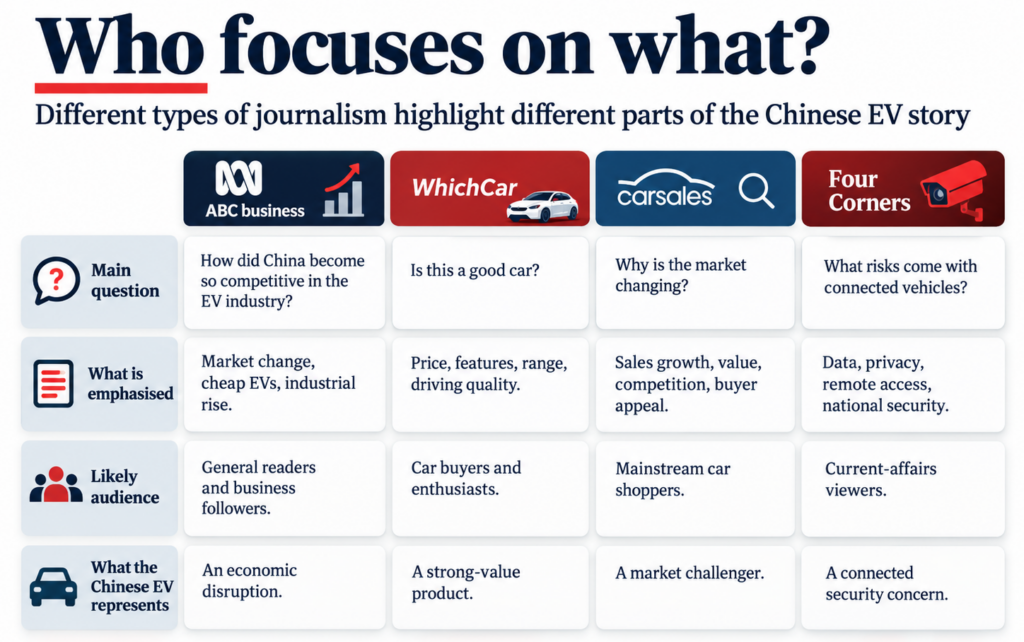
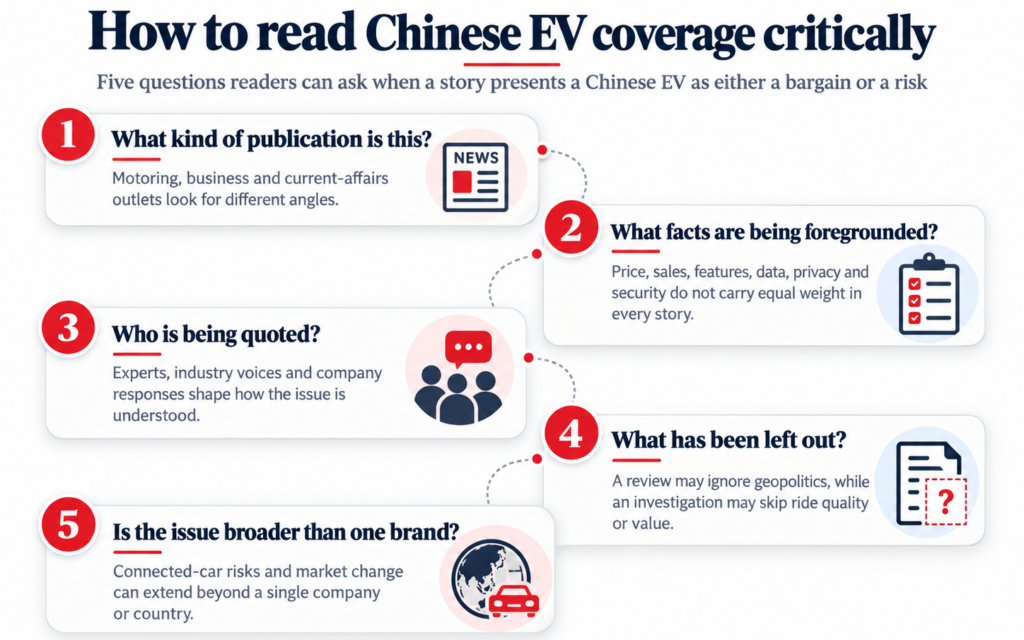
That makes it difficult to argue that “mainstream media” has one simple position on Chinese EVs. What seems to matter more is the kind of journalism being produced and the question the journalist is trying to answer. Every story involves choices about which facts deserve attention, who should be quoted and which issue should become the main focus.
A car review cannot realistically investigate every geopolitical issue connected to the company that built the vehicle. At the same time, an investigative program about cybersecurity is not going to stop for several minutes to discuss suspension quality, boot space or whether the seats are comfortable. Neither approach automatically makes a story dishonest. They simply produce different versions of the same subject.
A low price can be true. Rapid sales growth can be true. Good technology can be true. Privacy and cybersecurity concerns can also be true. The important difference is which of those facts gets placed at the centre of the story and which ones are pushed to the side.
So, what does a Chinese EV represent?
For Australian readers, the answer can depend on what they happen to be reading. In one story, a Chinese EV represents how quickly China’s automotive industry has improved and how much pressure it is placing on manufacturers that have dominated the Australian market for decades. In another, it represents the growing privacy and security questions that come with cars becoming more connected.
Both versions have something useful to tell us. The problem starts when either version becomes the whole picture. Treating Chinese EVs only as cheap, feature-packed bargains risks overlooking genuine questions about data, software and privacy. Treating them only as possible surveillance devices can turn a much broader issue around connected cars into something defined almost entirely by where a vehicle was manufactured.
As Chinese brands take up a bigger share of the Australian car market, the way they are covered will influence how people understand them. That is why it is more useful to look beyond whether a particular article is simply “positive” or “negative”. A better question is what the story has chosen to make important, what it has left out and why.
The car may be the same, but the version of it we meet depends heavily on who is telling the story.
 Evie Vass
 Hayley Primmer
 soraya