
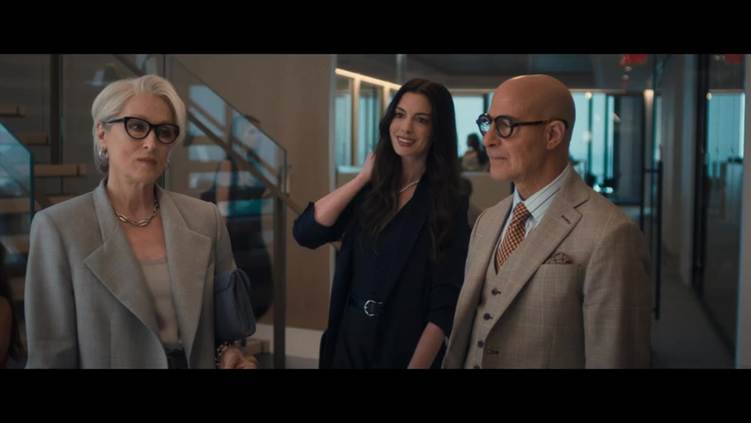
Miranda and Nigel occupy the foreground while Andy stands behind them, a visual echo of Runway’s familiar hierarchy. Frame from The Devil Wears Prada 2 – Official Trailer (1:08), directed by David Frankel. © 20th Century Studios. Source: official trailer.
Miranda Priestly can intimidate an entire office with a look. A shrinking budget is harder to frighten. The Devil Wears Prada 2 returns to a Runway whose authority is no longer assured. Its changing industry gives this reunion sharper stakes than its familiar office dynamics.
Director David Frankel reunites Anne Hathaway, Meryl Streep, Emily Blunt and Stanley Tucci twenty years after the original. After losing her journalism job, Andy returns as Runway’s features editor to find Miranda fighting to preserve the magazine.
Back in the office
Andy’s redundancy gives the film its sharpest example of professional insecurity. As she accepts a journalism award, a text message tells her that she and her colleagues have been made redundant. The collision of public achievement and private shock makes the industry’s decline personal. Her return to Runway puts her journalistic ideals up against the need to earn a living. Apparently, an award is no substitute for a pay slip.
Hathaway’s Andy brings experience to an office that once overwhelmed her. Her lingering unease around Miranda is believable; less convincing is how readily the writing makes her seem junior again. Twenty years is a long time for the script to keep her on probation. Her accumulated experience should create more friction with Runway’s old hierarchy.
Miranda’s vulnerability offers a more compelling development. Her judgement once helped determine what mattered in fashion; now she must answer to the people funding it. Screenwriter Aline Brosh McKenna describes her as defending human artistry against a prospective owner willing to replace creative work with AI. Her standards gain a purpose beyond protecting her position. Streep’s measured delivery suits this tension: Miranda can still unsettle a room even as her control over the magazine slips.
That sympathy needs limits. Miranda’s commitment to creative excellence does not excuse her treatment of employees. The sequel risks inviting admiration without properly examining the workplace culture she helped create. Defending the magazine while questioning her management would give its portrait of leadership more depth.
Emily makes that shift in power personal. The former assistant now represents a luxury brand whose advertising money matters to Runway. That must make reunions interesting. Miranda’s ability to exercise editorial judgement depends partly on keeping her former subordinate’s employer happy. Their rivalry now exposes who can afford to call the shots.
Nigel preserves a connection to Runway’s creative identity. Tucci’s reassuring presence makes the reunion welcoming, although Nigel deserves development beyond helping Andy through her problems. Giving him a fuller story would make the consequences of commercial pressure clearer for the magazine’s creative staff. Even its most reliable person should have a future beyond sorting everyone else out.
The audience has other tabs open
The Reuters Institute’s 2026 Digital News Report documents younger audiences’ preference for social and video platforms. Its research concerns news, but provides context for Runway’s struggle to retain influence. For readers finding recommendations through creators and feeds, one magazine deciding what everyone should care about may already feel like a period detail.
The film’s affection for established publishing deserves scrutiny too. Digital media can create opportunities for writers and creators excluded from elite institutions. Runway’s survival matters to its employees, but nostalgia should leave room to question who benefited from its earlier authority and who never got through the door.
The clothes make that exclusion easy to overlook. In the trailer frame, Miranda’s grey tailoring and Nigel’s checked suit five workplace authority an enviable finish. The visual polish helps explain Runway’s pull: even a punishing office can look like somewhere you ought to want to work.
For fans of the original, this is a worthwhile reunion. Its strongest material asks what happens when expertise and loyalty stop guaranteeing security. Andy and Nigel need fuller stories to match that insight. Even impeccable taste needs a worthwhile business model.
 Michael Chiodo
 Bryana McGowan
 Audrey James