
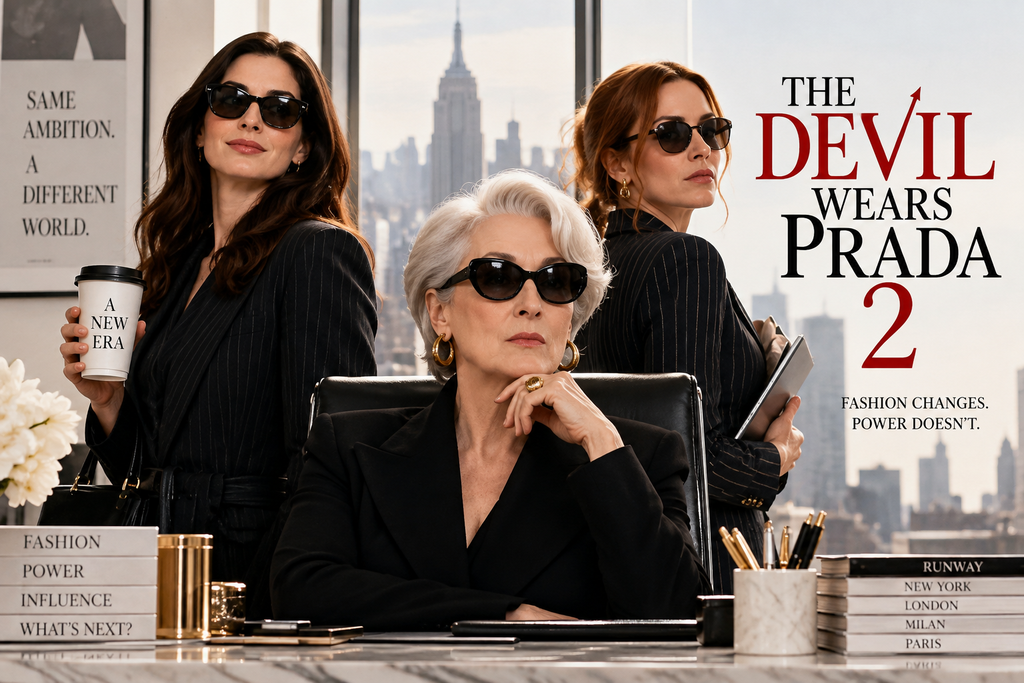
Twenty years after The Devil Wears Prada gave Andy Sachs one of cinema’s most satisfying exits, Hollywood has asked her to turn around and walk straight back in.
The question is not whether audiences wanted to see Miranda Priestly again. Of course they did. The real question is whether The Devil Wears Prada 2 has anything worth saying that the original didn’t.
The answer? Just enough.
Returning to such a culturally loved film was always going to be risky. The original did not end on a cliffhanger or leave its characters obviously unfinished. Andy walked away from Runway, chose the career she actually wanted and, most importantly, rejected the idea that becoming successful meant becoming Miranda. A sequel therefore has to justify reopening a story that already felt complete.
Where The Devil Wears Prada 2 succeeds is in recognising that while its characters may be familiar, the world around them is not.
The original was released in 2006, when fashion magazines still had enormous power over what people wore, bought and considered desirable. In 2026, that authority has been disrupted by influencers, social media, algorithms and digital publishing. The sequel’s most interesting moments come when Miranda, once the ultimate gatekeeper of fashion, is forced to navigate an industry in which Runway no longer holds the influence it once did.
This is the sequel’s strongest argument for its own existence. Instead of simply asking where these characters are now, it has the opportunity to ask whether the world that made Miranda powerful still exists.
Unfortunately, The Devil Wears Prada 2 does not always trust that idea enough.
For a film about an industry obsessed with what comes next, the sequel spends a surprising amount of time looking backwards. Familiar faces, callbacks and references to the original regularly appear, sometimes feeling less like meaningful storytelling and more like reminders that we have seen all of this before.
Bradshaw (2026), writing for The Guardian, similarly argues that the sequel repeatedly recreates elements of the original. Nostalgia is not necessarily a weakness. Seeing Meryl Streep return as Miranda and Emily Blunt as Emily is undeniably part of the appeal. But when recognition becomes the joke, the emotion and sometimes the point, the sequel struggles to establish an identity of its own.
That is particularly frustrating because its returning characters provide opportunities the original never had.
Emily is no longer simply the exhausted assistant desperate to survive Miranda’s demands. Seeing what years of ambition have actually given her allows the sequel to revisit one of the original film’s biggest ideas: what are you willing to sacrifice to become successful?
Meryl Streep’s Miranda remains the film’s greatest asset. But she is more interesting when the sequel allows her power to feel uncertain. The Miranda of 2006 could decide what mattered. The Miranda of 2026 has to compete for attention. Watching a character built around control confront an industry she can no longer completely control is far more compelling than any recycled reference to the first film.
So, did we need The Devil Wears Prada 2?
No.
But “need” is probably the wrong standard for a sequel like this.
At its best, The Devil Wears Prada 2 uses the 20-year gap to reconsider ambition, influence and what happens when an industry moves on. At its weakest, it relies on the fact that audiences already love these characters enough to enjoy simply seeing them again.
The original became iconic because it captured a cultural moment. The sequel is entertaining because it lets us revisit it.
And that difference is exactly why Miranda Priestly probably never needed a second entrance.
 Michael Chiodo
 Bryana McGowan
 Audrey James