
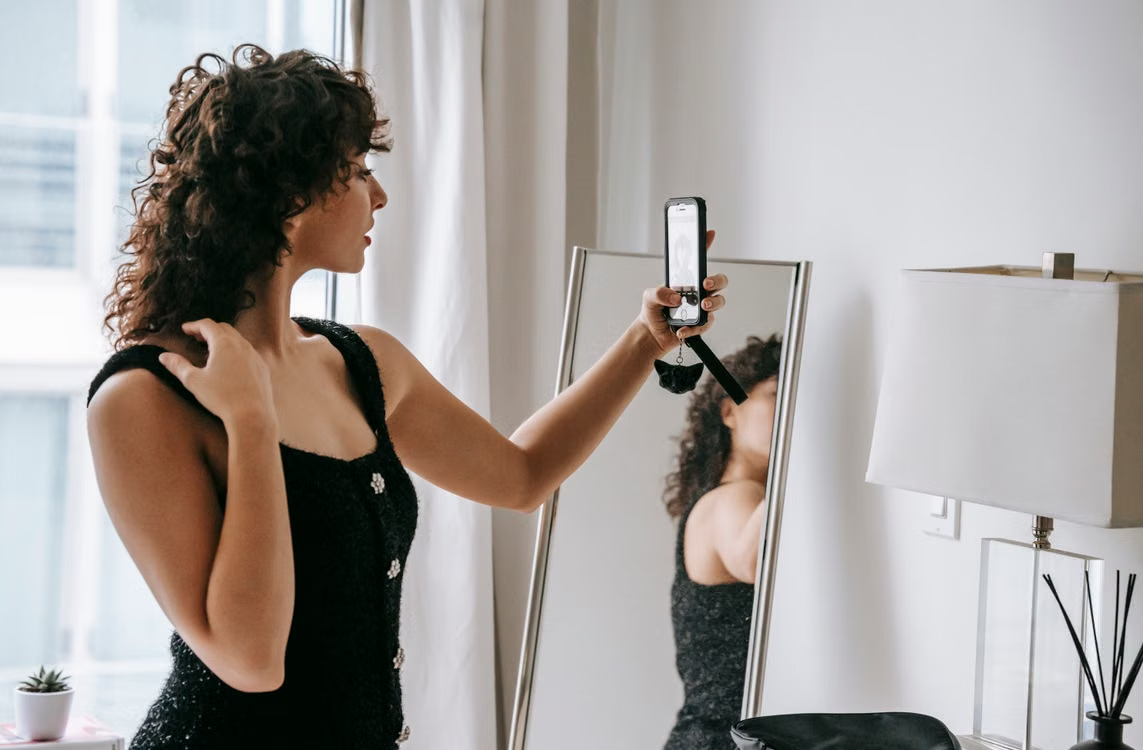
Photo: Sam Lion. Pexels.
Casual, unpolished fashion videos feel like advice from a friend. But as Australia’s consumer regulator continues to penalise businesses that conceal paid endorsements, it is worth asking whether looking “real” has become just another style.
She never says it is an ad. Propping her phone against a bedroom mirror, coffee in hand, a creator says, “Get ready with me,” pulls on a pair of wide-leg jeans and, somewhere between a story about her weekend and a complaint about the weather, mentions where they are from. There is no studio lighting, no voiceover and no slogan. Videos like this fill my For You page every day. They do not look like advertisements. Most of the time, they may not be. But when a brand is involved, that same casual style can make a promotion very hard to spot.
Whether the creator was paid is not a trivial question. In March 2026, the Australian Competition and Consumer Commission (ACCC) announced that online photo-book retailer PhotobookShop had paid penalties of $39,600. Between August 2024 and September 2025, the business told influencers on 107 occasions not to disclose that they had received free products in exchange for reviews of its photo books. This was not a fashion case. But it shows the practice regulators are concerned about across every product category: commercial content presented as independent opinion.
Fashion is where that worry is sharpest. In an earlier ACCC review of 118 influencers across platforms including Instagram and TikTok, 81 per cent had published posts raising concerns about potentially misleading advertising. Fashion was the worst of the seven sectors examined: 25 of the 26 fashion influencers reviewed, or 96 per cent, were flagged. These were concerns rather than findings of legal breach, and the sweep was partly targeted using public tip-offs, so the figures may overstate the problem. Even so, they show how hard it can be to tell a personal recommendation from a paid promotion.
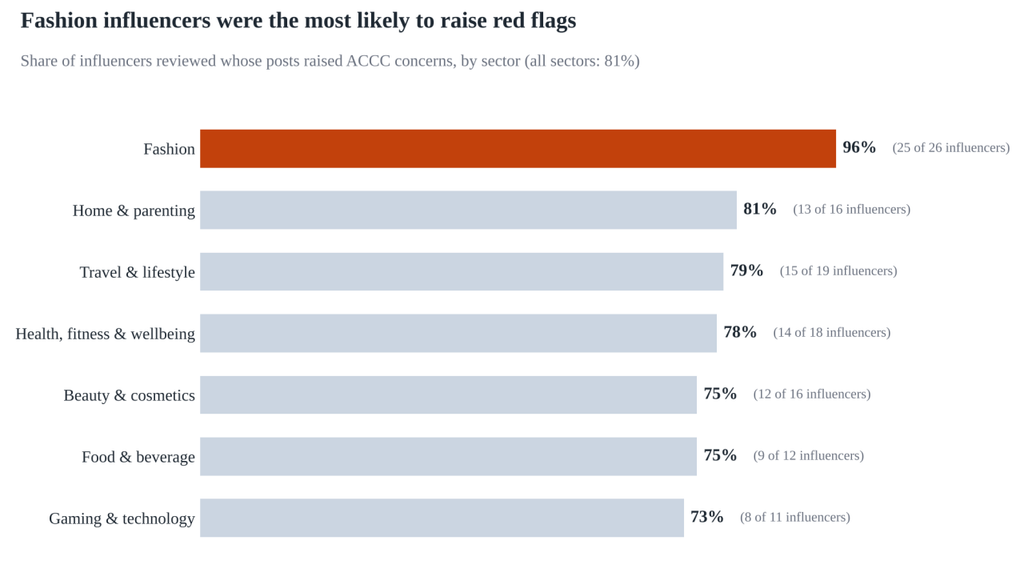
Fashion topped every other sector in the ACCC’s influencer review. Graphic: Yuxi Xu. Data: ACCC.
That is the tension at the heart of TikTok fashion content – the “get ready with me” (GRWM) videos, “outfit of the day” (OOTD) posts and try-on hauls that Australians aged 18 to 25 scroll past every day. Casual filming, relatable styling and spontaneous brand mentions make a recommendation feel authentic. But each of those cues can be performed. Looking genuine is not proof of an honest recommendation, and as a Gen Z viewer myself, I think it is time we stopped treating it as one.
TikTok has become one of the main places young people discover what to wear. Marketing agency Tinuiti’s 2024 survey found that Gen Z respondents were 16 times as likely as Baby Boomers to say they most often discover new apparel on TikTok. The figure is from an industry survey, not an Australian one, but it captures a broader shift: for many young shoppers, the fashion feed has replaced the shop window.
Why would a shaky phone video persuade anyone? Researcher Vasiliki Andonopoulos and colleagues point to perceived authenticity. In a series of experiments, they showed US participants fictitious Instagram profiles and found that people who saw an influencer as authentic reported stronger intentions to buy the products that influencer endorsed. The effect ran through two factors: the influencer’s perceived trustworthiness and their ability to inspire. There are important limits, however. The products tested were travel-related, such as hotels and suitcases, not clothing, and Instagram’s still images differ from TikTok’s fast, algorithm-driven short videos. The findings suggest a mechanism that may also operate on TikTok, but they do not prove that it does.
Research on TikTok itself offers closer, though partial, support. A 2025 study by Lacap and colleagues found that TikTok videos from local fashion brands had a significant effect on Generation Z’s purchase intentions, and that viewers’ attitudes and trust helped explain that effect. However, it examined videos posted by brands, not independent influencers, and was not conducted in Australia. Neither study settles the question alone, but together they suggest that trust links watching a video to considering a purchase.
Three cues that feel real
Watching the genre closely, three cues make a fashion video feel trustworthy:
- Informality: Videos are filmed on a phone in a bedroom, car or change room, with minimal editing. The low production value can make the video feel less like a conventional advertisement.
- Relatability: Creators mix budget pieces with expensive ones, show clothes that do not fit and comment candidly on fabric and sizing. Viewers see someone like themselves rather than a model.
- Spontaneity: Brand names come up in passing, mid-conversation, as though the creator has only just remembered where the top is from.
These cues closely resemble the ones Andonopoulos and colleagues used to make their fictional influencers seem authentic: spontaneous posts, amateur-quality photos and personal disclosure. Three recent videos show how these cues play out, and how little they reveal about whether money has changed hands.
Isabela’s three-outfit try-on haul for House of CB is clearly disclosed as an ad. Video: @isabelajuliana_
The first, from creator Isabela, is openly promotional. In a try-on haul of three dinner outfits from fashion label House of CB, the video carries TikTok’s brand-partnership label, and its caption includes #ad and #houseofcb. Yet it uses exactly the same casual cues as unsponsored content: it is filmed on a phone, delivered in a chatty tone and styled for a night out. Viewers may still feel a connection, but they know the recommendation is part of a commercial arrangement.
Meisha Carson tags several fashion brands in her caption, but the video carries no advertising label. Video: @meishacarsonn
The second, an outfit video from Meisha Carson, looks almost identical on the surface. Her caption tags the brands she is wearing, including Dissh, Henne, Kmart, Princess Polly and Nude Lucy. The difference is what is missing: there is no advertising label. The tags may simply tell followers where each piece is from. But the same tags could also appear on gifted or paid content. The point is that the viewer cannot tell.
Michelle’s de-influencing video warns viewers against Sol de Janeiro’s Jelly Perfume Balm. Video: @michellenewyen
The third, from Michelle, belongs to the “de-influencing” trend, in which creators warn followers against buying products rather than promoting them. Her video, titled “Sol De Janeiro Jelly Perfume Balm Honest Review & Longevity”, is about fragrance rather than clothing: she tells viewers the balm is not worth buying. But the trend moves freely between beauty and fashion content and relies on the same cues. Criticism feels like the ultimate proof of honesty, and research supports that intuition: in one experiment by Harff and Le, young adults in Vietnam rated an influencer’s negative review as significantly more helpful than a positive one, although the experiment found no significant difference in purchase intentions between the groups. Yet de-influencing is not always free of commerce. When the trend took off, the Associated Press reported that some de-influencers steered followers towards cheaper alternatives while earning commissions through affiliate links. Being critical can itself be a way of performing authenticity.
Marketing researcher Alice Audrezet and her colleagues offer a useful way to interpret these differences. Studying how influencers manage authenticity under commercial pressure, they identified two strategies: “passionate” authenticity, which emphasises an influencer’s genuine enthusiasm for what they share, and “transparent” authenticity, which involves being open about commercial arrangements. All three videos use cues associated with passionate authenticity. Only one, Isabela’s, is verifiably transparent. The lesson is uncomfortable: the cues viewers rely on most are also the easiest to stage.
The ACCC’s review shows how this plays out in practice. The most common problem was influencers failing to disclose their brand relationships at all; others used vague labels such as “sp” or “spon”, or formatted posts so that the disclosure was easy to miss. Announcing the findings, ACCC Acting Chair Catriona Lowe observed that influencers “often cultivate an image of themselves as being relatable and genuine”, and warned that influencers, brands and advertisers may be “taking advantage of consumers’ trust”.
“Influencers often cultivate an image of themselves as being relatable and genuine.”
— Catriona Lowe, ACCC
Australian regulators have already seen this happen in fashion. The advertising industry’s Code of Ethics states that “advertising shall be clearly distinguishable as such”. In 2022, Ad Standards upheld a complaint against activewear brand LSKD over an Instagram story in which an influencer unboxed and tried on the brand’s clothing without clearly labelling it as advertising. The brand argued the story was not an advertisement; the panel disagreed. A try-on, in other words, can be an advertisement even when it feels like a chat.
Andonopoulos’s research adds a further twist. The same study found that authenticity is not always necessary: even influencers with polished, staged profiles – the ones participants saw as inauthentic – could still inspire consumers and increase their intentions to buy hedonic products, which are bought mainly for pleasure. In the study, those products were hotels and restaurants, not clothing. But much of what appears on TikTok’s fashion feed is bought for pleasure too. If the finding holds there, a video’s aspirational appeal may sell even when viewers do not fully believe the person behind it. That should make us more cautious, not less, about treating a casual tone as a guarantee of honesty.
None of this means that every casual recommendation is a disguised advertisement. Plenty of creators genuinely love the clothes they wear and say so without being paid. The problem is that tone alone cannot separate these cases. Only disclosure labels and verifiable evidence can tell viewers which is which.
Trust, but check
Informality, relatability and spontaneity help explain why Gen Z trusts TikTok fashion creators, and that trust shapes what many of us buy. But these cues are signals of style, not proof of honesty. Because they are cheap to produce, they are also easy to imitate. The responsibility to disclose sits with creators and brands, but until disclosure is consistent, viewers need habits of their own.
Before acting on a fashion recommendation, it is worth running a quick check:
- Look for a clear “#ad” or a paid-partnership label. TikTok offers creators a built-in disclosure setting for branded content.
- Treat discount codes and affiliate links as signs of a commercial relationship.
- Check the caption and the creator’s bio for brand partnerships.
- Notice whether the creator mentions any downsides, such as sizing, quality or price.
The next time a GRWM video ends with a brand name, look past the vibe and check the disclosure.
 Tyler James
 Charlie
 Jez Murdock