
A Formula 1 race has a finish line. Formula 1 content apparently does not. On Sunday, a fan might spend two hours watching strategy unfold at 300 kilometres per hour. On Monday, the same race becomes a thirty-second highlight, a driver interview, a radio-message meme and an argument in the comments. By Thursday, the internet has already found its next storyline.
This is the Formula 1 that millions now follow: not just a championship with occasional broadcasts, but a media product that keeps talking between races. The change is visible in the numbers. F1’s 2026 half-year review reports more than 125 million social-media followers and a 54% year-on-year rise in video views. Its estimated global fanbase exceeds 830 million, with 43% under 35. Those are the sport’s own estimates, not a count of people watching every Grand Prix. Still, they reveal where F1 sees its future: screens of every size, all week long.
When the race used to be the main event
For a traditional television audience, F1 followed a timetable. Practice built anticipation, qualifying established the starting order, and Sunday’s broadcast delivered the result. Newspapers, specialist magazines and later websites filled the gaps, but the race remained the centre of the experience. A fan could be deeply committed without seeing a driver speak outside a press conference.
The difference today is not that racing has stopped mattering. It is that the gaps have been filled. F1’s official YouTube channel packages highlights, explainers and behind-the-scenes moments; its TikTok account offers short clips built for instant recognition; and Instagram turns drivers, teams and race weekends into shareable visual stories. A viewer who misses the live race can still encounter its characters and controversies repeatedly.
The new timetable is effectively permanent. And that changes the first question F1 asks. Instead of only asking how to attract someone to the next broadcast, it must also ask what that person might want to watch today.
Netflix made the drivers into characters
The most obvious turning point is Netflix’s *Formula 1: Drive to Survive*, first released in 2019. Its appeal is easy to understand. A newcomer may know nothing about tyre compounds or aerodynamic upgrades, but they can understand ambition, rivalry, disappointment and a team fighting to survive. The series gives the sporting results a cast of characters. Its eighth season, released in February 2026, continues that approach.
This is more than a marketing assumption. In their study of narrative storytelling, Caroline Soble and Mark Lowes identify adventure, rivalry, sacrifice and heroic figures as key ways the series builds emotional connections. Another study by Dhwanil Shah and Anthony Lamont Williams, based on interviews with twelve viewers, found that participants described learning about F1, developing social connections and responding to the documentary’s dramatization. It is useful evidence of *how* conversion can happen, rather than proof that Netflix alone caused F1’s worldwide growth.
The show offers something a traditional race broadcast cannot easily provide: a reason to care about a midfield driver before learning where they finished. Once viewers recognise the people in the helmets, the actual race carries more emotional weight. Storytelling becomes an entrance, not necessarily a replacement for sport.
WATCH: Netflix’s official Drive to Survive Season 8 trailer (YouTube)
The algorithm can find a fan before the fan finds F1
Netflix supplies long-form drama; social platforms keep the conversation moving in small pieces. TikTok makes a funny team-radio clip understandable without a two-hour race. YouTube can turn a confusing penalty into a short explanation. Instagram allows a driver’s personality, clothing or travel photos to circulate far beyond motorsport followers. Each platform edits F1 into a different kind of entertainment.
That matters because distribution is no longer limited to people deliberately searching for racing. In *Writing for Algorithmic Audiences*, John R. Gallagher argues that online writers must consider algorithms as a kind of audience. Platforms use signals such as viewing and interaction to decide what to surface. A person may discover F1 through a recommended clip, not a sporting decision to follow the championship.
But visibility has a cost. A short clip may capture the emotion of a controversy without the race context that explains it. Recommendation systems also reward repeat engagement, so the most dramatic personalities or arguments can travel further than a careful technical analysis. The platform-friendly version of F1 is often quicker, louder and easier to share. It does not always tell the fullest story.
Old fans versus new fans? The numbers tell a more interesting story
It is tempting to divide the audience into two camps: traditional fans who care about racing and younger fans who care about Netflix personalities. That makes an easy online argument, but it misses how fandom actually works. Someone may discover a driver through a meme, then begin watching qualifying, learning race strategy and eventually planning a Grand Prix visit. Another fan may have watched for decades and still enjoy a good behind-the-scenes video.
The 2025 Global F1 Fan Survey is revealing here. Among respondents, 39% identified friends or family as their introduction to the sport, compared with 24% for television, 12% for social media and 10% for *Drive to Survive*. Another 12% cited interest in drivers. These are not percentages of the entire worldwide audience: more than 100,000 self-identified, highly engaged fans volunteered to respond. That limitation matters when industry research is used to describe millions of people who never took part.
The same survey found 61% of participants engaged with F1 content daily, while 90% said they were emotionally invested in race results. That pairing undermines the idea that digital fans are somehow less authentic. Their entry points may differ, but interest in the competition remains powerful. The collision between old and new platforms has produced overlapping habits, not simply two competing fan bases.
In fact, the combination may explain why F1’s media strategy works. A Netflix episode provides context, a social clip keeps the name familiar, and a live Grand Prix supplies the unscripted ending nobody can guarantee.
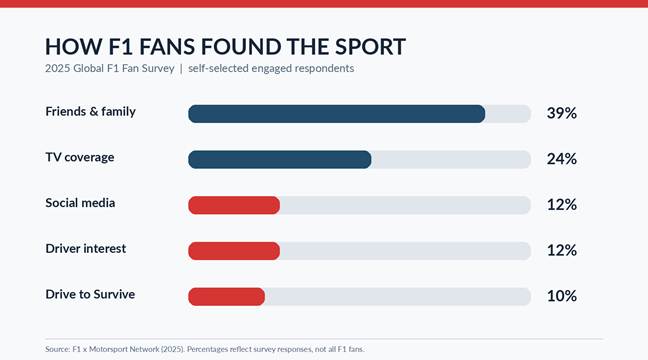
Where surveyed fans first discovered F1 (2025). Opt-in respondents; results are not population estimates. Source: Formula 1 x Motorsport Network.
A driver is now an athlete and a media personality
The shift is also happening inside the paddock. Success still comes from speed, consistency and engineering. Yet visibility increasingly shapes which people the public recognises, which stories circulate and which relationships fans feel they have with drivers. That recognition can matter to teams, sponsors and the championship’s wider image.
Researchers Desiree J. Campbell and Leon Davis describe *Drive to Survive* as changing the distribution of ‘symbolic capital’ in F1: media attention can increase a driver’s public importance, not merely report their race performance. Their analysis also raises a less comfortable question. A driver who is expected to appear emotionally open, constantly available and entertaining performs a kind of media labour alongside the job of racing. Not everybody has the same freedom to participate or refuse.
The business side is becoming equally visible. In 2026, Apple TV became F1’s exclusive live broadcaster in the United States, integrating the sport with a much wider technology and entertainment ecosystem. This is not just another television contract; it shows why digital distribution and ongoing engagement are valuable to the people selling access to F1.
Still, ‘more platforms’ should not automatically be translated as ‘more viewers’. In July, *Axios* reported that limited public viewership data made the early performance of the Apple deal difficult to judge independently. The companies may see substantial long-term opportunity, but outsiders need evidence to measure it.
When storytelling outruns the truth
There is one risk to treating every race weekend as material for the next compelling episode: reality can become less exciting than the version producers want to sell. In 2025, Lando Norris criticised *Drive to Survive* for the way it portrayed his rivalry with Max Verstappen. The dispute involved footage that gave viewers a misleading impression of Verstappen’s reaction to a race result. The production company defended its storytelling and acknowledged an error.
That controversy is important because F1 sells access as well as excitement. If behind-the-scenes media feels constructed, fans may begin questioning whether the personalities they follow are real or edited for maximum drama. Sports documentaries are selective by nature, but selecting a story and inventing tension are not the same thing.
There is also a difference between attention and understanding. Views, likes and clips tell F1 that people have noticed something; they do not tell us whether viewers understand the regulations, respect the sport or will still watch in five years. The most successful media strategy may be the one that turns curiosity into lasting interest without sacrificing trust.
The chequered flag is no longer the end
The important change is not that Formula 1 has abandoned racing for entertainment. It is that the race now sits inside a larger experience: streaming series introduce the characters, algorithms distribute their stories, social platforms sustain the conversation and live broadcasts settle the sporting argument.
There is room for both the fan who studies lap times and the fan who first clicked on a driver interview. What matters is whether F1 can welcome the second without dismissing the first, and whether it can keep the excitement without distorting the truth.
A Grand Prix ends when the flag falls. In the modern media economy, Formula 1 is already preparing the next episode.
 Tyler James
 Yuxi Xu
 Jez Murdock