

Social media platforms have become a hub for true crime lovers to investigate and engage with both solved and unsolved cases in recent years. Highly participatory, many platforms enable the rapid consumption of media and the rapid publication of content.
Social media can bring high visibility to cases, like Gabby Petito’s, and sometimes, when applying the correct methods and tools, social media users have even solved cold cases.
But are we really taking “I saw it on TikTok” as a credential for being a detective now?
One case TikTokers have taken to meticulously following, with summary videos of each day’s events, is the Lindsay Clancy trial. Being televised, the legal process is transparent and held accountable by the public. The only problem is many TikTokers have taken this accessibility too far, posting theories amongst their own opinions, turning public discussion into a public investigation.
One journalist termed this the ‘Tiktok Jury,’ sharing her experience of dinner with friends when “Lindsay Clancy came up and, within about 30 seconds, everyone at the table became a criminal lawyer.”
So, why are random people on the internet staying up all night untangling inconsistencies in timelines, body temperatures, and the impossibility of infant resuscitation with zero experience or authority besides a wi-fi signal and a ring light?
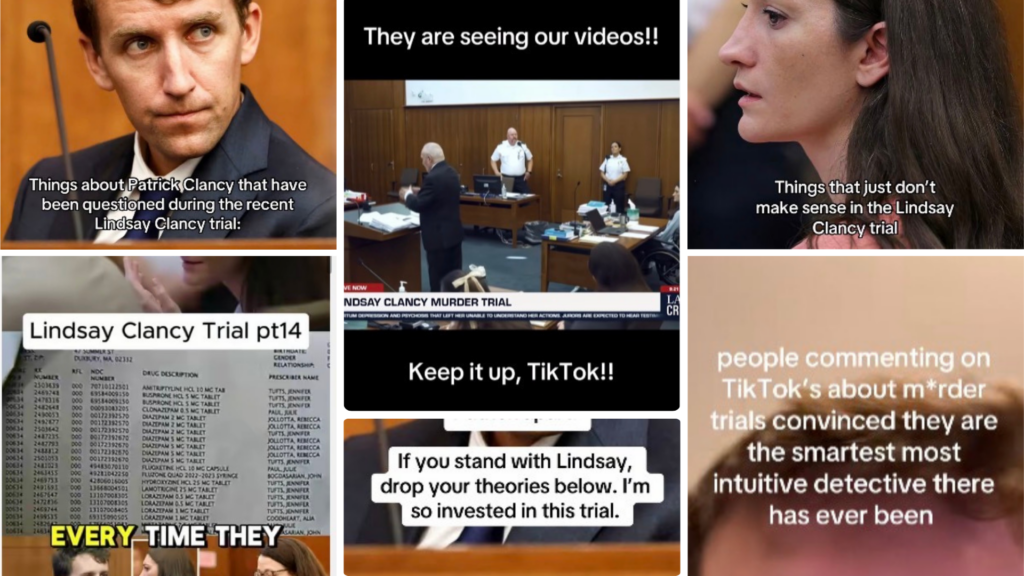
When I initially heard of the case, the information I received was this: Lindsay Clancy is on criminal trial for killing her children in the context of postpartum psychosis despite repeatedly seeking help. There was no doubt in my mind about the nature of the crime, nor the trial. However, after TikTok videos found their way onto my For You page, the story became: “It was the husband. The facts don’t add up,” and I was reeled in, wondering if this trial would uncover the husband, Patrick, to be a villain.
What TikToks like this fail to mention is that the question in Lindsay’s trial is not “who really did it?” but “can she be held responsible for her actions?”
TikTok has perhaps too much control over how we perceive a narrative and, clearly, supports conspiracy, the spread of misinformation, and false accusations rather than truth in a ‘trial by social media.’
Utah Law Review (ULR) commented: “Platforms like TikTok have become popular sites for true crime content, allowing online detectives to spin their own narratives…often with little regard for the truth.”
ULR explains that this behaviour undermines the legal system and harasses witnesses, victims’ families, and innocent people. Similarly, independent and unbiased jurors may struggle to escape the For You page and consider evidence out of context, leading their verdicts to be unfairly influenced.
TikTok is designed for this rabbit-holing by rewarding the most compelling videos, rather than the most accurate, with virality. Who wants to watch the eight-hour TV coverage of a trial when the fourteen-part series and three-minute clickbait opinions are so short and accessible?
TikTokers almost successfully completed a fourth wall break when debate took place over whether viral Emily Thorndike would testify in Lindsay’s trial. Thorndike had posted a video challenging a prosecution nurse’s account of the quality of Lindsay’s treatment at a hospital they had both worked at, despite having left a year prior to Lindsay’s stay.
The judge responded: “This is not TripAdvisor.”
Close call. As it turns out, opinions aren’t facts. Too bad there isn’t a regulatory body overseeing TikTok detectives.
 Debbie Choo
 Bethany Miguel
 Tarkyn Sharples