
By Isabella Molina
Think of a time you bought clothes online, what was the process? You scrolled through hundreds of options, maybe filtered them to match your preferences, picked the most appealing one based on the picture and description, then purchased it hoping it would fit you properly or look good on you. If you replaced the clothing with people, you’ve got yourself a dating app.
Modern dating has transitioned from finding real meaningful connections to searching for someone better with just one swipe. Dating apps have made first impressions everything, with carefully curated photos and short bios advertising themselves to a potential partner. It’s hard to get to know someone properly when you’re judged within seconds based on appearance and how you market yourself online. People are treated as products on this app, constantly competing for attention in a website full of options.
When people have too many options, they become more selective. Pronk and Denissen (2019) held a study and found that with more profiles people viewed, the higher the chances of rejecting a potential partner got. They found that there was a 27% drop in people accepting a partner as they continue to swipe on the app. This creates a “rejection mind-set” when there are too many options and choosing someone becomes more difficult and selective.
https://doi.org/10.1177/194855061986618
Not only do these apps make people more selective and less likely to find a potential partner but it affects people’s confidence and enhances the fear of being single as found in Thomas et al. (2022) research as there is a “partner choice overload.” They also discussed that these apps benefit from users browsing rather than finding a connection and deleting the app. This shows that these apps were designed for scrolling not for finding connections.
https://doi.org/10.1016/j.chb.2021.106977.
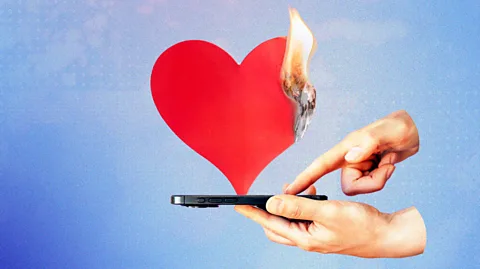
There’s no doubt that real relationships can come out from these apps, people can find genuine connections online. The issue is that these apps are designed to allow users to continue swiping and shopping through options instead of finding the right person. Each swipe reminds the user that there may be someone better with a simple scroll and encourages people to never settle.
Love isn’t impossible to find on these apps, but when thousands of people are choosing based on looks first, comparing options and having easy access to “something better,” it makes finding real connections and relationships difficult to find.
 Joleen Jublee
  Jamez
Jamez  Scarlett Johnstone