
“Run, don’t stop.” This is the most intuitive feeling of watching the 2025 new version of The Running Man directed by Edgar Wright. It will be released in theatres on November 7, 2025, and is currently playing on Amazon Prime Video. In the 133-minute film, Ben Richards, played by Glen Powell, never stopped. He fled from the abandoned hotel to the street, and then ran from the street to the plane, rushing all the way to the final ending.
But when the film came to an end, I asked myself: what do I remember? The answer surprised me a little. There are only two things I can clearly recall: the warmth between Ben and his wife and daughter at the beginning, and the reversal at the end. As for the nearly two hours of running, chasing, fighting and running away… They have become a vague shadow in my memory. I just finished watching it, but it seems that I haven’t seen anything.
This has become the most ironic paradox of the film: a work that should have criticized “our fast-paced entertainment culture” is trapped in its own fast pace.

Paul Hendriks Vettehen and Gabi Schaap (2023), in An attention economic perspective on the future of the information age , introduce a disturbing concept: the spiral of lack of attention. The more information floods the market, the fiercer the competition for attention. In order not to be overwhelmed, content producers can only make the work faster, more and more exciting. The audience’s attention became more and more scattered and shallow. Therefore, the next round of competition needs a faster pace and more intense stimulation. The cycle goes back and forth, and the spiral keeps rising.
The setting of “30-day survival” in the original work has become a shackle for the film when moved to the screen. The plot in the middle of the film is tedious. The protagonist tosses and turns in various scenes, and the allies he meets take turns to appear and leave in a hurry.
The problem of characterization in this film is far more than the thin writing of the script, but also the structural consequences of the rhythm. In order to maintain the continuous narrative tension, the film has almost no space for emotional and psychological portrayal. The characters appear on the stage, complete the task, and then leave. They serve the plot, not exist as complete and three-dimensional people.
Even the protagonist’s original motivation to protect his family is more like a functional narrative setting than a real and sensible emotional support. His wife and daughter were basically absent after the opening. Without continuous emotional landing, it was difficult for the audience to establish a real and deep empathetic connection with the protagonist.

From this point of view, the film not only creates flat characters, but also takes the initiative to flatten them. The pursuit of speed compresses the success of personality. In the continuous action scenes, fresh individuals are simplified into parts that can be replaced at any time.
What’s more ironic is that the most three-dimensional character in the film is the villain. The host is pompous, the producer is cold-blooded but persistent, and even the masked hunter hides complicated emotions. However, the protagonist Ben does not have any distinctive personality characteristics except for the standard characteristics of heroes such as anger and wanting to save his family. The actor’s performance is also bland and boring. The protagonist’s sense of existence is completely crushed by the villain, and the theme that the film wants to express is also gradually deviating.
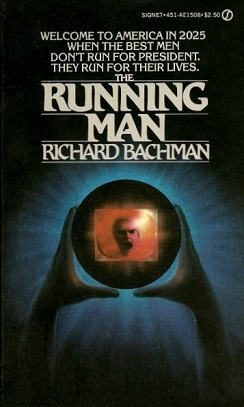
The film is adapted from a 1982 novel. The original story’s review of authoritarian rule, media manipulation, and the gap between the rich and the poor should be of great practical significance in 2025. However, the adaptation of the film weakens this sharp criticism. It seems to criticise the attention economy, but in fact, it has become such content.
As scholar Jenny Odell (2019) argues, in the era of information overload, we are losing the ability to truly understand and empathise. She calls the phenomenon “context collapse”.The Running Man pursues a fast pace throughout the whole process, making the character become an empty body. The emotion is cut off and the theme is diluted. It wants to criticise the attention economy with a chase scene, but in the end, it ends in failure.
But the film is not worthless. It is like a mirror, reflecting the pain point of current content consumption: we always pursue faster and more intense sensory stimulation, but it is difficult to really feel the core of the work with our hearts. Sometimes, real thinking and resonance never rely on non-stop running, but on the willingness to stop and calm down to see more.
I don’t need a movie that never stops running. I need one that makes me want to stop — to think, to cry, and then to move forward with something real. Please give me back that kind of movie.
——–Yuan
 Shoujie Wang
  Yinan Zhou
  SUN Yinchen