

The Clicks That fuel Division
The internet has turned anger into a spectator sport. Influencers bait the crowd, algorithms sell the tickets, and we’re the ones paying at the gate.
Scroll for more than a few minutes on TikTok, Instagram, Facebook, or X and you’ll probably find it — a video crafted not to entertain or inform, but to provoke. The creator deliberately says something shocking, flaunts something extreme, or sparks an argument just to reel in views and engagement. A luxury “haul” dripping in wastefulness, a smug political hot-take, or a staged couple’s fight – and you can feel your jaw tighten before you’ve even scrolled to the next clip. It’s irritating, it’s manipulative, but it works. You’re already engaged. And you might even comment, duet, or share it, evening lingering on the post for a few extra seconds is training the algorithm to give you more of this ‘genre’ of content. Outrage is the business model.
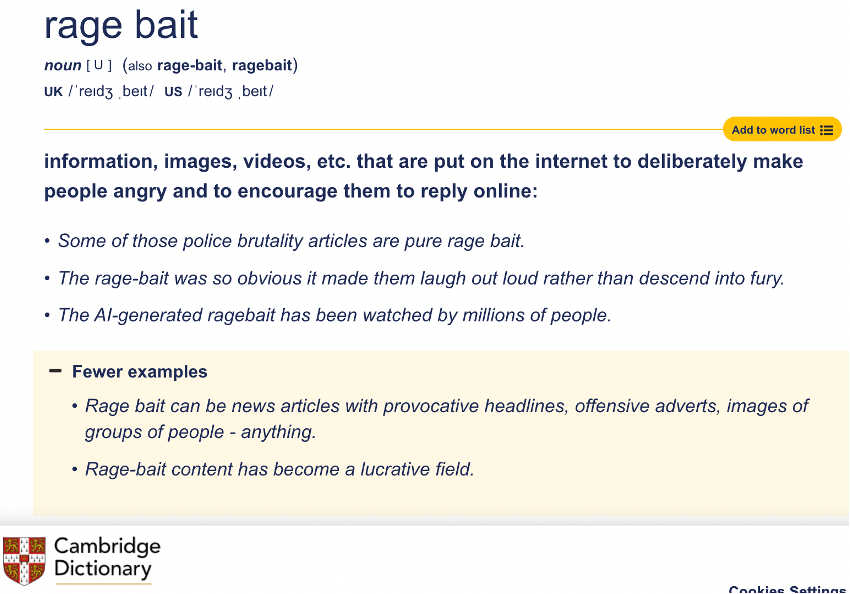
This phenomenon, known as ragebaiting (or rage bait/rage-farming), is quickly becoming one of the defining currencies in the attention economy. Where algorithms reward whatever keeps users scrolling and rage is high-yield fuel. As ABC News reports, “attention is the primary currency of social media.” Platforms like TikTok, Instagram and YouTube are engineered systems where the loudest, most outrageous, and most emotionally charged content gets elevated because it keeps users hooked to amplify whatever triggers emotional reactions. Creators armed with this knowledge across platforms have learned to exploit that system with surgical precision to the most profit to them.

At first glance, ragebait might seem trivial just another internet annoyance, like spam or clickbait headlines. But dig deeper and its impact is far more insidious. Research shows anger-laden content spreads faster than almost anything else online. This makes ragebait not just an irritant but a mechanism for amplifying misinformation, pushing extreme views into the mainstream, and fracturing public discourse. In some cases, it becomes a deliberate political tool. Political/ideological influencers like Charlie Kirk and Andrew Tate had built entire digital empires on outrage, embedding misogynistic and authoritarian ideas into algorithm-driven feeds.
Ragebait doesn’t just annoy us. It profits from us, while reshaping culture, politics, and even our mental health. Whether through grotesque consumerism, staged conflict, or overtly controversial political hot takes, ragebait exploits human psychology, turning anger into profit, and civic discourse into collateral damage. As psychologist Sara Quinn warns, repeated exposure to outrage content can fuel alienation and depression, leaving people disconnected and exhausted. Ragebait thrives on this cycle, exploiting division and turning it into profit.
Ragebaiting can be unpacked into five parts: the types of content that fits into the genre of ragebait, why algorithms fuel it, how it can polarise politics and culture, the role of misinformation, and the very real human cost.
What Counts as Ragebait? Content Types and Tactics
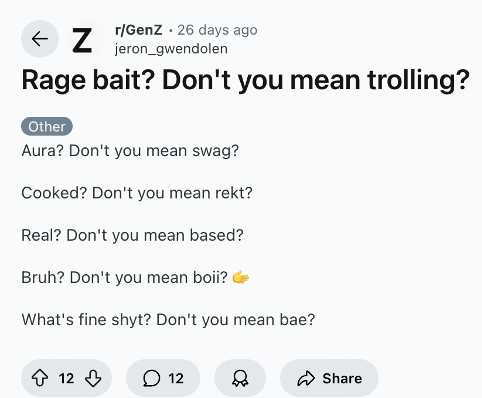
“Old people called it pushing buttons, our parents called it pranks, millennials called it trolling, Alpha calls it ragebaiting” (Reddit, 2025). But what began as trolling has evolved into a sophisticated genre on digital and social media platforms designed to monetise outrage.
YouTuber Cheets created a video ‘educating’ other digital media users, by creating a “masterclass in being blatantly, violently, disrespectfully wrong” because the internet doesn’t reward truth, it rewards audacity. His guide to ragebait follows steps: be loud, pick fights with people who can’t resist correcting you, never break character, and monetise from the madness. It’s a playbook many creators adopted and even more can now follow.
Ragebait Formats:
- Personas & Skits: Scripted videos of “weaponised incompetence” or contrived ignorance; a man who “doesn’t know how to do laundry,” a woman faking a clueless opinion about politics. Viewers pile on, generating engagement.
- Grotesque Consumerism: Over-consumption content: luxury hauls, mukbang excess, or “toilet cooking” (yes, literally mixing food in a toilet bowl for shock value, complete and blatant waste of food?!). These clips thrive on disgust, spectacle and moral outrage.
- Fake Drama: Staged couple fights, birthday dinner blowups, cheating scandals or a gender-reveal disappointment. Even after being exposed as fake, audiences in the comments of these videos still debate the etiquette or morality as if these were real scenarios.
- Political Bait: Hot takes on feminism, civil rights, climate, or immigration. U.S. influencer Charlie Kirk, for example, had built an empire on outrage. Ranging from comparing abortion rates to the Holocaust (“It’s worse. It’s worse!… It’s 45 million babies” and “What’s the moral difference between a small baby in the womb and a grown Jew who is killed at Auschwitz?) and calling the Civil Rights Act a “huge mistake.” He even argued that “some gun deaths every single year” were worth it to protect the Second Amendment. Each clip was designed for maximum virality… though one can only hope his ignorance was tactical, not accidental.
- Misinformation & Conspiracies: Ragebait thrives on lies. From vaccine myths to climate denial or flat Earth theories, content spreads through shock and fear, reinforced in algorithmic echo chambers.
A deep dive by Toni Bryanne TV shows how creators engineer outrage with filthy house cleaning videos, fake pranks, staged baby mama dramas, “toilet punch” cooking, and absurd “life hacks.” Whether it’s disgust, anger, or mockery, it all fuels the same engine.
Even “joybait,” the cheerful cousin of ragebait, runs on the same formula: emotional manipulation for engagement. Creators profit from surprising people, often without telling them they’re being filmed, and cash in on those raw, authentic reactions. Rage just happens to travel faster – thanks to the platforms’ algorithms.
Algorithms and Profit: Why Rage Pays
Platforms like TikTok and Instagram are built on a simple logic: more attention = more revenue. Every click, like, or share boosts a post’s reach, ensuring ads are seen by more eyeballs. Negative stimuli, particularly moral outrage, are especially sticky. A study by Princeton University showed that anger-laden content spreads significantly faster across networks than neutral or positive posts.
Dr. Teodor Mitew explains, “attention is the primary currency of social media.” Algorithms don’t distinguish between truth and toxicity. They amplify whatever drives engagement, and outrage is simply good business.
For creators, the incentive is clear. TikTok’s Creator Fund, YouTube’s AdSense, brand sponsorships, and paid subscriptions all reward reach. Content like Bonnie Blue’s deliberately provocative OnlyFans marketing/clipfarming proves the formula: “the more women complain about her at the dinner table, the more likely their husbands are to subscribe.” Outrage = attention = profit.
For platforms, it’s a self-feeding loop – algorithms drive engagement, engagement drives profit, and outrage is the cheapest fuel powering the attention economy.

Polarisation and the Normalisation of Harmful Rhetoric
The danger of ragebait isn’t just annoyance it’s: desensitisation and radicalisation. Constant exposure to outrage dulls public sensitivity while pushing extremist rhetoric into the mainstream.
The Pew Research Center found that 1 in 5 Americans get their news from political influencers, and 65% say those influencers have shaped their opinions. A PNAS Nexus study shows liberals share a broader and more toxic range of elite political messages than conservatives, producing fragmented “information bubbles.”
Psychologist Sara Quinn notes, repeated exposure leads to “alienation or loneliness, feeling disconnected from others.” Similarly, a study from University of Warsaw, Poland found that exposure to hate speech increases prejudice through desensitisation.
The effect is visible in everyday life. My own 23-year-old brother has adopted extreme American right-wing beliefs fed to him by Instagram reels and YouTube/podcasts. Family debates once grounded in shared values have fractured into ideological clashes imported from U.S. culture wars. This is ragebait’s global reach in microcosm.
Andrew Tate provides another case study. As Roberts et al. (2025) show, Tate’s videos thrive on shock-value snippets. But beneath his “banal” self-improvement content lies a scaffolding of misogyny. His notoriety is a textbook example of how outrage-laden content normalises toxic ideologies and is shared and reproduced by clip farming short form video platforms facilitating the spread of this content.
Ragebait, Misinformation, and Political Manipulation
Ragebait doesn’t just shape culture; it manipulates politics. Dr. Copland explains that anger-inducing posts can “change people’s perceptions” even when “based in lies.”
Charlie Kirk’s influence exemplified this globally. His Turning Point USA platform churns out clips declaring empathy is “a made up new age term that does a lot of damage” or arguing against civil rights protections. These soundbites bypass nuance and weaponise emotion, spreading outrage instead of informed debate.
Meanwhile, young people are opting out of political speech altogether. A 2025 study from the University of Minnesota Morris, USA shows that emerging adults avoid posting strong political opinions for fear of backlash, creating a “spiral of silence.” The vacuum leaves louder, more extreme voices to dominate.
Here, ragebait becomes more than entertainment it’s a tool of political manipulation, subtly reshaping public opinion, civic engagement and even electoral behaviour through the economics of anger.
The Human Impact: Burnout, Division, and Exploitation
The cultural cost of ragebait is measured not only by polarisation but also in its impact on mental health.
Dr. Quinn links repeated exposure to depression, hopelessness, and alienation. Psychologists at Australian Psychological Society warn that “rage bait content is everywhere … it still manages to anger or upset us.” The constant negativity leads to doomscrolling, burnout, and disengagement.
Creators themselves sometimes exploit this. By using calculated ragebaiting as a marketing strategy. The Spectator framed it as a “business model built on resentment.” Others, like family vloggers staging conflicts or filthy living conditions, exploit and actively harm children and pets for engagement.
Disparagement humour also plays a role. As The Conversation noted, jokes framed as “just humour” allow hostility toward marginalised groups to circulate unchecked. “Humorous hate speech” has been found to normalise dehumanisation under the guise of entertainment. For younger, impressionable audiences, irony becomes a Trojan horse for ideology – until the joke hardens into a worldview.
Ragebait thrives on the exploitation of anger, attention, identity politics, and often of vulnerable people themselves.
Counterarguments: Neutral Tools, or Dangerous Amplifiers?
Some argue that ragebait is simply a reflection of existing social divides. Social media, in this view, is a neutral tool, the content mirrors cultural conflict rather than creates it. Others point to the rise of “joybait” as proof that positive content can thrive too from this same model.
But the evidence suggests otherwise. Algorithms are not neutral. By rewarding the most inflammatory content, they amplify outrage disproportionately. Joybait may exist, but ragebait pays better.
Conclusion: Breaking the Cycle
Ragebait is not just a nuisance clogging our feeds. It’s a structural feature of digital capitalism, engineered by algorithms, exploited by influencers, and paid for with our attention. The result is political polarisation, cultural toxicity, and widespread burnout.
As long as outrage is profitable, the cycle will continue. Breaking it requires three interventions:
- Regulation and Transparency: Platforms must disclose algorithmic biases and limit amplification of harmful content.
- Digital Literacy: Users need the tools to recognise and resist ragebait, from fact-checking to resisting the urge to comment.
- Cultural Shifts: Audiences must learn that withholding attention is the only way to starve the rage economy.
Until then, the “rage-to-hate pipeline” will radicalise audiences, destabilise civic dialogue, and keep turning anger into profit. The cost of outrage is one we all pay.
 TianYuran
  Lu Yunyan
  Pauleen