
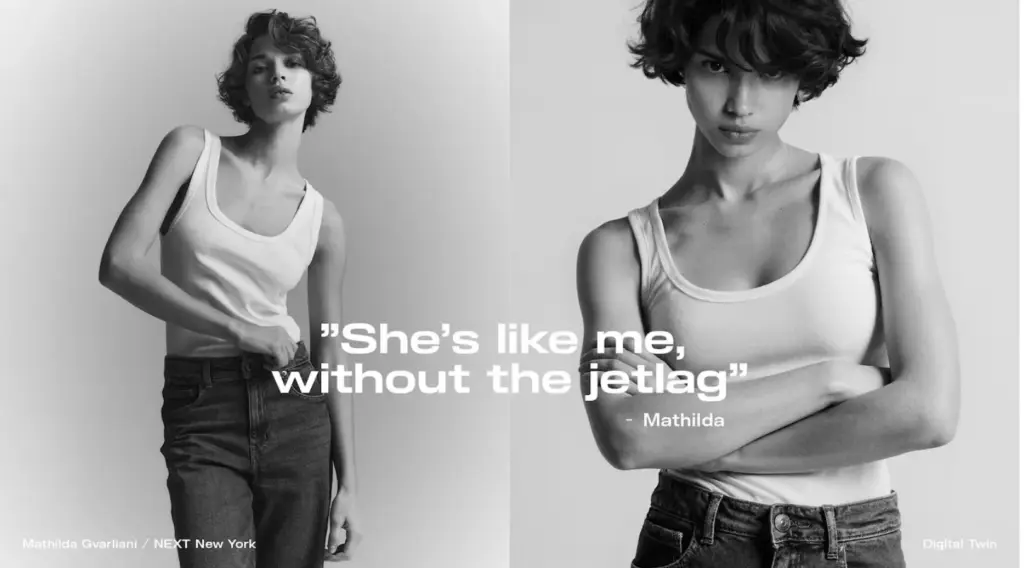
H&M says its AI digital twins can open new creative possibilities without removing people from the process. The models involved own their digital copies and are paid when those copies are used. This sounds fairer than replacing real models with completely invented ones, but it does not settle the issue. Customers still need to know when they are looking at an AI image and the people who normally work on fashion shoots need more than a promise that they will remain involved.
Scroll past one of H&M denim advertisements and nothing may seem unusual. The model has a familiar face, the clothes look natural and the city behind her is polished enough for any fashion campaign. However, the person in the image may never have stood in that location or worn those clothes in front of a camera. The image may show an AI copy of a real model.
This is what H&M means by digital twin. It is not a fictional model created from noting. It is a digital version of a real person, made with their permission and based on her appearance. H&M announced plans to create digital twins of 30 models in March 2025. In July, the company released its first campaign using the technology. The campaign has created a difficult debate for the fashion industry. H&M presents AI as another tool for creative work. Critics are more concerned about what it could mean for jobs, customer trust and control over a person’s image. H&M has made a positive start by promising consent, ownership and payment for its models. However, the campaign should not be judged only by how realistic the images look. It should also be judged by how honestly the company informs customers and whether the wider creative team continues to receive proper paid work.
A real model and her digital copy
H&Mʼs first digital twin campaign showed AI version of models in backgrounds inspired by major fashion cities. The image advertised denim and were released with a video showing how the campaign was made. In its official announcement, H&M said a dedicated creative team worked on the campaign. The company described AI as a way to support creativity and find new ways of presenting fashion.
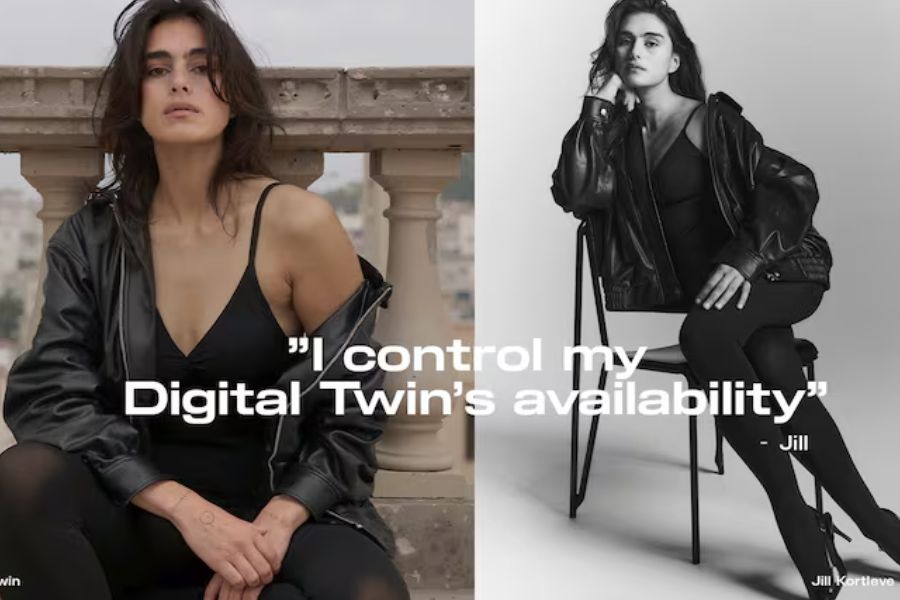
Model Vanessa Moody described her experience as professional and transparent. According to FashionUnited, H&M said the real models would own their digital twins and be paid whenever the images were used. This is a different from creating an artificial model who has no real person behind her and does not need to be paid. There are clear benefits for a model who chooses to take part. Her digital twin could work while she is travelling, completing another job or taking away time from physical shoots. H&M chief creative officer Jorgen Andersson compared this idea to musician earning money from online streams while performing somewhere else. For an established model, this could offer another source of income without requiring constant flights, fittings and long days on set.
H&M approach is also better than using someoneʼs appearance without permission. A model face and body are connected to her identity and career. If a company can copy her appearance, change it and use it many times, consent cannot be treated as permission that lasts forever. The model should know where her digital twin will appear, how it can be changed and how long each agreement will last. She should also be able to reject uses that she did not originally approve. Saying that the model owns the digital twin sounds reassuring, but the arrangement must also be clear in practice. The model may legally own it while a brand, agency or technology company stores the files and manages the production process. This raises several questions. Who can access the files? Can another company use them? Can the model withdraw permission later? These details matter because a digital copy can be altered and reused more easily than an ordinary photograph.
Payment should also reflect how the image is used. A single Instagram post is not the same as an international campaign that appears for several months. If the image is altered and used again, the model should be informed and receive another payment. Otherwise, the company could continue profiting from her appearance while she loses control over where it appears. Paying models whenever their twins are booked creates a positive standard for other brands to follow. However, fair treatment should also include approval for new uses, clear limits and the right to see how an image has been changed. Without these protections, a model could gradually lose control of her digital copy.
The people outside the frame
The model is only one person involved in producing a fashion image. A traditional campaign may employ photographers, assistants, stylists, makeup artists, hair professionals, lighting technicians, set designers and production staff. Most never appear in the finished advertisement, which makes their work easy to overlook. AI raises serious question for them. How many of these jobs will remain if brands can create new images from existing digital material? This concern emerged when H&M first announced its plans. The Guardian reported that the creative industries union Bectu warned about the possible effects on workers in hair, makeup, lighting and other roles. A survey cited in the report found that 54 per cent of Bectu workers believed AI would negatively affect the fashion industry. The article also explained that newer models and workers who reply on regular online store shoots may face greater risk than established models represented by powerful agencies
H&M argues that people remain central to its process. In a FashionUnited interview, Andersson said photographers, stylists and hair and makeup professionals continue to be involved. Human creatives still shape the final image, while an AI artist gives instructions to the technology. However, their involvement does not address the wider concern by itself. What matters is whether these workers continue to be hired, paid fairly and given the freedom to make creative decisions. AI could help creative teams explore ideas that would be difficult or expensive to produce on a traditional set. It may also create roles for AI artists and people who understand both fashion and technology. However, these positions may not replace all the work that disappears. If one small team can produce dozens of campaign images, a company may decide that it no longer needs as many physical shoots. The effect on employment will therefore depend on the choices made by brands, not only one the technology itself.
H&Mʼs use of AI did not end with the 2025 digital twin campaign. In September 2026, the company worked with photographer Nick Knight and SNOWstudio on an interactive display at London Fashion Week. AI was used to transform studio photographs of real models and original illustrations into moving images. People at the show could influence the visuals through their movements. Knight said the technology did not replace anyone and that the project required a larger team than usual. This supports H&M claims that AI can work alongside human creativity. However, one major fashion show does not prove that every future campaign will protect jobs in the same way. The 2026 project is useful because H&M can identify the models, photographer, illustrator and production team behind it. The company should provide the same level of information for its other AI campaigns so people can understand how the technology was used and what it changed.
Customers should know what they are seeing
Most customers do not know how an advertisement was produced or who was paid to create it. They may only notice the jeans, the styling or the person wearing them. Even so, fashion advertising does more than create an attractive image. It also shapes what customers expect from the products they may buy. When part of an advertisement has been generated or altered by AI, this should be clearly disclosed. An artificial city in the background is not the same as changing how a garment fits. When shopping online, customers may rely on details such as shape, colour, texture and proportion. If AI smooths the fabric, changes the model body or creates things that would not exist in real life, the image could give customers a misleading impression of the clothing. There is no evidence that H&M did this its campaign. However, the possibility explains why a label should identify what AI changed rather than simply stating that it was used.
H&M said its digital models were clearly tagged. This is an important first step, but the information must appear beside the advertisement itself. Someone scrolling through Instagram or viewing the image on another account may never read H&M announcement or watch its video. A direct label such as “AI image using the digital twin of a real model” would be clearer than a small watermark or general mention of AI. Clear labelling does not mean customers will reject the advertisement. It gives them enough information to form their own opinion. Some may support the arrangement because the model gave permission and receives payment, while others may prefer a campaign photographed on a real set. Either way, explaining the process openly is more trustworthy than allowing customers to discover it later.
Research suggest that this trust matters. In a 2026 study published in the Journal of Retailing and Consumer Services, Sanghee Kim examined responses from 875 people in the United States. Advertisements featuring AI models produced greater scepticism among participants. This made them less likely to support the brand, recommend it on social media or intend to purchase from it. The findings do not mean every H&M customer will respond in the same way, but they show that a realistic image is not automatically a convincing one. H&M said people in one of its tests recognised invented avatars but struggled to distinguish digital twins from real models. This makes labelling even more important. If an advertisement is designed to appear real, customers should not have to work out for themselves that AI was involved.
A label alone cannot show whether everyone involved was treated fairly. It may tell the customer that AI was used, but it does not explain whether the model approved the final image or whether creative workers still received paid opportunities. H&M therefore needs to explain both what customers are seeing and how the campaign was produced. These details would allow people to judge it on more than appearance alone.
A fair experiment still has something to prove
H&M digital twins are based on real people who agreed to take part, own their digital copies and receive payment. This is more responsible than inventing a model or copying someone likeness without their permission. The technology may also give models greater flexibility and offer creative teams new ways to produce fashion advertising. However, responsible use cannot stop with the model whose face appears in the advertisement. H&M must also show that photographers, stylists, makeup artists, hair professionals and production workers continue to receive fairly paid opportunities. Saying that people remain involved is not enough if fewer workers are hired, their hours are reduced or their creative ideas have less influence.
Customers also deserve labels that are clear and easy to understand. They should know whether AI changed the model, the background, the clothing or several parts of the advertisement because these images shape what people expect from a product. H&M has shown that AI does not have to remove people from fashion production. Its 2026 work with Nick Knight demonstrates that a project involving AI can even employ a larger team. The real test will be whether H&M maintains this approach in smaller campaigns where there is less public attention and greater pressure to reduce costs. The face of fashion may be changing, but realism should not be only measure of success. A campaign cannot be considered responsible if the people behind it lose control, income or recognition. H&M experiment will be strongest if models remain in control of their appearance, creative workers retain a genuine place in the process and customers are clearly told what they are viewing.
 IAmAWeirdLittleKnickKnack
 M.Ritchie
 Sabhyata Singh