

It came on five floppy disks and catalysed the entire genre of first-person shooter. It was built for an operating system that precluded graphics and has since run on, literally, a toaster. Sometimes it’s Sonic the Hedgehog, Mario, a cereal mascot, or an indie darling. At its most complicated, you shoot the cyberdemon until it dies. At its simplest, it’s a community that has spent thirty-three years loving and building on a computer program that’s closer to the end of racial segregation in America and the origin of the computer mouse than the present day
Its plot is nearly absent, its engine has been built, rebuilt, and rebuilt again, and from it has spun indie successors wearing its bones. Its hero is named, simply, “DoomGuy.”
It’s had clones, sequels, and reboots, with the latest expansion released mid-2026. So why are we still building on DOOM (1993)? What does it take to keep its forever-stew of fans, level editors, modders, engineers, and racers simmering?

It’s not entirely surprising- Doom is the grandpappy of the first-person-shooter genre, after all. Games were called ‘Doom clones’ before the genre fully materialised. Just as unsurprising is how much of a hit it was, with various iterations in the nineties selling somewhere in the realm of four million copies , and Doom II being the second most-sold CD in 1994. It was also early to online play, being entirely feasible to deathmatch friends and strangers over dial-up internet. Doom‘s appeal involved a community of other players very early on.
But simply, it was genre defining, and enthusiasts wanted more and were willing to reverse-engineer the engine to get it. The tools id Software used to create new levels (or maps, as they’re also called) wasn’t available to consumers, so they built their own- the Doom Editing Utility program came out a few months after Doom did, and third-party levels followed. Hundreds of them. Unusually, so did commercial level sets. The Plutonia Experiment and TnT:Evilution followed in 1996 as bought and redistributed by id Software themselves under the title of Final Doom. Other companies, like WizardWorks, scoured the early internet for third-party maps distributed freely by their creators and resold them in boxed packages knowing their creators had no licensing leverage to stop them. They got sold as D!Zone.
Still, they were bound by the limitations of Doom‘s engine. It WAS cutting-edge for the time, with lighting techniques previously unseen in a computer game, spritework and sound design that popped, and faux-3D levels that well-exceeded the confines of predecessors like Wolfenstein. It also had its share of bugs and limitations, like how high a wall or texture needed to be to render textures properly, how many save files one could have, level size limits, and so on.
Fortunately, in 1997, id Software released the source code for the engine as a show of good faith while promoting its newer engine with Quake. Shortly thereafter, fans built on the engine, removing map limitations, implementing newer functionalities. They’re called source ports, and there’s a whole family tree of them:
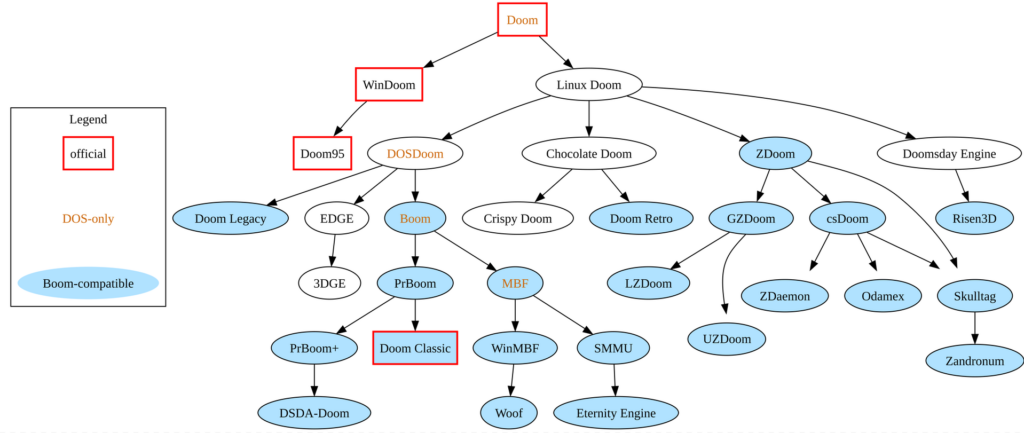
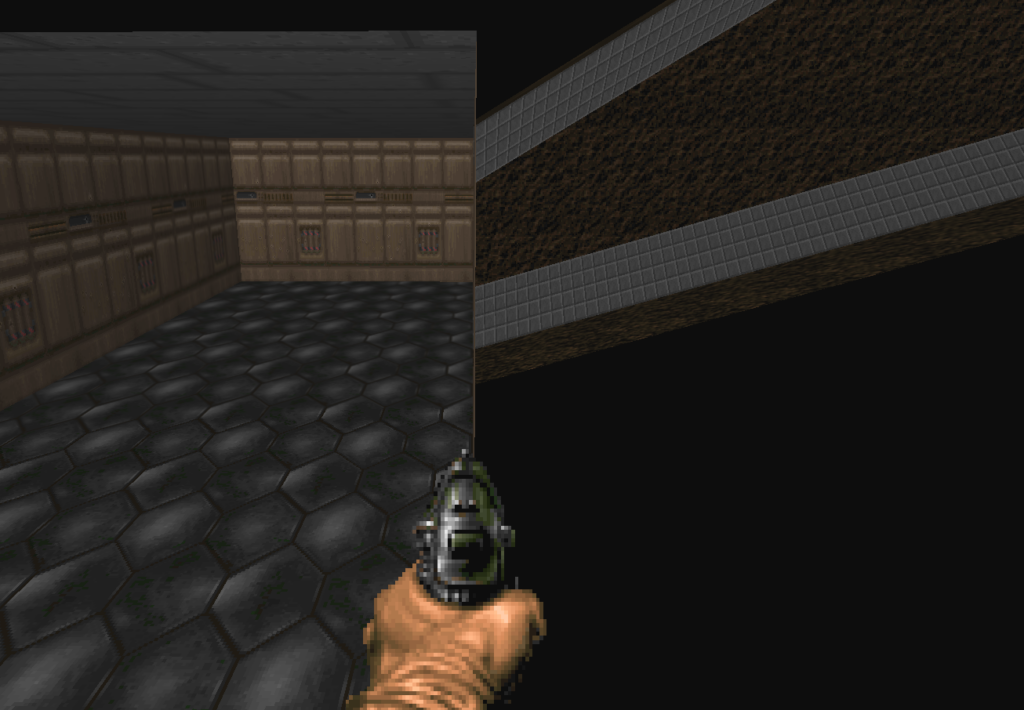
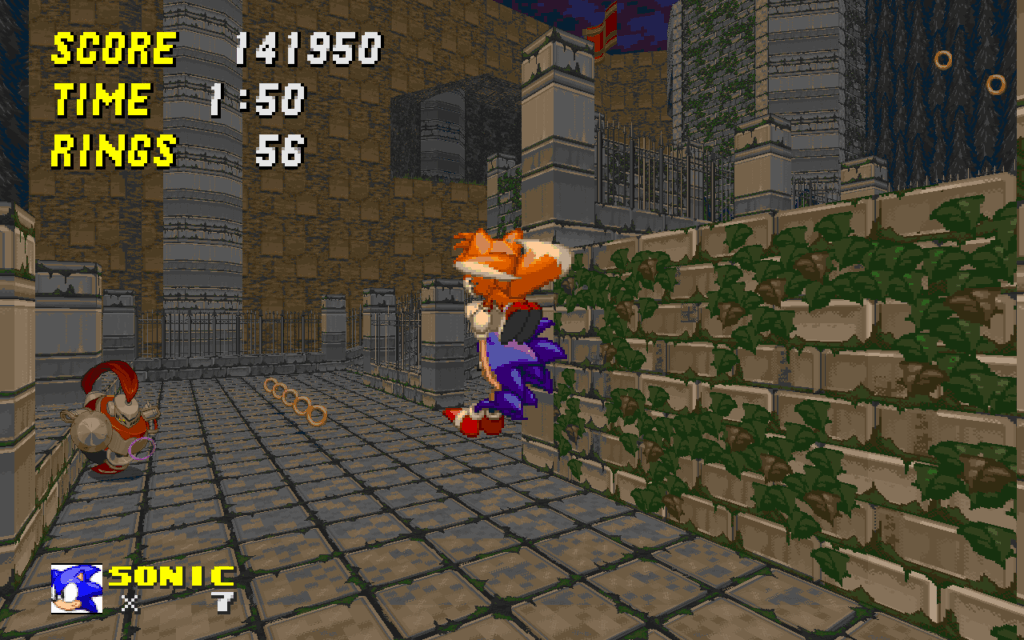
Some focused on remaining faithful to the original, some implemented the OpenGL rendering engine, some specialized in multiplayer, some retained compatibility with Doom‘s earliest demos. Many added features that were rudimentary, but absent to the original game- a jump button. Slopes. Moving floors. Transformative to mapmaking was the invisible teleporter, which allowed mappers to emulate separate floors or interiors by hiding a teleporter in a dark hallway or staircase to move the player to a separate part of the map. Any given map isn’t a true 3D space, and it’s impossible to place one room directly above another without some ingenuity.
Oh! Demos- players can record inputs and play them back deterministically, effectively replicating gameplay in-engine without being attached to a hefty video file. While console players were mailing their fastest games over VHS tapes, Doom had tiny demo files and a competitive racing scene through the 90s. It has its own history, along with a ten-year reflection penned in, well, 2003. Its author, “Opulent,” ran what became the
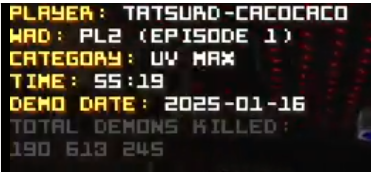
Doom Speed Demos Archive. That archive still exists today and holds demos across some 5,000 levels and sets, some dating back as early as 1994 and some as recent as last week. One Twitch channel streams random demos non-stop, and counts the total demons slain over broadcast. The current tally? Approaching 191 million.
Other coders took the source code and ported it to other operating systems, and then to other devices, and then to all sorts of electronics which really have no right to be running Doom. “It runs Doom” is something of a meme (and challenge) for programmers, and has entire cultures dedicated to putting the game in silly places. A dashcam? Sure. A synthesizer? Why not. In Photoshop? May as well. In a PDF file? Nothing is sacred.

Despite it all, the game was having 10-year retrospectives two full decades ago, and while it was well-received, attitudes at the time were that the world was probably ready to move on. Doomworld, ready standby and host of the /idgames file archive, felt it in the air. Following the retrospective, fellow maintainer Stephen Browning (“Scuba Steve“) penned the first (cheekily-titled “11th annual“) Cacowards, a celebration of the year’s best and most enticing releases wrapped in a little longform writing as a send-off to what the game’s community had accomplished. “Half the people that stuck around wanted to challenge what could be done with the engine,” he remarks.
People loved it- so much so there was a cacophony when the awards were absent in 2012 and the community elected its own replacement writers. Browning points out that the Cacowards has its own Wikipedia page, and Doomworld hosting it does not. The annual article has stuck around since. “People like reading long-form hand-written articles by humans in a large celebration,” Browning admits. Twenty-some years later, it’s another crucial piece of Doom‘s enduring legacy.
It wasn’t the only website around- others, like DoomNation, Gamesby Network, and NewDoom, served the same purpose but quietly went under, taking hosted history with them. Browning says the persistence of Doomworld’s community is simply one long chain of successes that would have fractured the modding community if any link broke. “Everything went right.”
Just as importantly, its community stuck around because there was deliberate effort by long-time enthusiasts to maintain its lineage. Browning credits Doomworld’s continuity to Andrew Stein, who sought to preserve the forum’s many discussions and works, and to protect it from the rise in right-wing toxicity following the Gamergate fiasco. According to Browning, a contractor from the Nightdive Doom + Doom 2 release used that income to finance the website and upgrades for the webserver. Another Nightdive ex-employee lovingly maintains the Doomwiki in his retirement. It’s a small collection of people passionately tending the monolithic garden of history the game has accrued. “You can’t replace those people.”
Its community also emphasises mentorship and collaboration. From their humble beginnings with the Community Chest back in 2003, community projects have become so prevalent in the last ten years that they got their own subforum. Many exist specifically to encourage new mappers to submit work or collaborate with experienced ones. Others run on themes, like floors on a skyscraper or simple geometry. Mappers collectively assembled 32 levels in the style of Drake O’Brien, long-time mapper who passed in 2024, done in remembrance of the pioneering that shaped modern Doom.
There’s even a free/libre reconstruction of Doom‘s assets to leverage the open-source license of the engine, for lost souls looking to play any of those projects.

In a sense, Doom‘s community of creators also stuck around because it was easy. Maps are simple enough that replicating one’s house is a regular early project, and sprites are considerably easier to make than 3D models. The ease of building new levels and mods encourages newcomers, as Rebecca Kelly (“ToxicFrog“) found in 2022.
Kelly admits upfront that she’s more interested in what people have made from Doom than Doom itself. She draws inspiration from sibling game Duke Nukem, its Build Engine, and a much-beloved War of Attrition mod for it. She describes how it featured a random level mode, choosing from a hundred different player-made maps for it, and how the mod allowed players to improve their weapons with use. Surprisingly, Doom didn’t have a weapon progression mod like that, but it did have thousands of player-made levels to be shuffled through! The resulting Gun Bonsai mod built to fit the task would later be acclaimed with a Cacoward in 2022.
She credits the community for happily sharing code and advice. And the tool for the task? A simple text editor. While Gun Bonsai hasn’t seen much development recently, other modders have released their own fixes and add-ons for it, building ever upwards from the works of others.
Mapmaking is much the same. “It’s not like there’s a wall to push the engine or tools to, because people keep removing the limits that used to apply to them,” she says.
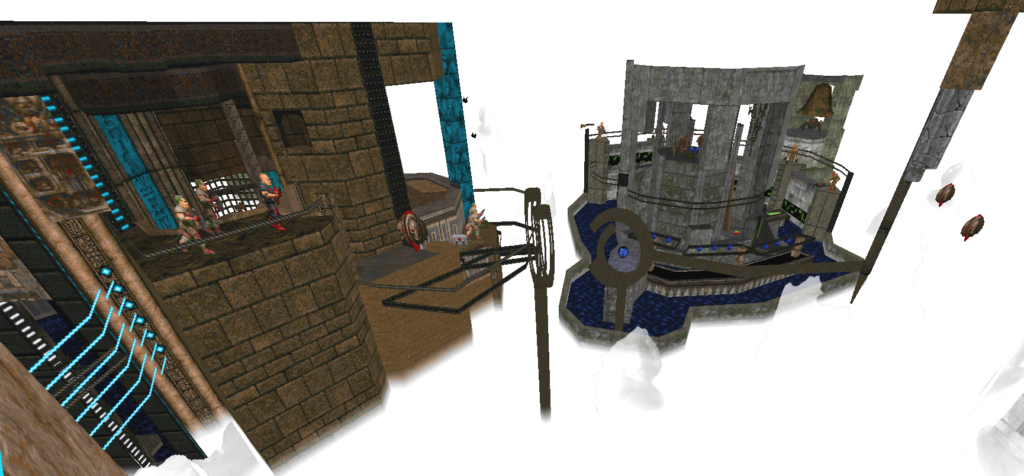
That same disinterest in base-version Doom inspired Kelly to build another implementation of the Archipelago randomiser for Doom, one that would allow her to use the mods and levels she prefers over the original set. It’s now her most widely-used project. (Author disclosure: I’m one of those users. I’ve contributed logic to the project.)
She also agrees the open-sourcing of the original engine was crucial, with modern modding being considerably easier than patching the engine in-memory like in the game’s early years. Her mods are built in zscript, a language designed specifically for the GZDoom family of source ports.
“As a programming language, I have a great deal of complaints about it (and most programming languages, to be honest), but as a modding API, there is SO MUCH you can do with it.” She describes it as a little bit “scrungly,” but clearly made by modders, for modders. “Any game developer that wants to add a modding API to their game should be looking at it and learning from it.”

Doom, thereby, has stood the test of time: a little tarnished with the decades, but kept shiny and interesting under the touch of thousands of visiting hands.
It’s a little bit of ‘making history’ and a little bit of ‘becoming history,’ and the unbroken links of continuity binding the community together have built something greater than the sum of its parts. Doom is lasting because Doom is lasting. Doom is also lasting because a handful of indispensable people have taken initiative to preserve its history and discussions, to ensure a welcoming attitude with the community, to lovingly curate and document through its wiki, to write irreverently for readers and creators alike.
They’ve made great efforts to pass old knowledge forward, to challenge what the engine is capable of, and in the process, built an accessible open-source engine fit to succeed commercially in the current era. Doom is lasting because it’s so much more than Doom and the five floppy disks it originally sold on.
Now, if you’ll pardon me, there’s more demons to toast.
 IAmAWeirdLittleKnickKnack
 Idea Phochaiya
 M.Ritchie


