
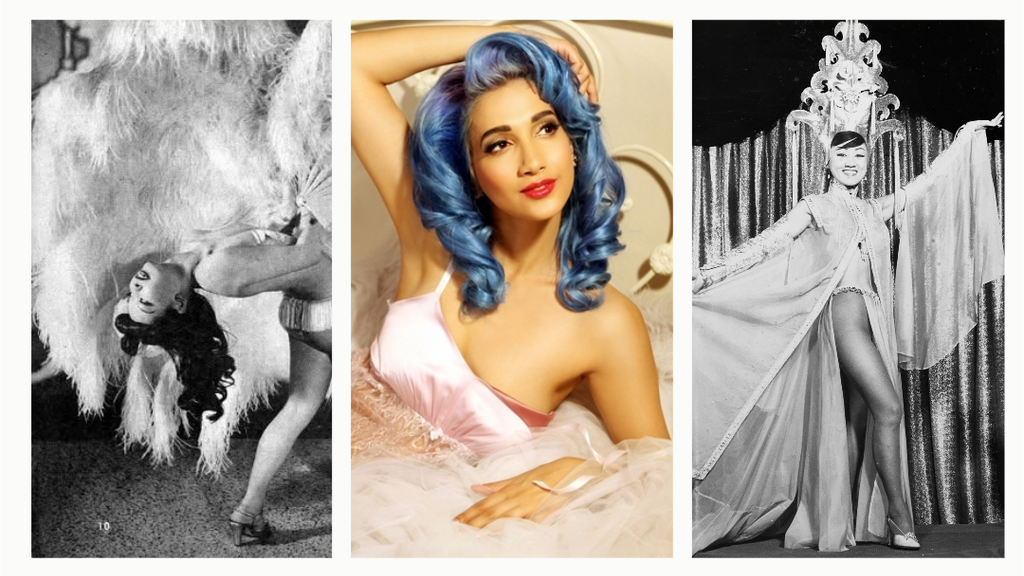
I went looking for someone who looked like me on the burlesque stage. Instead, I found a history of performers negotiating who gets to construct the person an audience sees.
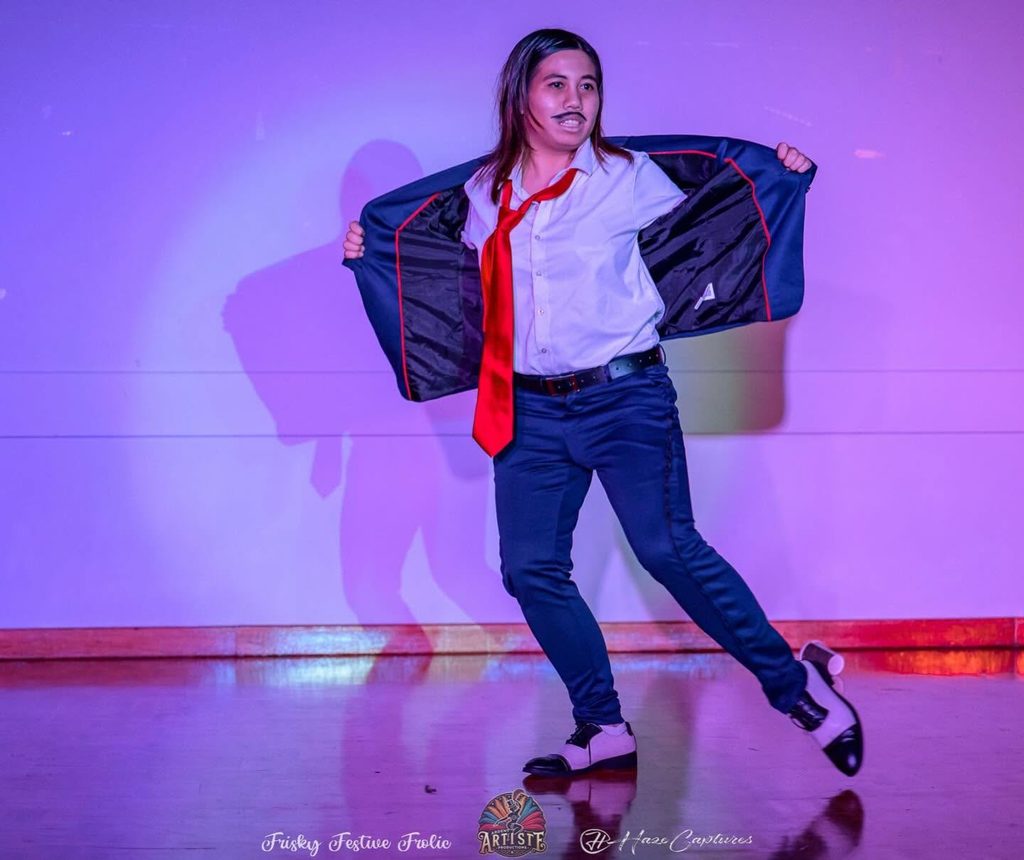
The jacket changes my posture before I consciously decide to change it.
My shoulders settle differently. My chin lifts. The person in the mirror has my face and my body, but he occupies them with more confidence. His name is Noah, my masculine alter ego, and costume is one way I make him physical.
I have written about this transformation before. When I dress up, a binder can flatten my chest, a jacket can change my silhouette, and jeans can alter how I see my hips. “Costume negotiates between the body I have and one I imagine,” I wrote after encountering Noah in a Tokyo mirror.
Burlesque gives that negotiation a stage. The art form can combine dance, costume, character, comedy, sensuality and striptease. For me, its attraction lies partly in that construction: deciding what an audience sees, what it doesn’t, and who I can become while it is looking.
As a Southeast Asian aspiring performer, I began wondering who had entered this space before people like me. I went looking for an ancestor. And I found Noel Toy.
A Stage Built on Contradiction
Born Ngum Yee in San Francisco in 1918, Toy became one of the best-known performers in a nightclub world then known as the “Chop Suey Circuit”: Asian-American entertainers who toured American cabarets during the 1930s and 1940s, often before predominantly White audiences.
These weren’t simply displays of traditional Asian culture; performers sang popular songs and danced the rumba, waltz, cha-cha and tango. Clubs featured comedians, acrobats, bands and striptease. Kwan describes the shows as American cabaret with strategically ‘Oriental’ touches, making the performers feel both familiar and exotic. Ashawnta Jackson’s account of the circuit puts the contradiction neatly: these artists were “both challenging and solidifying racial boundaries”.
That contradiction followed Toy. At San Francisco’s Forbidden City, she performed fan and bubble dances and was marketed as the “Chinese Sally Rand”, after the famous American fan dancer. Her success helped turn the nightclub into a major attraction.
Toy’s acts also make the mechanics of burlesque visible. In a fan dance, feathers don’t simply decorate the performer; they conceal, reveal, and redirect the audience’s attention as the body moves behind them. Her bubble dance similarly turned a prop into part of the spectacle. The performance depended on anticipation: the audience watched not only what Toy revealed, but what she chose to keep just out of sight.
A 1942 CO-EDS profile preserved by the Burlesque Hall of Fame called her “Broadway’s most publicised Chinese (American-born) glamour girl”. Even her Americanness arrived parenthetically. Yet the same profile describes her fan work, recording a performer who used movement, concealment, and revelation to control what her audience could see.
Toy wasn’t simply being looked at—she was performing the act of being looked at. But she did so inside an entertainment industry already deciding what her Asian body meant.
Homi K. Bhabha calls this racial process “fixity”: difference becomes recognisable through images repeated until they appear stable and natural. Toy could be a glamorous American nightclub star and still be marketed through an exoticised “Chineseness”. Her later acting career made that limitation clearer; after leaving burlesque, Toy appeared in film and television, but eventually grew tired of being cast as what she called “the ornamental Oriental”.
The phrase complicates any easy reading of her burlesque career as either liberation or exploitation. The better question is: who constructed the Noel Toy audiences saw? Toy did, through feathers, movement, wit, and technique. But so did promoters, journalists and audiences accustomed to reading Asian femininity as spectacle.
Coby Yee Takes Control of the Lights
A generation later, Coby Yee seemed to step into a familiar script. Born in Ohio in 1926 to Chinese immigrant parents, Yee trained in tap dance as a child and eventually became a star in San Francisco’s nightclub circuit. At Forbidden City, she was billed as “China’s Most Daring Dancing Doll”, but her career changed that question; Yee didn’t just wear costumes—she made them.
Her nephew Darrell Leong recalled that she was uncomfortable simply exposing herself onstage, so she added more layers to her costumes and required the spotlight to become darker as each piece came off. “A tease, right?” he said. This small detail captures something fascinating about burlesque: revelation is constructed, and what the audience cannot see can matter as much as what it can.
Yee turned that skill into another career, travelling with a sewing machine and making wardrobes for other showgirls. Then her control expanded beyond her own body—she became a producer, teacher, and nightclub operator. In 1960, she became part-owner and public face of the Dragon Lady nightclub; the following year, she opened a studio where she taught dance and sold handmade clothing. She also created the touring Dragon Lady Revue.
Eventually, she and her family took over Forbidden City itself. Changing a show meant rehearsing performers, selecting music and producing new costumes. “Every 6 weeks we changed shows,” Yee recalled.
The woman who had once been marketed as a “Dancing Doll” was helping determine what the entire room saw. Her daughter, Shari Matsuura, later resisted making that life sound grander than Yee herself might have considered it. “In her mind, she was just going to work,” Matsuura told SFGATE.
The Person I Was Actually Looking For
By this point, my original search had developed a problem. I had gone looking for an Asian performer who had come before me, but “Asian” was doing too much work. Toy and Yee were Chinese-American women negotiating mid-century American ideas about race and femininity; their histories couldn’t simply become mine because our faces might be placed beneath the same continental label.
Chris Barker writes that identities are “neither pure nor fixed”, but emerge where categories including gender, race, class and nation intersect. Kwan’s history makes the dangers of flattening those distinctions particularly visible: Japanese, Korean and Filipino performers could all appear within nightclub entertainment marketed as ‘Chinese’.
There was another obvious difference—I was looking for Noah. Whereas Toy and Yee performed highly constructed femininity, Noah is my way of constructing masculinity. He isn’t necessarily a drag king, but drag-king scholarship gave me a language for something I had already felt through performance. In Ashley Baker and Kimberly Kelly’s interviews with Southern drag kings, one performer described taking the most confident and energetic part of himself and amplifying it “by five”. Another said his “whole demeanour changes” in drag.
I recognised the change in demeanour. In my own writing about Noah, I have described him as having my face but a different bearing: “Where I hesitate, he occupies space as though it has always belonged to him.” Perhaps I was no longer searching for someone who looked exactly like Noah; I was looking for what performance had allowed other people to do.
From Singapore, Another Answer
That search eventually brought me closer to home, though not to an exact reflection. Singapore-born Sukki Singapora, born Sukki Menon, grew up in a Singaporean-Indian and British family. In a 2015 Time Out Singapore interview, she described a traditional upbringing in which her parents hoped she would become a lawyer or doctor. “I wanted to do something that felt liberating,” she said, and she found it in burlesque.
Singapora’s account also dismantles the idea that burlesque begins and ends when clothing comes off. She designs and hand-sews costumes, develops choreography, and decides on lighting. Time Out reported that a five-minute act could take up to two years to develop. “There’s a real art behind it,” she explains; her description of striptease could almost answer Coby Yee’s carefully darkening spotlight across the decades: “it’s more about the tease than the strip”.
The parallel is striking. Decades earlier, Yee had added layers while asking for the spotlight to darken as each one disappeared. Now, Singapora describes the same principle through the language of tease. In both cases, removing clothes is only one element of the performance. Costume, timing, movement and lighting determine how the audience experiences the reveal; withholding becomes part of the spectacle.
In an interview with Singapore Business Review, Singapora described burlesque as both artistic practice and business. Costuming, choreography, makeup, promotion, and branding all contribute to the few minutes an audience eventually sees. She also described wanting “full control over every aspect” of her public presentation.
That word, control, matters. It would be too neat to arrange Toy, Yee, and Singapore into a steady progression from objectification to empowerment; they performed in different countries, generations and cultural conditions. Each negotiated different constraints, and what connects them isn’t a single “Asian burlesque experience”— it is a constructed work.
What I Found Instead
I started this search wanting to find someone who looked like Noah and me. I didn’t.
Instead, I found Noel Toy moving behind enormous feather fans while American publicity turned her ethnicity into part of the show. I found Coby Yee sitting behind a sewing machine, adding another layer to a costume and deciding when the spotlight should dim. And I found Sukki Singapora describing the choreography, stitching, lighting and business hidden inside a few minutes of spectacle.
None is an earlier version of me, and that may be the more useful inheritance. Perhaps I had misunderstood what an artistic ancestor needed to look like—inheritance doesn’t have to mean resemblance. These performers offer me not a blueprint for being Southeast Asian, masculine, or myself; they show that the stage can be a place where identity isn’t merely displayed, but deliberately made.
When I become Noah, the body doesn’t disappear—it’s still mine. But costume alters its silhouette. Movement changes its meaning. A lifted chin or shifted stance can turn uncertainty into swagger. The audience sees a masculine character because I’ve learned how to construct one.
Burlesque has never given every Asian performer the same freedom to determine how they are seen. Its history contains exoticisation alongside artistry, racial stereotypes alongside self-invention, and audiences who arrive with ideas the performer cannot completely control.
But a performer can still reach for the costume. They can choreograph the movement, and decide when the light goes down.
I went looking for Noah in burlesque’s past. Instead, I found the history of people constructing themselves under an audience’s gaze, one feather, stitch, gesture, and spotlight at a time.
 Idea Phochaiya
 M.Ritchie
 Sabhyata Singh