
Project Hail Mary is a movie released in March 2026, based on the novel of the same name by Andy Weir.
Protagonist Ryland Grace wakes from an induced coma and finds himself in a spaceship with two dead astronauts. As he recovers body function and memory, he finds that Earth was threatened by an unknown force consuming the Sun. The crew were sent to another solar system that was exposed to the same threat but survived. Their mission was to discover why and relay a solution back. On arrival at his destination, Grace encounters an alien spacecraft on the same mission. Grace meets the remaining crew member he nicknames ‘Rocky’ and they bond trying to solve the sun-threatening problem.
Much has been said about the film: it uses credible science concepts. It takes snatches of NASA experimentation and theory and throws them in. It’s a ‘buddy’ movie. It’s best experienced in an IMAX type cinema, because of the special effects. It’s too long, too comedic and the alien is too ‘cute’. Andy Weir has been quoted as attributing his original story, in terms of hidden themes or metaphors, as nothing more than entertainment.

Project Hail Mary (2026) — Film Stills & Cinematography | StillsLab
Something to remember in the post-Covid world is that the public consider these statements superficial. The strengths of ‘Project Hail Mary’ are borne out in the characterisation of the ‘buddy’ relationship and how that changes Grace. The story needs the time to build quiet emotional depth while also delivering immersive special effects scenes. They confront mortal dangers, finding the bravery to protect each other at risk to themselves. Through these moments, the audience feels the risk, fear of loss, and relief when each survives, empathising with each protagonist. The film makes extensive use of flashbacks to provide the viewer with Ryland Grace’s backstory, which helps to explain his ineptitude as an astronaut and the background of the greater, ‘save-the-world’ narrative. In this pre-storyline, science consultant Grace is disillusioned and withdrawn from commitment, ambition and socialisation. Trying to understand the astronauts’ readiness to brave a one-way mission, Grace denies possession of a ‘bravery gene’. He is told that “It’s not a gene. You just need to find someone to be brave for.” In a nutshell, this underlines the moral of the story: Grace finds that someone and his courage.
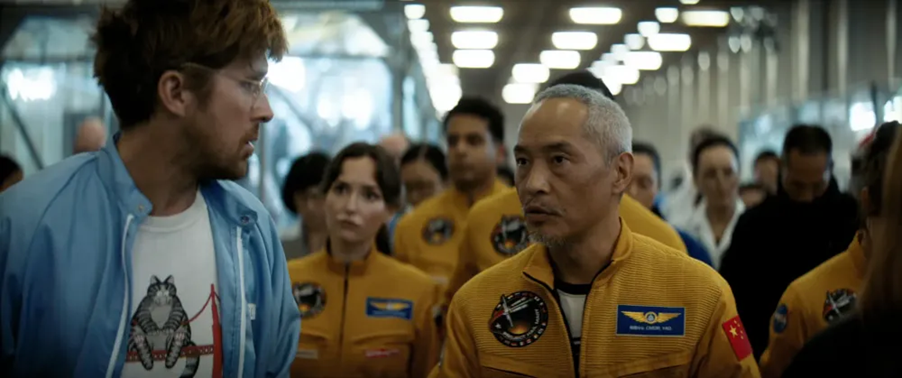
Project Hail Mary (2026) — Film Stills & Cinematography | StillsLab
It’s often said these days that contemporary society is guilty of short-attention spans. This is at odds with typical scientific practice, where sampling, analysis and discoveries take time. Directors Phil Lord and Christopher Miller remained mostly faithful to the Andy Weir novel. Instead of a J.J. Abrams-style explosive-action movie, or a tedious philosophical journey like Interstellar, the viewer sees Grace and ‘Rocky’ work applying their science coupled with a growing relationship. That provided time to build a repertoire between the two. The desperation of the characters to succeed despite impossible challenges is driven by growing hope and companionship that they share. Visually, the film immerses the viewer in spectacular special effects, the scenes that will remain in visual memory. But they provide a counterpoint to the close confines of the spacecraft internals that act as a stage for Grace’s change. He learns to love someone, finds someone to be brave for. This is what the viewing public takes with them from the screening and what makes the film so likeable.
Project Hail Mary may not be for everyone – but it almost is. Its success indicates the long runtime is not a deterrent. If merely about the science and special effects, then it may have only reached cult status. But the integration of humour, and character change through friendship, bring the movie home. If you haven’t seen it yet, I recommend you do.
 bella
 Hayden Price
 Finn Wilson