
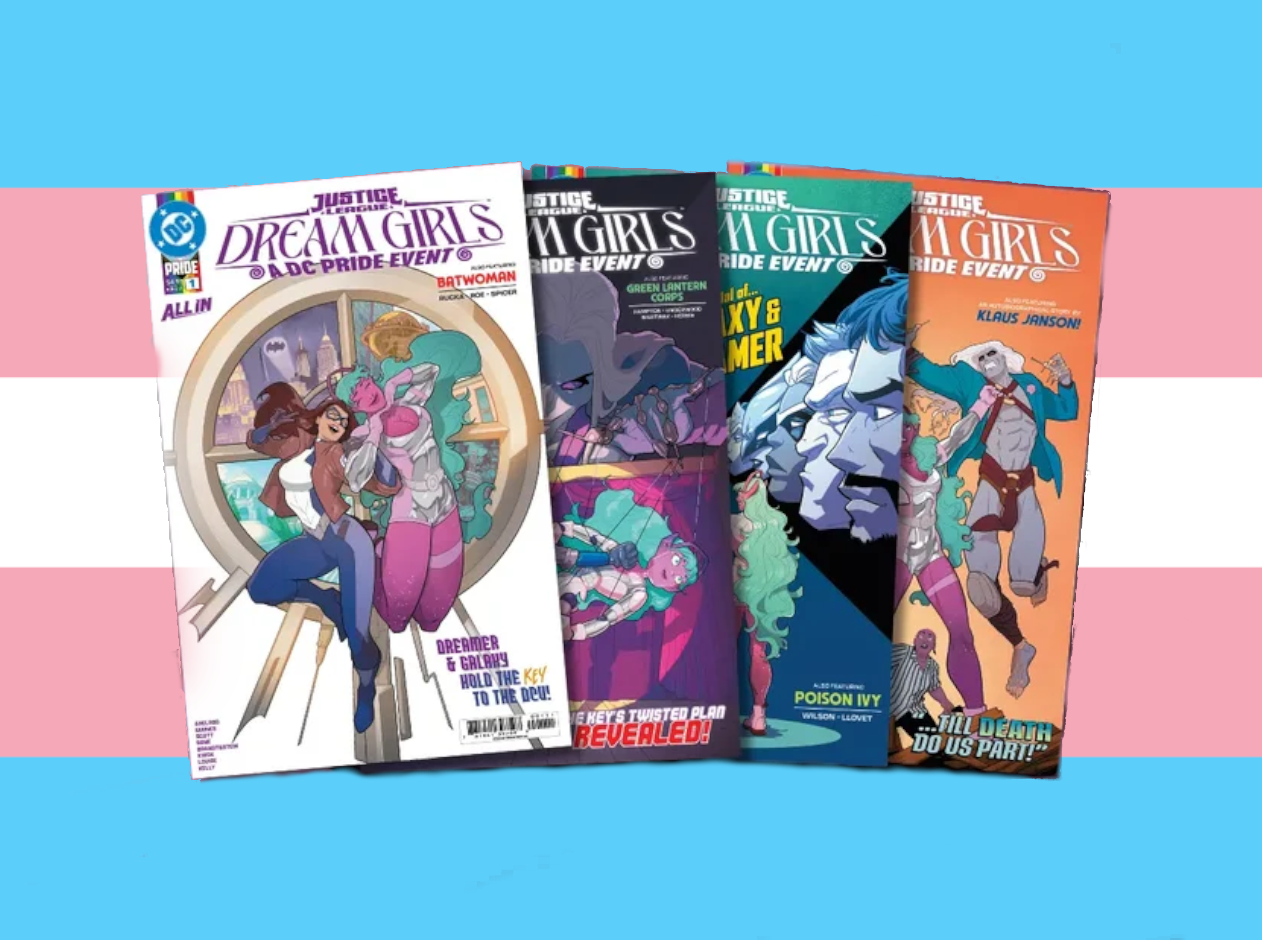
For decades, transgender characters have existed at the margins of mainstream superhero comics, often appearing as supporting figures or isolated milestones. In June 2026, DC Comics placed two transgender superheroes at the centre of Justice League: Dream Girls, a four-issue miniseries released as part of its annual DC Pride initiative. Written by transgender writers Nicole Maines and Jadzia Axelrod, the mini examines not simply the visibility of transgender characters, but how they function within one of comics’ most established heroic teams.
As a transgender woman who has previously examined trans representation in DC Comics, I approached Dream Girls with a particular interest in how it depicts trans characters when they take centre stage. The result is somewhat of a mixed bag.

KatherineJuliaCarter, CC BY-SA 4.0, via Wikimedia Commons
At the centre of Dream Girls is Dreamer and Galaxy, two transgender superheroes whose paths into the DC Universe differ dramatically. Dreamer, or Nia Nal, was co-created and portrayed by actress Nicole Maines for The CW’s Supergirl, before making her comic debut in Superman: Son of Kal-El #13 three years later. Galaxy, or Taylor Barzelay, was created by Jadzia Axelrod for the 2021 graphic novel Galaxy: The Prettiest Star, a canonical part of DC’s universe from the outset.
Their stories converged in April’s Justice League: Intergalactic Special, which brought Dreamer out of a nine-month absence and officially confirmed Galaxy to be transgender—which writer Jadzia Axelrod insists is not a retcon.
The Intergalactic Special left the pair mistrusted by the Justice League, and trapped in a dream world. Thus, the stage was set for Dream Girls.
Dream Girls uses its dream-world premise to explore the psychological weight of being a transgender superhero.
As Dreamer becomes increasingly absorbed in an idealised fantasy of superheroism, she avoids the trauma that has shaped her life as being both half-alien and a transwoman. Galaxy, meanwhile, recognises the cracks in the illusion. Her role becomes to remind Dreamer that the relationships and community she has built are more valuable than the perfect heroic identity she’s constructed.
That sense of belonging is also central to the mini’s treatment of the Justice League. Despite the League increasingly accepting former enemies among its ranks, Galaxy finds herself effectively put on trial over her past actions and perceived failures as a hero. For transgender readers, this can evoke the exhausting demand to continually prove that they deserve the same place at the table as everyone else.
The parallel is particularly pointed given Maines’ own history: As a teenager, she became the plaintiff in Doe v. Regional School Unit 26, a landmark case in which Maine’s highest court ruled that excluding her from the girls’ bathroom constituted discrimination.
However, Dream Girls sometimes makes this metaphor too explicit. Although the conflict is framed through the marginalisation of trans characters, Galaxy’s trial ultimately read less as a commentary on transphobia than as a creator putting her critics on trial through her fiction. This weakens the story’s authenticity, particularly when Justice League characters behave inconsistently with their established personalities.

Three Cheers for Sweet Dreams, drawn by Cassidy Dylyn
For Dreamer, the dream world offers a glimpse of the life she actually wants: A quiet retirement with Jon Kent—a gift to long-time Jon and Nia shippers, but also an expression of her desire for happiness beyond superheroism.
Ultimately, Galaxy breaks Dreamer free by reminding her of the love and community she already possesses. Dreamer chooses to step away from the League and prioritise herself—a resolution that treats self-preservation not as failure, but as another form of strength.
Dream Girls demonstrates how far trans representation in superhero comics has come. Transgender characters can now occupy the centre of a Justice League story without their identities being the story itself. Yet its shortcomings are equally instructive. As argued by Scott et al., meaningful representation requires more than placing trans characters in traditionally heroic roles; it requires allowing them the same complexity, contradictions, and narrative freedom as their cisgender counterparts.
Dreamer and Galaxy are not defined solely by being transgender, but neither is their transness irrelevant to the stories they tell. Dream Girls ultimately suggests that the next step for trans representation is not simply being allowed into the room, but being allowed to be complicated once we get there.
 bella
 Hayden Price
 Finn Wilson