
<All Her Fault> Critiques Women’s Struggles in Childcare
In November 2025, Peacock quietly launched the limited edition drama All Her Fault. This drama has almost become a phenomenal text worldwide without any prior notice. Because this drama features motherhood punishment and widowed parenting, which are already topical, coupled with suspense and twists, making it one of the most watched TV dramas at the end of the year. In the first week of broadcasting, female viewers accounted for 74%, and the age group of 35 to 64 years old accounted for 64% of the viewing time (Alejandro Bastidas, 2025). Most of this group of people are those who hold their mothers accountable.

The beginning of the story is played by Sarah Snook, who plays the mother Marissa. She receives a text message from her classmate’s parent Jenny, saying that her son is playing with her son, so she follows the address on the message to pick up her 5-year-old son from a strange address. However, the person who answers the door is a stranger who does not know her son, and the child disappears. As the investigation progresses, “mistakes” are constantly being attributed, and cracks in the perfect life are being revealed layer by layer, and the “she” who carries all of this is always the mother.
Although this is a suspenseful drama about missing children, it has instead sparked discussions among viewers about “widowed parenting” and “perfect motherhood”. So why did this drama spark such intense social discussions?
This TV series is adapted from Andrea Mara‘s novel, and under the visual processing of Minkie Spiro and Kate Dennis, the story is no longer just about “who took the child”, but about why responsibility automatically points to the mother before everything is proven. This reflects that the risks and responsibilities that parenting requires are often the role of the mother.
This clip reflects the excessive criticism of a mother’s role in society’s stereotypical parenting beliefs: The child was lost, and no one blamed Peter. No one would blame him at all. Marissa cared about him and wanted to come over to comfort him, but was criticized head-on. He felt that he had not fulfilled his mother’s responsibility.Although an apology was made. However, Marissa did not believe that her husband was also responsible for this, but rather blamed herself entirely. She constantly regretted that she shouldn’t have easily believed that unfamiliar text message, and felt that she shouldn’t have wanted to withdraw from work before picking up her son. But she is also a victim, and her mindset has deeply engraved ‘this is my fault’ in her mind. This detail is the sharpest social criticism in the entire drama.
The reason why this kind of accountability appears’ natural ‘in the drama is precisely because it rarely appears in a coercive form. As Michel Foucault pointed out, power in modern society is not always achieved through external oppression, but through internalization, allowing individuals to actively self regulate without supervision. (Foucault, 1977).
This indicates that women have been disciplined by society, making them believe that everything in parenting is their responsibility. Therefore, the mother in the drama began to blame herself before being explicitly accused, and entered a state of self judgment before the truth was revealed.
But this state is the result of the long-term shaping of “intensive motherhood“. This is a parenting model proposed by Sharon Hays, which takes the mother as the sole responsible subject, regards the child as the absolute center, and requires high-intensity labor and emotions. (Wrigley & Hays, 1997). In this logic, the mother must not only be present, but also be present in an unconditional way. Sharon Hays pointed out that motherhood has been shaped into a field that must be sacrificed, pure, and not calculated in this high-intensity society that emphasizes competition and personal interests. (Wrigley & Hays, 1997). This also indicates that women always have a sense of responsibility and self sacrifice in parenting compared to men.
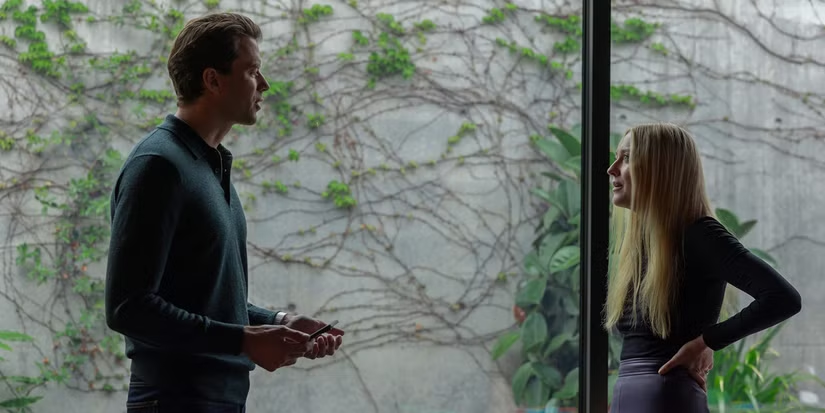

This model leads to a complete weakening of men’s original responsibilities and duties in parenting. This is also specifically reflected in the drama, when Peter and his wife were interviewed by the police, Peter couldn’t say any other details except for his child’s school and blonde hair. There is also another male character in the drama, Richie, who lied to his wife and went to a physics Q&A session to avoid picking up his child from school. In fact, he drove his car to the beach to daydream.
This indicates that men have no desire to take on parenting responsibilities and do not even consider themselves responsible during this stage of parenting. This is also in line with reality. Lawer stated that married men nowadays are unwilling to give up their hobbies to spend more time with their families, even if they cannot remember their children’s birthdays. (Lawler, 2025).
The drama ‘All Her Fault’ criticizes the plight of women in parenting through a case of a missing child. Through this drama, I want to tell all women that when choosing a father for their children, the healthy growth of the child should always be the top priority. If it’s not possible, they can choose not to have a father. Just like the line in the drama: “I don’t want my child to treat other women like you treat me in the future”.
 Shoujie Wang
  Yinan Zhou
  SUN Yinchen