
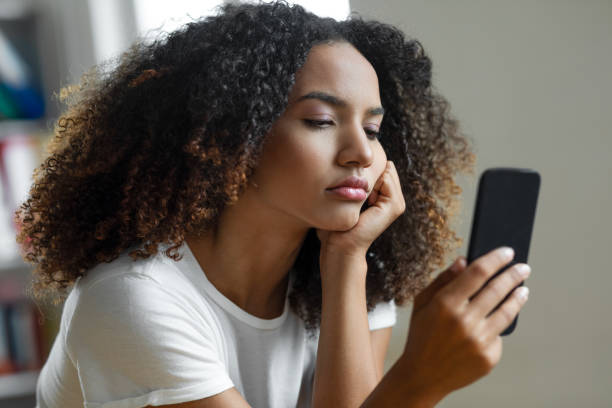
As a woman, have you ever compared yourself to somebody online? Their body, their face?
Have you then found yourself asking ‘Am I too fat, too wrinkly, or too pimply? Or ‘Are my breasts too small and are my thighs too big?’.
If you have, you are one of millions, but it is not your fault. Social media, as we know, is a world-wide network which allows a variety of people to stay connected to and informed about the topics they are interested in, while sharing snippets of their own lives. TikTok has approximately 1.6 billion monthly users, and Instagram had 2 billion active users at the beginning of the year (Statista). With this large amount of people consuming content, unfortunately these social media apps can have harmful effects on users, especially women. One of the largest issues is body image, with social media apps being proven to lead to body-related cyberbullying, eating disorders, and unrealistic appearance standards, often leading to the purchase of cosmetic procedures or products. Social media use creates risks factors for women and young girls to adopt negative body image and related harmful behaviours. The best way to combat these risks, is to understand them, and be able to recognise the patterns of how certain content can break down self-esteem.

Insecurity can be fostered by social media use, and though individuals find their own self-doubts, other users can wear down their self-esteem in different and harsher ways. Cyberbullying refers to bullying that is done through the use of technology, both by people known to the victim, and strangers. Social media apps have been known to cause severe bullying, often to do with people’s appearance, which affects self-esteem and can lead to mental health issues, such as anxiety and depression. Cyberbullying encapsulates a variety of online behaviours which aim to hurt and embarrass, such as sharing other’s personal photos and videos, isolating users from their friends, and spreading rumours (Australian Human Rights Commission). Many users take to social media apps to attempt to find a sense of community, and some are met with the opposite. Due to accounts having the option to be anonymous, people often believe they can say anything to anyone. The false belief that anything said cannot be traced back to them, allows people the freedom to say horrible things they often would not say out-loud or to the user in person. Additionally, in our technology rich society, a phone is seen as crucial in day-to-day life, making harmful comments much harder to get away from. Females additionally have been proven to be more susceptible to social media addiction, which increases the risk of cyberbullying and victimisation, leading to negative views of oneself (Kucuk, et al.).
Social media apps allow for anyone to share whatever they choose, and often harmful posts are not taken down, due to faulty safety guidelines. Unhealthy weight loss, nutrition, and exercise-based content is easily available, and often leads to users copying what they see, especially women, which is a risk in encouraging disordered eating. Tiktok and Instagram are filled with fitness influencers, intense and subtle diet culture, ‘thinspo’ and ‘fitspo’, ‘what I eat in a day’ videos, and more.
Fitspiration and Thinspiration both emphasize being lean and thin, with pictures and videos of very underweight women being shared as ‘inspiration’ for weight loss or as a ‘body goal’.
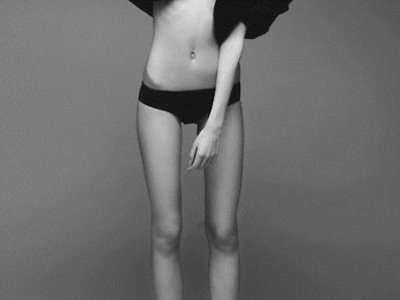
With social media’s algorithms, it is often hard to escape these negative influences, as TikTok and Instagram show more of the content users interact with.
TikTok specifically, works to create a stream of content for users to consume through an endless row of suggested short form content, and research has shown that even small amounts of “exposure to unattainable appearance standards can have a negative impact on body image” (UNSW Sydney). This is due to the inevitable comparison of themselves to the ‘ideal bodies’ they see, which “impacts their mood and increases body dissatisfaction”. The algorithm influences people, often young women, to see this appearance-based content, as it focuses on gender, age, and interests, when suggesting videos on the for-you-page. Meaning, if you are a woman interested in fashion or make-up, you could see hundreds of idealised bodies and faces in a day while scrolling, which is bound to affect the way you see yourself very quickly.
Further, social media is home to many ‘Pro Ana’ (pro-anorexia) accounts and communities, which encourage starving and over-exercising and allow women to share harmful tips, such as chewing on ice when hungry, instead of eating. It is also a place where users compare goal weights and food amounts. Some social media users post pictures of themselves while dangerously thin, which can trigger people in eating disorder recovery, and cause relapses in harmful habits. A famously severe example of a user that does this, is Eugenia Cooney, who has been sharing pictures of herself for years at different locations, while so underweight that other users have been predicting her death. However, eating disorder communities do not just focus on anorexia, there are specific forums for those struggling with binge eating and/or bulimia, where users often share their routines and feelings of shame and guilt. These online communities or groups foster an environment which usually becomes competitive, worsening the physical and mental state of (usually) young women, until they cause permanent bodily damage and/or need to be hospitalised.
Since the beginning of magazine popularity in the 19th century, especially those targeted towards women, appearance has been a key topic, with columns on fashion, makeup, diets, and more. In the early 2000’s, many magazines featured cover pages that targeted female celebrities and their looks, focusing on ‘excess weight’, cellulite, and more. This negative focus on famous women, continues to decrease the self-esteem of other women, as they question, “if these celebrities aren’t good enough, how could I ever be?”.


Despite older media, such as TV shows and magazines, still heavily contributing to problematic body image, social media is such a constant influx of information, that it is more difficult for women to avoid harmful messages, and easier for them to seek out ‘health-related tips’. Many ridiculous pieces of advice or diets are shared under the guise of health and wellness, and young women are more susceptible to following strangers’ advice if it promises to make them thinner, fitter, and ‘more attractive’. Additionally, factors have shown that younger women are more likely to take diet advice from older women, due to their lived experience, but this just causes risks in further passing down factors and attitudes which create low self-esteem.
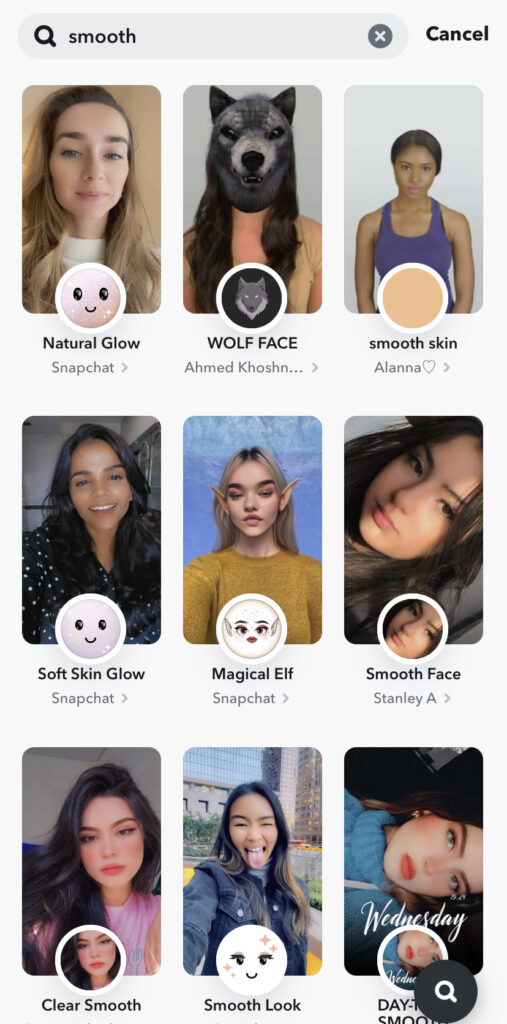
The sharing of appearance-focused photos that are often unrealistic and heavily edited, creates an impossible beauty standard, which makes women feel inferior and provides a want to change themselves. Social media users are able to apply filters to their face and body, and filters are heavily available on Snapchat, Instagram, and TikTok. On Snapchat, users are able to search a large database of filters using key words, such as smooth, which brings up numerous filters which blur pores and give the illusion of a brighter and completely blemish free face. Additionally, many people (4.6 million downloads in 2022) use Facetune to ‘improve’ their appearance in posts e.g. making their waist smaller, hair thicker, and teeth whiter.
Although filters can be used for fun, to try out coloured hair or piercings, or simply make a friend laugh, the normalisation of body editing creates a dangerous competitive culture, and with the constant changing of technology, it is becoming harder to tell what is and is not edited.
Experts believe that “If appearance-ideal video content is perceived as unedited and enhanced when it in reality is, then users may be more likely to engage in negative social comparisons and internalise the appearance ideals” (UNSW Sydney). Due to the use of filters and Facetune often leading to a dissatisfaction with individual’s natural bodies, those who can afford it change themselves to fit the fake version of women that they see online, using procedures such as lip filler, Botox, breast augmentation, liposuction, etc.
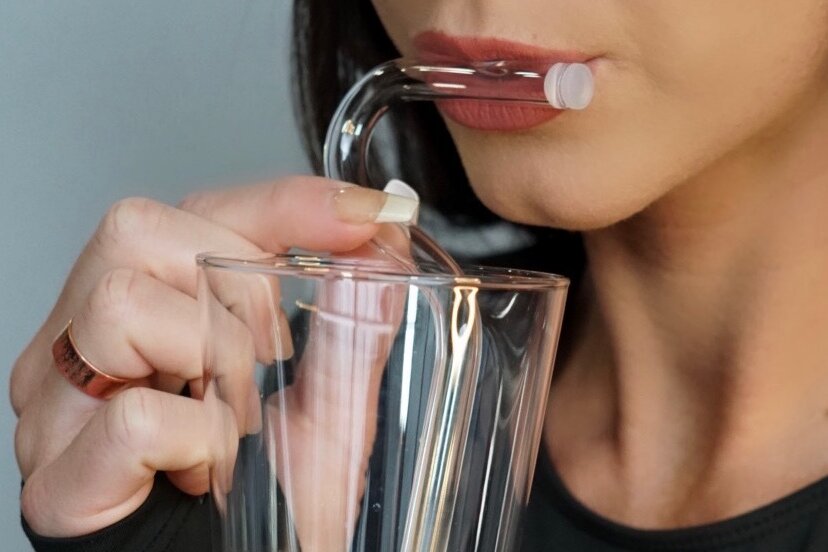
Social media is additionally filled with advertisements for beauty products and fads which target insecurities and are both a waste of money and can cause bodily damage. These expensive products often promise to combat aging, such anti-aging red light masks with ‘LED therapy’, as well as the anti-wrinkle straw which aims to reduce wrinkles around the mouth created by a normal straw.
Other products can produce real damage, such as waist trainers, to create a smaller waist, resulting in organ displacement and breathing issues, or ‘flat tummy teas’, which are marketed to ‘detox’ and ‘debloat’, but are essentially laxatives which can negatively affect the digestive tract.
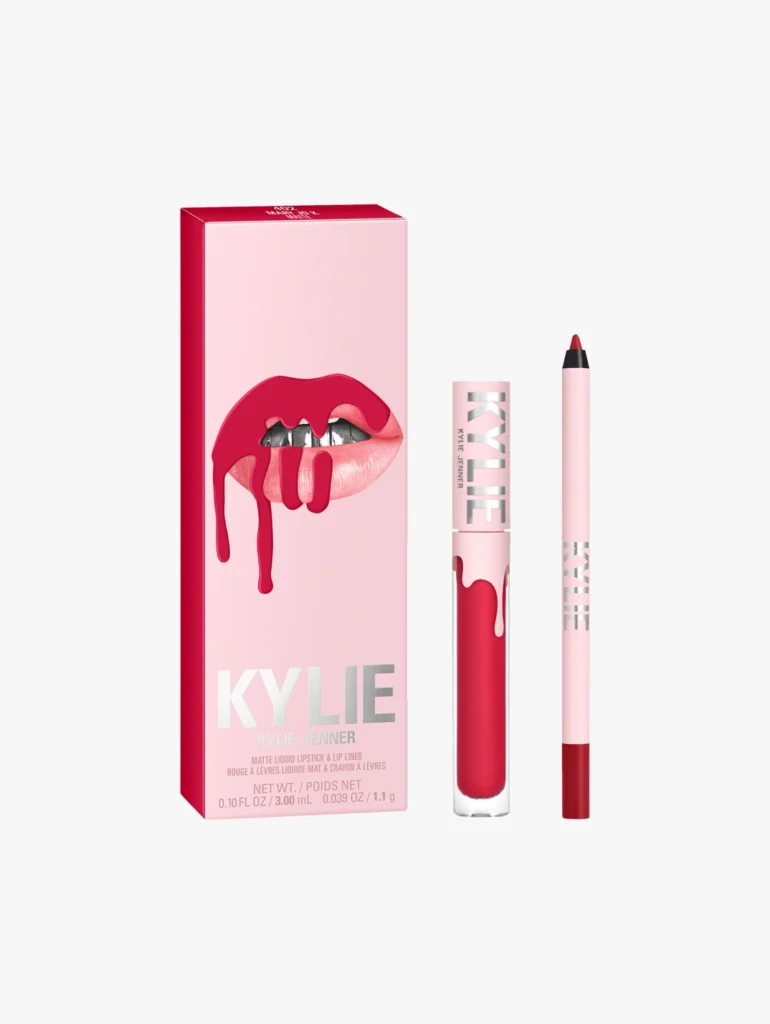
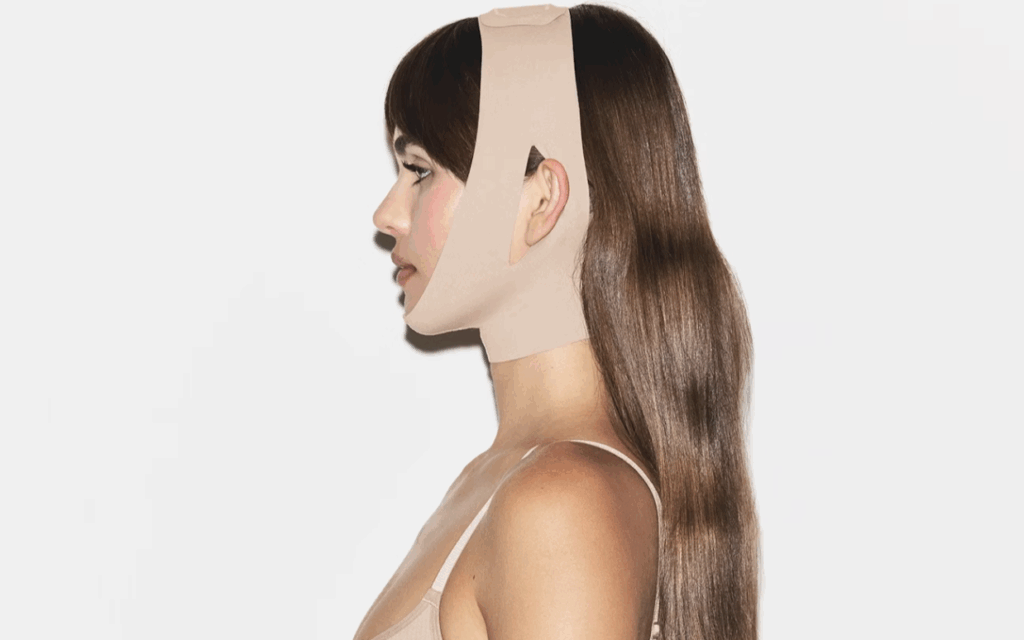
Further, with users admiring celebrities for their looks, individuals are more likely to buy products from celebrities which promise to make ‘average’ women look like they do. A great example of this, is products sold by the Kardashians, such as the famous Kylie Lip Kits which were sold on the basis of making women’s lips look like Kylie Jenner’s, or the ridiculous 2025 SKIMS Seamless Sculpt Face Wrap, which promises to reduce a double chin.
As explored above, there are significant negative behaviours which can stem from social media use, such as over-exercising and dieting, heavily editing photos and videos, seeking out continual cosmetic procedures and products, and believing harmful comments from online bullies. Although social media can create long-lasting thoughts and feelings, there are ways to combat them.
To reduce the harmful impacts on body image and self-esteem, research has found that adopting the following social media habits significantly assists users:
- Unfollowing accounts that present unhealthy eating, exercising or ‘beauty’ habits. For example, fitness influencers which only show perfection in their routines, or preach a lack of rest, with statements such as ‘no pain, no gain’ ruling their approach to exercise.
- Reporting accounts/posts that promote dangerous body ideals or tips. For example, those who share low ‘weight goal’ or ‘BMI goal’ numbers, or pictures of small amounts of food being claimed to be too much.
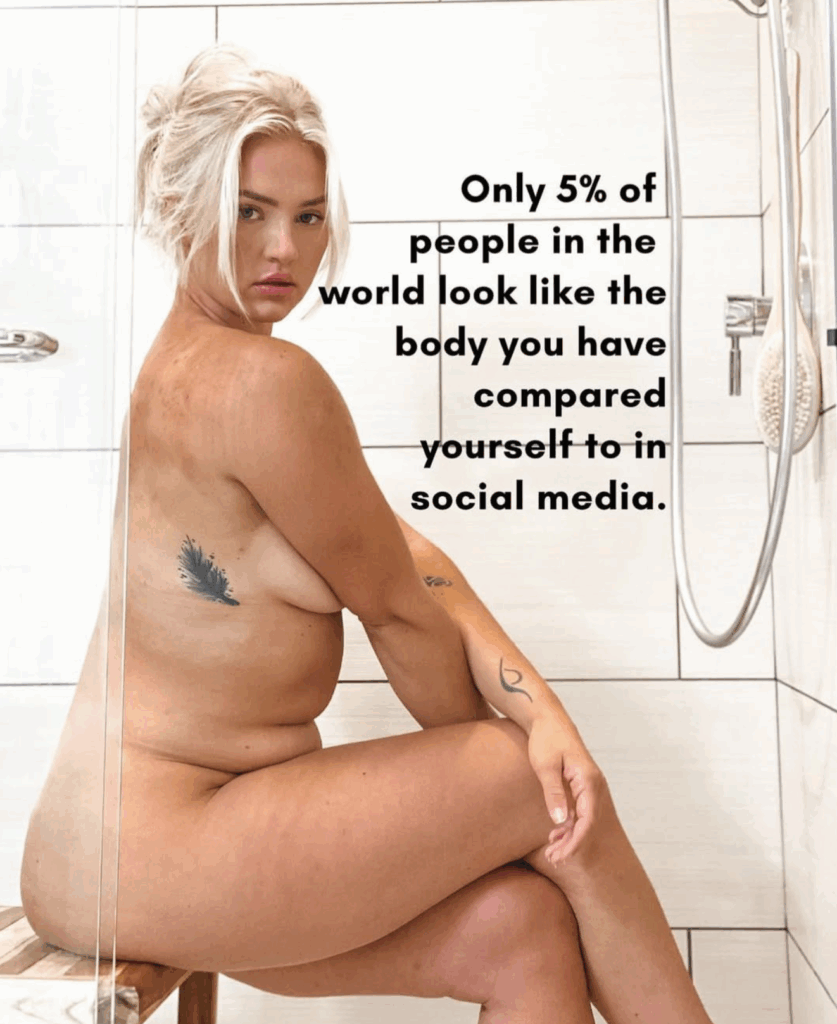
- Blocking and reporting users who harass or bully. This includes reporting users who have harassed yourself or others (even if you do not know the person being bullied in real life, it can assist them). There are ways to report a user on their profile anonymously on Instagram and TikTok.
- Following accounts that promote positive body image and mental health, such as @beyondblueofficial or @thebodcon, and body positive/body neutral users, such as @mikzazon or @spencer.barbosa.
- Reducing general social media use. Recent research has found that teens who reduced their social media usage by 50% for a few weeks saw an improvement in their view of their weight and appearance (Goldfield 2023). Though, any reduction of screen time can cause significant benefits, such as improved sleep.
- Fostering open conversations with friends and other women about body image, self-esteem and insecurities. Having a network can make you feel less alone in battling negative thoughts and desires to harm yourself directly or indirectly.
As a woman it can feel impossible to be good enough, thin enough, and pretty enough, but the more we entertain and interact with these insane ideals presented on social media, the more we believe them, and damage our self-esteem.
So, look after yourself and remember that social media thrives on insecurity. Don’t let it win in convincing you that you need to change who you are.
 Guan QiuYu
  REN Ren
  Tan Kane