
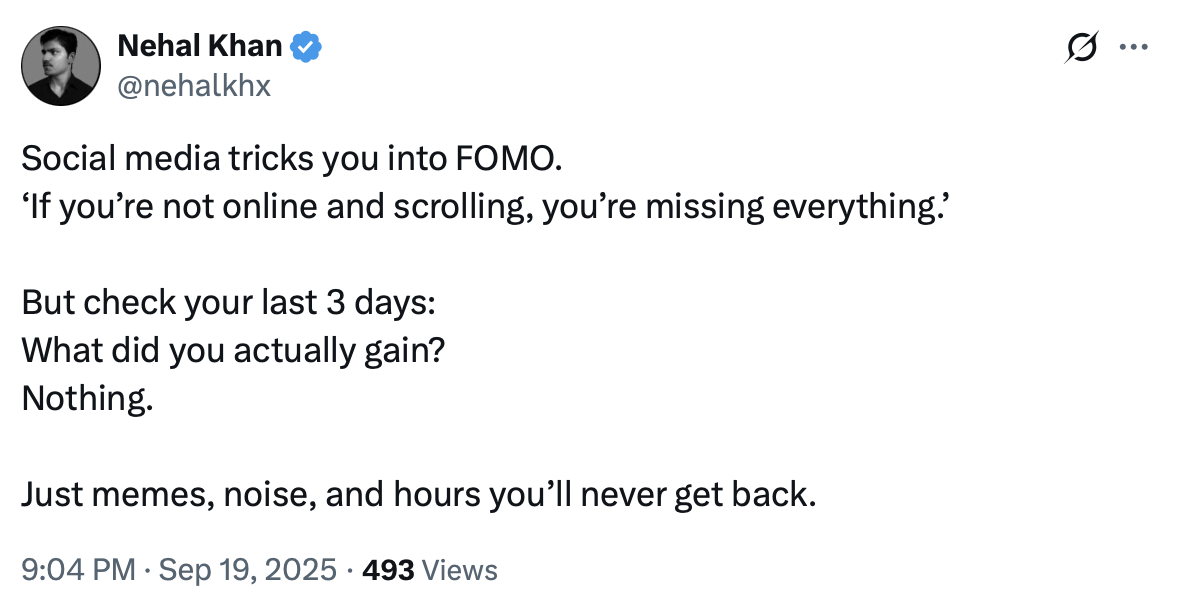
Despite the widespread belief that social media is a necessary tool for young adults, it’s actually not that important. In the contemporary landscape of digital society, the concept of a social media disconnect is difficult to define. The variety of options available leaves the choice of action to the individual themselves. In the context of this text, disconnect refers to an extended removal of social media participation, with no exemptions. For the past two months I have been living a social media free life, and I would be lying if I said that this hasn’t changed my personal welfare. However, it has come at a cost. Through my personal experimentation and examination of scholarly research on the concept of a social media disconnect, it is abundantly clear that young adults find it highly difficult to take a step back and disconnect from social media platforms. But why is this? Despite the creation and acknowledgement of countless studies that identify the risks of social media, there is widespread difficulty in the separation of ourselves from such factors. It all comes down to the simple, yet pitiful, notion of FOMO: fear of missing out.
For years I have wanted to separate myself from the addiction of social media, however I have never been able to carry out this action – until now. The concept of a social media disconnect is incredibly daunting to an individual whose entire life is dictated by relationships across media platforms. Instagram and Snapchat have been a means of communication, in the sense of establishing both relationships and identity. As someone who is greatly involved in popular music culture, X and TikTok were essential for me to stay up to date. Some people may be embarrassed to admit how much power FOMO has in their engagement with social media, but I can openly admit that FOMO was the singular thing that tied me to staying active online. Two months ago I deleted TikTok on a whim, then other social media platforms followed in pursuit. Honestly, it doesn’t feel like I’m missing out on anything. After committing to a complete social media disconnect, it has been fascinating to see how the anxiety I felt in relation to FOMO has completely disappeared.
When I tell people about my choice to delete all social media platforms, the response is always a question of why. It is quite peculiar how many individuals seem surprised when they learn that others have chosen to disconnect, given that a 2022 Australian National University study found that social media usage primarily results in decreased life satisfaction for Australian teenagers. The countless number of resources that outline similar truths of harm are outweighed by the addictiveness of social media platforms. The concept of doomscrolling has emerged from the toxic relationship combination of dissatisfaction and dependence. In my experience, I would doomscroll to seek some form of entertainment and relaxation, yet I would only become uncomfortable and dissatisfied with the media content I was consuming. The vast extremes I was subjected to while doomscrolling on TikTok was something that I found very difficult to compute. Scrolling from a video about a child with cancer to a funny pop culture reference was jarring to say the least. It is well understood that social media, such as Instagram, is designed to gain and maintain your attention. Individuals know this, yet we fall victim over and over again to the same systems of business. One X user even went so far to equate this action to an addiction relapse, which given the circumstances is arguably not untrue. The question of why people, in particularly young adults, should disconnect is intertwined with the question that lies within the unwillingness to connect. I believe it takes a courageous effort to identify the personal factors that constrict welfare, and this process requires individual evaluation. A reflection of identity in such a critical way is difficult, but it is necessary if one feels like their identity is being warped by social media platforms. Not only does social media play a negative role in individual mental health, it also is limiting our critical skills as humankind. To repeatedly fall victim to social media giants just to maintain some sense of connection with the world or others is ironic, because at the same time there is a loss in the sense of self.
There is limited discourse available online about why it is difficult for people to disconnect from social media, in comparison to the assortment of resources that proclaim the need for disconnect. The collaborative experience and understanding of FOMO is the concept to blame, as this common-sense encounter requires no explanation within most contexts. A TikTok user who participated in a three-year-long social media disconnect identified “four unexpected downsides off being social media … you lose the motivation/inspiration that other peoples’ lives offer you … you lose a means of easy connection with others … you lose a built-in incentive to document moments of your life … you will have no easy way to stay in touch with acquaintances and temporary people in your life.” These factors contribute to the unwillingness for individual detox, and they also directly link to FOMO. There is an underlying fear of disconnect that makes the idea of a detox unattainable to most people, but individuals cannot be primarily blamed for the effects of actions curated by major companies. However, it is important to note that the alienation of others that is sometimes expressed online does play a role in developing social expectations of behaviour. In 2023, a TikTok user posted a video that pokes fun at people who chose to delete TikTok for screen-time reduction purposes. While the video was light-hearted, it highlights just how toxic the relationship between social media platforms and users is. If social media posts are created to develop a stigma around the choice to disconnect, how are online users supposed to feel comfortable in taking a step back? Writing expectations of social media usage into societal norms is only a recipe for disaster.
To disconnect from social media platforms requires a conscious choice to sever the relationship between the user and the platform. Participating in a short-term disconnect can assist in the process of separation, given that the bond between the user and the platform is not completely severed. There is an understanding that the user’s account will not be deleted from the platform and is still accessible once the platform has been re-downloaded. A 2022 study, conducted by thirty-one young adults, found that a short social media detox can reduce the effects of social media addiction. While a legitimate social media disconnect is a long-term commitment, it is clear that shorter commitments can also be beneficial. Like many big changes in life, baby steps are the best way to build up confidence. It is recommended that individuals who desire a break from social media trial short periods of detox, with whatever apps they desire. This once again comes back to the complexity of social media relationships, as the choice of action belongs with the individual and what they think would work best for themselves. While the weight of such choices can be overwhelming, there are many informative sources that guide individuals through these processes. For example, the social media detox checklist posted by New Leaf Products outlines 6 small tasks that an individual can implement into their daily routine to decrease their social media intake overtime. Like any other skill, routines are easier to build through continued behaviour. Isn’t it ironic though that we are subject to posts on social media that encourage us to disconnect from social media? The collaborative, yet significantly unspoken, dissatisfaction of social media users always creeps through the seams.
Firsthand accounts of people who have attempted, and succeeded, in carrying out social media disconnect actions are valuable sources to inform the choices of others. In my ongoing personal experience of participating in a disconnect, I have found that I was influenced to finally take the step towards a detox as a result of interacting with anecdotes of others. A TikTok user shared her personal experience of living offline for four years, noting that she became her most authentic self, had a lot more time to do things, was able to stop comparing herself to others, learnt to process her emotions, and felt an improvement in her relationships. In the pursuit of disconnect, my goal is to develop and understand my identity – without the influence of external factors. To hear that other individuals have been successful in developing their sense of self appealed to me, and encouraged me to commit to the action. It is evident that this experience is desired by many social media users, as the video had over 18,000 shares. A collective desire to disconnect, yet a fear to commit, only further demonstrates the dependent but toxic relationship between social media users and the platforms. This TikTok was shared five months ago, and there is a point of discussion in the question of how many of those eighteen thousand users have since committed to a disconnect. There is certainly no way to determine such date, but one can assume that a video of virality would have influenced the behaviour of some users. Once again, there is great irony in the act of being influenced by others to disconnect yourself from being influenced by others. It is a strange circulation of action, but it is innately human to learn from the experiences of others.
There is no set answer of how a social media disconnect would improve the lives and wellbeing of individuals, but there is information from literature reviews to guide expectations. Wellbeing blogger Kristen Domenell experimented with a five-week social media detox, sharing that even a short period of disconnect provided her with the insight that you actually aren’t missing out on anything when you’re offline. Sure, there are some popular culture references that she may have been unaware of, but in the grand scheme of things, the positives outweighed the negatives. Domenell shares how she gained a positive outlook on life that prioritised meaningful connections with other individuals by having to actively contact them to stay in touch, as well as having more time to strengthen other meaningful routines. This perspective raises question in the contention of offline relationships being more meaningful and authentic than those fostered online. By breaking the habits of social media, such as the addictions of doomscrolling and FOMO, there is great potential for young adults and people of all ages to develop healthier habits. While it may be a big challenge at first, it seems that the theoretical barriers created by fear are overcome by the ease of the action of disconnect in practice. This is not to discredit the difficulty of participating in a disconnect, but it is crucial that there is an understanding of how the process is simpler than one would expect. In certain situations it may be more difficult, but if small steps are taken overtime to break habits before acting upon a long-term disconnect, then the simplicity is likely to be a reality.
While individuals of all ages find it highly difficult to take a step back and disconnect from social media platforms, it is worth identifying the trap that young adults continuously fall victim to. Growing up in a contemporary landscape where social media is a norm is a fire waiting to start. FOMO and addictive tendencies are uncontrollable costs of business choices conducted by major companies, and as a result there is a widespread inability to disconnect – regardless of desires to step away from social media. This does not mean that users do not have the choice to distance themselves from habitual use of such platforms. It is difficult, but it is clear that genuine disconnect is possible and attainable. My disciplined actions have made me feel less connected to acquaintances, but I have gained more meaningful relationships with my friends and my identity. A disconnect is truly worth it, whether it is for a short period or for the foreseeable future. Our future belongs to us, not to the expectations of social media.
To disconnect or not to disconnect, that is the question.
 Guan QiuYu
  REN Ren
  Tan Kane