
History has never been presented to us with such vividness, nor has it ever felt so profoundly artificial.
Soft 1980s Cantonese songs drift through the background while girls dressed in red wander across neon-lit Hong Kong streets beneath layers of retro filters. The copywriting is also accompanied by classic lines from Hong Kong films.

This photograph posted on Xiaohongshu looks like a fragment of 1980s Hong Kong, edited through a “retro” preset. What appears to be memory is, in reality, a carefully engineered digital aesthetic shaped by algorithms.
However, all of this is artificially constructed and edited. What is even more striking is that many people who are obsessed with these fragments of the last century have actually never experienced the era they seem to miss.
On social media, nostalgia no longer functions as memory — it operates as an algorithmically engineered emotional aesthetic that compresses history into consumable symbols, reshaping how a generation of users encounters time, identity, and the past.
Digital Alchemy: How Social Media Reinvents the Past
Social media transforms historical fragments into instantly consumable nostalgic aesthetics through filters, recycled audio and stylised editing.
This process conducts a form of “digital alchemy“ in which filters, recycled audio and stylized editing compress fragments of history into instantly recognizable nostalgic aesthetics. Discolored film filters and slowed-down clips from old television dramas circulate repeatedly online, reshaping the way users visually imagine the mediated history. In this process, the meaning of “old” is fundamentally transformed. “Old” no longer functions simply as a temporal concept, but a visual and emotional code that can be generated, recognized, and circulated.
However, nostalgia itself is not new. Yet digital nostalgia differs from earlier forms of remembrance because social media platforms transform the past into rapidly circulated affective media shaped by algorithms, remix culture and user participation.
Online nostalgia emerges through analogue imperfections such as low-resolution footage and distorted sound effects. In other cases, it appears through cultural artefacts including retro fashion, classic Cantopop songs and long-running historical dramas that continue to circulate across digital platforms (Wulf, Rieger & Schmitt, 2018). Increasingly, users are not engaging with historical context itself, but with media-generated emotional atmospheres associated with the past.

A “Back to 2000s” tutorial on Xiaohongshu. This exemplifies “Digital Alchemy” in action: the user isn’t preserving a memory, but utilizing specific filters and color grading to manufacture a curated “vintage” aesthetic for modern consumption.
Because nostalgia now functions more as an aesthetic style than a historically specific period, elements from different decades can easily be remixed together. The originally independent old songs have been broken down to become background music for short videos, old television dramas are clipped into short emotional scenes, and outdated fashion styles have also regained popularity with the help of filters and shooting angles. On platforms such as Xiaohongshu and TikTok, gesture dance videos frequently combine 1990s-style Cantopop with contemporary editing techniques, collapsing multiple temporalities into the same visual space. In these algorithmically curated environments, nostalgia becomes increasingly detached from any specific historical reality.
Therefore, what users consume is not history itself, but an artificial aesthetic stylized emotional simulation of history. Complex historical periods are compressed into simplified aesthetic markers: neon-lit Hong Kong streets, retro fashion, grainy film textures and familiar old songs.
Social media nostalgia no longer depends on historical depth or narrative complexity; a single retro filter or familiar song is often enough to trigger immediate emotional recognition. In algorithmically curated social platforms, nostalgic content is designed for rapid emotional recognition rather than historical understanding. Users engage with recurring aesthetic signals such as analogue distortions, retro music and vintage colour grading, regardless of the original historical context behind them.

Over time, repeated exposure to these emotionally familiar aesthetics risks reshaping how users perceive and remember the past itself. As nostalgic content becomes increasingly standardised across platforms, users begin engaging with culturally recognizable representations of the past rather than historically specific experiences.
Yet the appeal of digital nostalgia extends far beyond visual aesthetics. Beneath the filters and recycled music lies a deeper emotional function.
Why Do Young People Miss Eras They Never Lived Through?
If Part 1 explains what the platform produces, this section asks why users keep coming back — and how the algorithm exploits an emotional vulnerability already present in digital life.
Why is a generation born into a world of instant connectivity so desperate to retreat into the grainy aesthetics of the 1990s? The answer lies not only in technology itself, but is rooted in our emotional exhaustion of contemporary digital life.
Menke (2017) helps explain the phenomenon: contemporary digital life is shaped by constant notifications, information overload and pressure to remain permanently available online.
Everyday interaction on social media often feels repetitive, performative and emotionally draining. Under these conditions, digital retrospective desire functions as a form of “retrospective refuge”: an emotionally comforting escape from the pressures of hyperconnectivity. Just as Juhl and Biscaas (2023) argue, the allure of the past isn’t its historical accuracy, but its function as a “stability machine” for the soul.
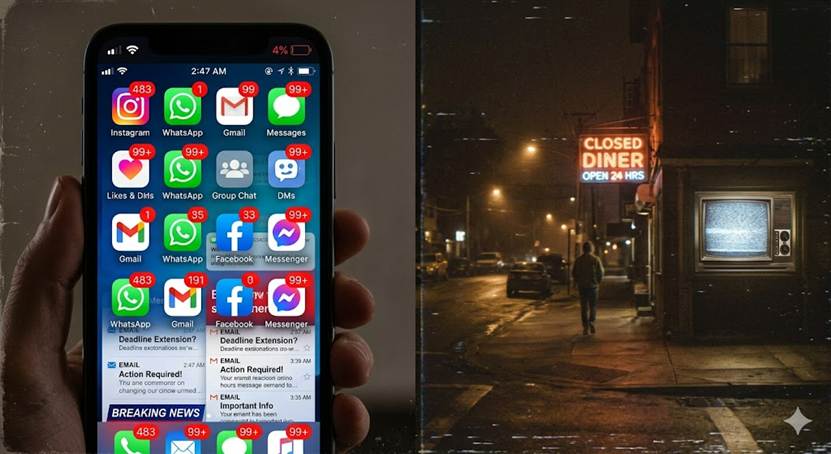
This emotional appeal helps explain why nostalgic content performs so successfully on social media. As Haberman (2026) notes, nostalgia online is often less about the reconstructed memory itself and more about “a sense of familiarity” and “carefree sharing.”

But this emotional appeal is not where the story ends — it is where the platform begins to act.
Psychologically, nostalgia can also be regarded as a form of emotional regulation. The media provides comfort by creating a familiar and controllable past version, contrasting with the unpredictable present.
Rewatching familiar television shows, replaying childhood games or revisiting discontinued snacks and cultural products creates a sense of emotional stability within an otherwise uncertain digital environment. Even users who never personally experienced these historical periods can still develop emotional attachment to the feelings associated with them.
Saadi(2026) similarly argues that people are often nostalgic not for a specific historical period, but for the slower and less performative mediated feeling associated with earlier internet culture.
“What people truly long for is not the year itself, but the feeling. What they miss is a simpler era of life, because we were less noticed, less overly optimized, and less pressured to turn every moment into something meaningful or worth sharing. Back then, surfing the internet was a pleasure, rather than a source of anxiety.”
As cultural theorist Svetlana Boym (2001) suggests, nostalgia is often not a longing for a specific historical moment, but for the emotional rhythms and imagined simplicity associated with the past. Instead, what we seek online is an idealized version of the past that feels emotionally safer than the uncertainties of the present.
Yet digital nostalgia is not entirely spontaneous. Platforms actively cultivate and reinforce nostalgic emotion because familiar content generates high engagement and repeated interaction. In this dream world fabricated by the media, there are no real-life pressures or algorithmic coercion. This form of content creates a sense of psychological stability. Platforms package this “mental ibuprofen” precisely because it keeps users coming back.
Algorithms will continuously recommend similar emotional content. Over time, nostalgia stops functioning as a temporary emotion and becomes a permanent mode of digital experience. In this sense, digital nostalgia functions less as historical recorder and more as emotional infrastructure: a constantly accessible space of comfort built and maintained by social media platforms.
Manufactured Memory and the Disappearance of Historical Reality
When emotional infrastructure runs long enough, it begins to overwrite the substrate it was built on — historical memory itself.
Algorithmically circulated retro sentiment reshapes “collective imagined past ” by replacing historical complexity with emotionally familiar digital representations. Within the constant flow of platform-driven content, history is compressed from complex historical records into visually appealing but shallow digital fragments. These endlessly repeated representations gradually replace historical complexity with culturally recognisable imagery.
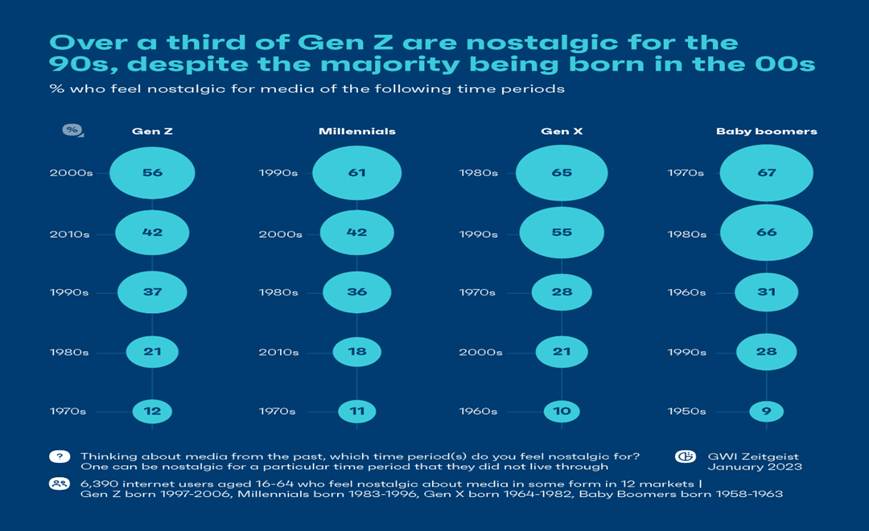
The scale of this effect is measurable. According to GWI’s 2023 Zeitgeist survey, Considering Gen Z were born sometime between 1997 to 2006, 37% say they feel nostalgic for the 1990s – a decade when some were very young, and others weren’t even born yet. Nostalgia no longer requires memory at all.
When we see new generations who have never experienced the 1980s or 1990s staring at the screen and reminiscing about an old video full of snow grain noise, we will feel something: We are not seeking lost time, but rather consuming a kind of “old sentiment” that has been produced and circulated.
Increasingly, younger users engage with algorithmically circulated representations of the past rather than lived historical experience. For many, nostalgia emerges not from personal memory, but from repeated exposure to emotionally charged digital aesthetics.
This form of nostalgia makes the past appear emotionally intimate while simultaneously stripping it of historical depth. To align with the trend of social media, history must be “dehydrated” into simplified aesthetic fragments. Nostalgic aesthetics such as 1980s vaporwave or 1990s media formats are selectively revived, while the political tensions, economic anxieties and social contradictions of those eras are largely erased. This highly simplified form of collective memory transforms history into a polished and emotionally comfortable fiction.
When history becomes “emotional content” on social media, it loses its capacity to confront or disrupt present realities. What we share is no longer vivid and real memories, but rather an emotional commodity packaged for consumption, a past that has been stripped of its essence and is stripped of its complexity and rendered emotionally consumable.
Societies often turn toward the past as a form of psychological refuge. This growing dependence on nostalgia reflects a broader cultural stagnation. In moments of uncertainty and instability, societies often retreat into idealized versions of the past rather than confronting the anxieties of the present or imagining alternative futures. As The Comfort Trap: How Nostalgia Shapes Our Media and Minds mentioned that nostalgic media may lead to restricted creativity and the disappearance of individuals. This tendency can also be observed in phenomena such as “Disney adults,” where consumers remain emotionally attached to nostalgic media worlds as a form of escapism from contemporary anxieties (Kirouac, 2025). Under these conditions, nostalgia stops functioning as reflection and begins functioning as avoidance.
Within algorithmic environments, the past no longer serves as a foundation for reflecting on the present, but instead becomes a tool for entertainment and escapism from an increasingly uncertain future. Ultimately, we lose not only the true history, but also the ability to imagine the future innovatively. When nostalgia becomes an industry, users are simultaneously its consumers and its unpaid producers — co-fabricating the very past they then mistake for memory.

Conclusion: Nostalgia is less about memory than survival under digital capitalism
Overall, the “digital nostalgia” that people experience is not merely a longing for the past. It represents a cultural reconfiguration created by media, emotions, and algorithms. In this process, the media produce an idealized version of the past, which users consume as emotional comfort, and the past is simplified into repeatable symbols.
The platform has transformed into a reconfiguration system. Through algorithms and editing tools, the fragmented past is reorganized and the consumable content is presented. However, nostalgia under digital capitalism is less about remembrance and more about survival. The refuge it provides for users is still at the cost of sacrificing the complexity of the past.
More importantly, digital nostalgia may be reshaping the relationship between humans and memory. As algorithms continue to influence users’ memories, the boundaries between reality and fiction are becoming increasingly blurred. The role of social media is not merely to enable us to remember the past. It constructs the past, packages it into consumable emotional content, and continuously creates fictional memories.
If the algorithm continues to recreate those addictive pasts, the danger may not only be the loss of an accurate depiction of history, but also the gradual loss of the ability to imagine other possible futures.
So the question arises: As algorithms continue to shape our memories, can we still distinguish between real memories and fabricated ones?
References
´^_−☆ 港.の记忆 18.图 – 小红书. (2024). Xiaohongshu.com. https://www.xiaohongshu.com/explore/681d736f0000000022026b49?xsec_token=ABle51e11PNzZORGB3d4AiT0levqXduokZhxA4BzWqm5E=&xsec_source=pc_search&source=web_explore_feed
Adriaansen, R.-J., & Smit, R. (2025). Collective Memory and Social Media. Current Opinion in Psychology, 102077. https://doi.org/10.1016/j.copsyc.2025.102077
Alfiora, C. (2023, July 3). Nostalgia in Media: Seeking Comfort in Scenes of the Past – EnVi Media. EnVi Media. https://envimedia.co/nostalgia-in-media-seeking-comfort-in-the-scenes-of-the-past/
back to 2000s ⊹✮+⋆ 调色教程 – 小红书. (2024). Xiaohongshu.com. https://www.xiaohongshu.com/explore/691ea828000000001e027c9b?xsec_token=ABF6j7Nb716NCKgDKclYmBvK3VhaOLb-jGtbQFAOW4m1k=&xsec_source=pc_search&source=web_explore_feed
拨开天空的乌云☁️#张嘉懿Austin #拨开天空的乌云像蓝丝绒一样美丽 #手势舞 #开始跳舞吧 !. (n.d.). Www.youtube.com. Retrieved May 9, 2026, from https://www.youtube.com/shorts/u3hJEMYbM24
Boym, S. (2001). The future of nostalgia. Basic Books.
Cambourne, K. (2019, December 12). Why are we so nostalgic for the 1990s? – University of Wollongong – UOW. Www.uow.edu.au. https://www.uow.edu.au/the-stand/2019/why-are-we-so-nostalgic-for-the-1990s.php
Christian Jarrett. (2023, September 21). Anemoia: the psychology behind feeling nostalgic for a time you’ve never known. Www.sciencefocus.com. https://www.sciencefocus.com/the-human-body/anemoia-nostalgia
Emma. (2026, February 13). Vintage vs Retro – Why the Difference Matters. My Vintage. https://www.myvintage.uk/post/vintage-vs-retro-difference-uk?srsltid=AfmBOorl-8AyrHatKDiKkBgouGlKarUWYyRm-m7fIiy2EZKnjnr6mF8M
Emrantraut. (2020, August 11). History of Vaporwave. Medium. https://medium.com/@agoraroad/history-of-vaporwave-99f77ae12f8f
Ferrara, G. (2024, February 12). The Impact of Nostalgic Media. Stony Brook Media Showcase. https://sbmediashowcase.com/2467/studies/the-impact-of-nostalgic-media/
gabi belle. (2022, November 11). How Nostalgia Controls Us. YouTube. https://www.youtube.com/watch?v=U7ogXHmQ-R8
Haberman, L. (2026). Why social media feels retro right now. Adobe.com. https://www.adobe.com/express/learn/blog/nostalgia-on-social
Harlow, S. (2025). Connecting the Dots: 2025 Consumer Trends | GWI. Gwi.com. https://doi.org/1023116164/1731408981082/module_181023116164_Navigation-new
Juhl, J., & Biskas, M. (2023). Nostalgia: An impactful social emotion. Current Opinion in Psychology, 49(49), 101545. https://doi.org/10.1016/j.copsyc.2022.101545
Kaycinho. (2018, September 4). What is a digital alchemist? Kaycinho. https://kaycinho.com/what-is-a-digital-alchemist/
Kirouac, M. (2025, August 7). The Rise of the Disney Adult. InsideHook. https://www.insidehook.com/culture/rise-disney-adult
Mariner Jaros. (2025, July 12). What Exactly is Nostalgia? YouTube. https://www.youtube.com/watch?v=5SEJxTE-iEI
Menke, M. (2017). Seeking Comfort in Past Media: Modelling Media Nostalgia as a Way of Coping with Media Change. International Journal of Communication, 11(0), 21. https://ijoc.org/index.php/ijoc/article/view/5534
Metzler, H., & Garcia, D. (2023). Social Drivers and Algorithmic Mechanisms on Digital Media. Perspectives on Psychological Science, 19(5), 735–748. https://doi.org/10.1177/17456916231185057
Navarro, M. (2025, December 19). What are algorithms and how do they make social media more harmful? Center for Countering Digital Hate | CCDH. https://counterhate.com/blog/what-are-algorithms-and-how-do-they-make-social-media-more-harmful/
Obradović, S., & Ivanović, J. (2025). Collective remembering and imagining futures. Current Opinion in Psychology, 67, 102158. https://doi.org/10.1016/j.copsyc.2025.102158
Payne, C., & Payne, C. (2019, April 12). Fetch Is Actually Happening: How We Traded the ’90s For 2000s Nostalgia. Billboard. https://www.billboard.com/music/pop/2000s-nostalgia-90s-trends-thank-u-next-video-8506495/
Roseate Mixes. (2025, December 8). 1990s nostalgia vibes ~summer throwback playlist. YouTube. https://www.youtube.com/watch?v=V9G-sW9gonM
Saadi, L. A. (2026, January 19). Why is 2016 Nostalgia Taking Over Social Media? Vogue Arabia. https://www.voguearabia.com/article/2016-nostalgia-taking-over-social-media
Smalera, P. (2017, October 22). Your memories are idealized versions of a past that never existed. Quartz. https://qz.com/1108119/why-we-idealize-our-memories-and-what-we-can-do-about-it
Suttie, J. (2021, November 18). Five Ways Nostalgia Can Improve Your Well-Being. Greater Good. https://greatergood.berkeley.edu/article/item/five_ways_nostalgia_can_improve_your_well_being
TED-Ed. (2016). Why do we feel nostalgia? – Clay Routledge. In YouTube. https://www.youtube.com/watch?v=WiTgn5QH_HU
The Comfort Trap: How Nostalgia Shapes Our Media and Minds – NETS2001 Writing on the Web. (2025, November 7). Netstudies.org. https://wotw.netstudies.org/2025/11/07/the-comfort-trap-how-nostalgia-shapes-our-media-and-minds/
Walmsley, J. (2025, November 7). The Rise of “Digital Aesthetics”: How Students Curate Their Online Selves. Medium; The Wildcat Word. https://medium.com/the-wildcat-word/the-rise-of-digital-aesthetics-how-students-curate-their-online-selves-39e714e8f425
Wulf, T., Rieger, D., & Schmitt, J. B. (2018). Blissed by the past: Theorizing media-induced nostalgia as an audience response factor for entertainment and well-being. Poetics, 69, 70–80. https://doi.org/10.1016/j.poetic.2018.04.001
 TianYuran
  Lu Yunyan
  Pauleen