
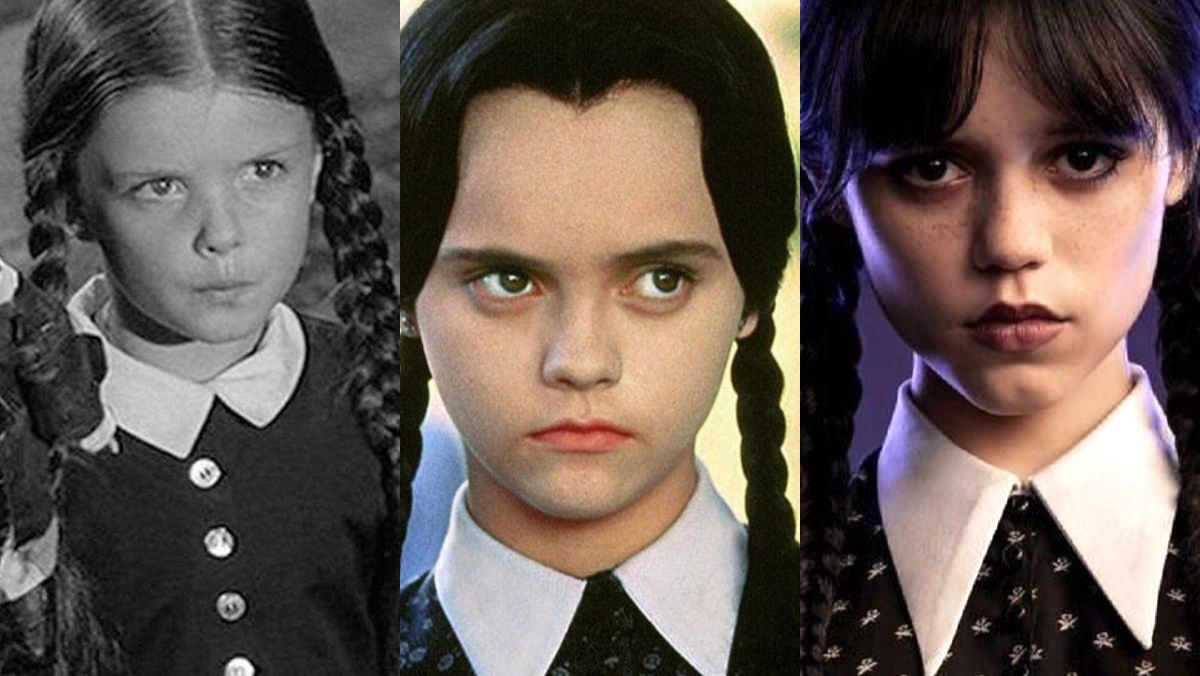
Do you ever wish that a quality canon story could just be laid to rest? Rather than being dug up over and over again, and then introducing the multiverse so that each of the undead main characters can interact and…okay, you get the point. But alas, this is the world we live in: the Remake Advent. Like it or not, TV and film entertainment have been swamping the on-demand services with reboots, remakes, sequels and prequels. It’s totally understandable to suffer from that Remake Advent fatigue, where your favourite entertainment artefact is revamped into a trend-driven (likely CGI) shell of its former glory. And worse of worse sins, it shares the same name, it claims the shared legacy. However, the Remake Advent doesn’t seem to be slowing down anytime soon, and it’s all because of fan response. Most of these remakes are shallow popcorn entertainment at best, live-action revamps such as The Lion King (2019), Mulan (2020), How to Train Your Dragon (2025) and Snow White (2025), yet an audience continues to show up. In 2019, following Avengers: Endgame, was the CGI Lion King as the 2nd highest-grossing film domestically, earning $543 638 043 in theatres. In 1994, The Lion King was Disney’s lightning in a bottle; it became an instant cult classic. But because of its unmatched beauty and entertainment as an animated film, it would be unrealistic to expect a remake to be able to recapture the lightning bolt.
So why did the audience show up? In Textual Poachers (2013), Henry Jenkins articulates the nature of a fandom through a discussion of how a toy becomes real in The Velveteen Rabbit (1922) by Margery Williams. Jenkins (2013) compares the entertainment product to a toy. He contends that the value of a new toy is not found in its material qualities, but rather in how the toy is used and received, and “how it’s integrated into the (consumers) imaginative experience” (p.50)1. He continues to draw on the discussion by asserting that the original product is not forgotten, but rather, it is “actively reworked” by the meaning that is attached to it. To apply this, the consumers’ investment in The Lion King (1994) gave it worth and life unanticipated by the creators. A meaning that defies “intrinsic merits or economic value” is cultivated from the significance the consumers bestowed upon the Lion King characters, music and story (p.50). Therefore, viewers who likely associated The Lion King with their childhood were drawn by nostalgia and appreciation to the corporate reworking of the product.
Such an intense personal investment in the ‘story’ that leads the fan to consume the recycling is often formed in lieu of the consumers’ social interactions with the product, feeding into a participatory culture2. This participation has become increasingly represented on social media, where fans attach to certain elements of the product and transform from ‘bystanders’ into ‘participants’. Fans often participate on social media through activities like debating character biases and love interests, writing fanfictions, editing compilations, crafting memes, and cosplaying. This sort of engagement cultivates a life and following of a canon that runs beyond the product itself. This process is exemplified in the multiple iterations of the Addams Family characters.
In 2022, Tim Burton’s Wednesday TV show debuted in a blaze of gothic glory, breaking records as “the most-viewed English-language Netflix series”. Horror star Jenna Ortega introduced a new version of Wednesday Addams, reimagining the eldest sibling of the Addams family as a gothic antihero attempting to power through the slough of adolescence. Despite the stylistics of Tim Burton and Danny Elfman, this product is still shallow popcorn entertainment developed by Netflix for a canon with a following. There are certain elements that viewers have latched onto, which ensured the legs from a successful season 2 that was released 3 years after the first season’s viral breakout.
Fans—across the Addams Family remakes, reboots and sequels—latched onto the Addams Family ideology, which is to be unapologetically yourself. The Addams Family is first and foremost a comedy of a family in the stereotypical suburban set-up where kookiness meets domesticity. All families have a little oddness, and typically, most products are about family members being ashamed of the skeletons in their closet. Whereas the Addams would hang the skeleton like a wreath on their front door. On the flipside, despite being unapologetically themselves, the Addams are never hostile towards other families for being ‘normal’ or concerned about their differences. This message runs through the evolving artefacts of the Addams Family, and is often the glue that sticks the fandom together.
In 1937, Charles Addams began illustrating the darkly comedic Addams Family comics. Inspired by gothic literary works, especially those done by Edgar Allan Poe, Addams illustrated the typical American nuclear family from the dark side of a mirror.
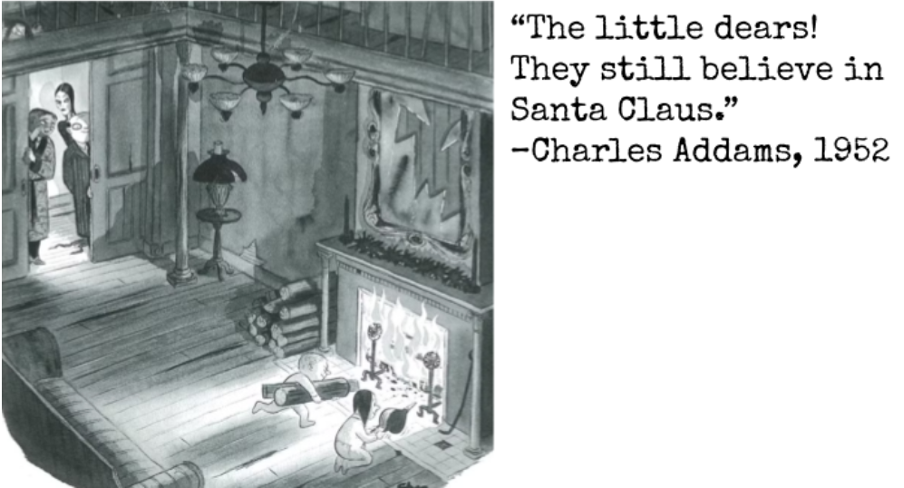
From 1964 to 1966, the Addams Family took on the stereotypical sitcom format. Showcasing comedy by their subversion of expectations, where in the Addams residence, every day is opposite day. For example, a Christmas tree is best dead, and 6-year-old Wednesday loves beheading her dolls with a miniature guillotine. The audience took a shine to this irony, and the gothic family was revived again in 1991 and 1993, in a two-part film series. The Addams Family Values (1993) is likely the most remembered Addams artefact to this day, mostly because of the personality of Christina Ricci’s 12-year-old Wednesday. Her fighting spirit and viciously brilliant one-liners add a much-needed edge to the dynamics of her good-natured parents and dull brother. Along with the gothic aesthetic, this film is characterised by irony. It follows the old married couple shenanigans of Gomez and Morticia, as well as Wednesday and Pugsley’s revolution at a summer camp. Ricci has some killer lines, for example,
*A couple is showing off their Goldilocks daughter, and the Karen-mother asks about Wednesday*
Morticia answers good-naturedly, “Oh, Wednesday’s at that very special age where a girl has only one thing on her mind.”
The Karen-mother grins patronisingly. “Boys?”
Wednesday replies, “Homicide.”
Overall, the Addams Family appealed to fans who appreciated Wednesday’s dark humour and boldness, and Gomez and Morticia’s old married couple dynamics. Furthermore, there was a positive reception at the Addams Family’s confidence in choosing to be themselves, to the point where they don’t even consider ‘not fitting in’ as a cost. Therefore, the Addams Family has been experiencing reworkings since 1937, and likely has the most following from the 1991 and 1993 films.
It is a combination of the above appeals, which inspired Netflix and revived the fandom to engage with the new product. Now, to address the new product itself. Wednesday (2022, 2025) is a genre-blend of gothic, horror, murder mystery and comedy, which expands upon the endearing, but limited domestic set-up of the earlier Addams products. This TV show could be considered a reboot, which is a product that shares characteristics, premises and (possibly) continuity with a predecessor, yet it may also differ in major ways. However, due to the legacy of iterations it taps into, Wednesday also presents some significant sequel traits, since the character roles are essentially the same. For example, the character of Wednesday has grown in a consecutive order with the release of products, from 6 years old (1964), to 9 years old and then 13 years old (1991 & 1993). In this iteration, Wednesday is a 16-year-old Latina girl who is trying to find herself.
Wednesday is sent to Nevermore Academy, a boarding school for outcasts in the small town of Jericho that hates outcasts. Most of the students are essentially people with fantastical properties (such as sirens, telekenetics, and werewolves) and general oddities. The murder mystery kicks into gear when a serial killer goes on a gory and violent killing spree in the small town, yet manages to escape Wednesday’s keen detective skills. In addition to the gothic-horror aspect, which has risen in popularity in the last few years, Ortega’s deadpan delivery triggered the humour of contrast between her violent messaging and methodically monotone voice. Additionally, the writing also made for incredibly quotable lines and satisfyingly savage insults. Those lines and character traits remain aligned with the Addams family values of being unapologetically yourself; however, the creators shifted them into a format that allowed social media users to engage.
Social media has been gaining an absurd amount of momentum since the early 2000s. From being launched to great success in 2016 to the present of 2025, “TikTok has established itself as one of the most influential social media platforms in the world”. In addition to the fan compilations of ‘Wednesday Addams once said’ or ‘Wednesday Addams being a mood’, TikTok was captivated by the viral Wednesday Rave’n Dance of season 1. Ortega came up with a simple and kooky choreography for Wednesday when she attended Nevermore’s school dance. This choreography resembled the simplicity of past TikTok dance trends. As a result, social media users all leapt for the chance to emulate their own versions of the girl who was unafraid to dance her own style in the middle of a crowded ballroom.
Furthermore, there are several moments where Wednesday expresses a rejection of modern devices and an overall digital social life (in addition to the rejection of an IRL social life). Therefore, she has dedicated herself to high-brow culture of listening to classical music on a record player, playing Vivaldi’s Winter on the cello, and writing a novel on a typewriter. However endearing and striking the old-fashioned visual, it is unrelatable to most of the audience. So, additional moments would need to be added for the audience to connect more.
For instance, this can be shown in Wednesday’s dialogue when she has a turf war with her roommate, Enid Sinclair, a buzzing socialite and digital gossip queen.
Wednesday responds, “When I look at you, the following emojis come to mind: rope, shovel, hole.” (Season 1, Episode 1)
The inclusion of emojis into Wednesday’s high-brow vernacular connects with our setting of a Digital Advent, and offers a humorous contrast, while remaining true to her typically savage one-liners. Another quote exemplifies her growth as a character and the continuation of Wednesday’s strong sense of justice and vengeance.
*Enid is getting ready to go on a date*
Wednesday tells her, “If he breaks your heart, I’ll nail gun his.” (Season 1, Episode 3)
In previous Addams artefacts, Wednesday had been a child and tween, with romance and friends being non-existent. As the fandom has grown, so has the character. Moreover, this applied Wednesday’s fierce protectiveness to a scenario in which a teenage girl is rooting for her friend, albeit in her own Wednesday-ish way.
One could say that the spin-off types, such as remakes and reboots, are creatively lazy and basically choose a money-grab over art. However, at the end of the day, the likes of Netflix and Disney are businesses with the need to make an income. But Wednesday exemplifies a product that exempts it from the prolonged sequel or lazy repeat, since the creators approached it as a beloved artefact, but expanded upon it with a stylistic vision of their own. The Edgar Allan Poe-informed lore, from gothic literature such as ‘The Raven’ (1845) and ‘The Telltale Heart’ (1843), provided the story with backbone. Therefore, the creators thought outside of the modernising box; they assessed what required modernising but focused on what characterised the fandom: the gothic genre. The gothic genre began in the 18th century and usually features an antihero, a “flawed, lonely, and a social outcast”. This morally complex antihero is conventionally involved in a battle between “human and unnatural forces of evil (sometimes man-made, sometimes supernatural)”, set in an oppressive landscape. Therefore, creators noted the untapped potential of the gothic genre and embraced it. Burton came in with his artistic knowledge of segmented body parts and the blending of life and death, then provided the perfectly oppressive scene for the Addams Family canon to be reworked into.
Moreover, with the rise of participation culture on social media and fans spinning out their reworkings of past canons, audiences will maintain their personal investment. However, relying on past products alone is not enough. In order to shape a remake to be worthy of the audience’s participation, creators need to respect and enhance the original material in a way that engages the fandom and honours its predecessors, even if it’s just popcorn entertainment.
- Jenkins, H. (2013). Textual Poachers: Television fans and participatory culture. 20th Anniversary Ed. Taylor & Francis Group. ↩︎
 WEI JIACHEN
  Guan QiuYu
  REN Ren