
Introduction
The waves of positive change brought by AI over the last few years have been nothing short of remarkable. From education to healthcare to sustainability efforts, it has transformed learning experiences, enabled medical breakthroughs, even protected biodiversity. And we’re merely witnessing the tip of the iceberg.
BBC, on 17 September 2025, shed light on the Delphi-2M, the health industry’s Chat GPT equivalent. Through language learning, the technology has been trained to identify patterns in medical records, enabling it to assess the risks for over a thousand different diseases. On the sustainability front, AI has made a groundbreaking step toward tackling plastic pollution, enabling the creation biodegradable vinyl copolymers with unprecedented precision, giving us the hope of eco-friendly plastics.
Yet, AI today has drawn as much criticism as it has praise. Counter arguments have been made for the exact same industries mentioned. For example, it’s no longer new news that AI is an energy guzzler, its annual consumption potentially exceeding that “of a small country like Belgium by 2026.”
AI is a double-edged sword that wields as much power to advance humanity as much as it does to regress us. Goldman Sachs estimated that 300 million jobs could be lost to AI, which potentially affects 25% of the global labour market. Beyond the usual suspects like administrative tasks, document drafting, practical writing and graphics, today AI has encroached into an industry previously believed to be un-replicable by computers: the music industry. In 2014, it was already abuzz with a classical composition written by a computer called “Hello World”. It was a convincingly good classical piece but still required a human to play the notes. Fast forward 11 years; today AI is no longer limited to just writing songs, but producing the music, arrangements, even forming “bands” that can play any genre, even if the “creator” knows nothing about music.
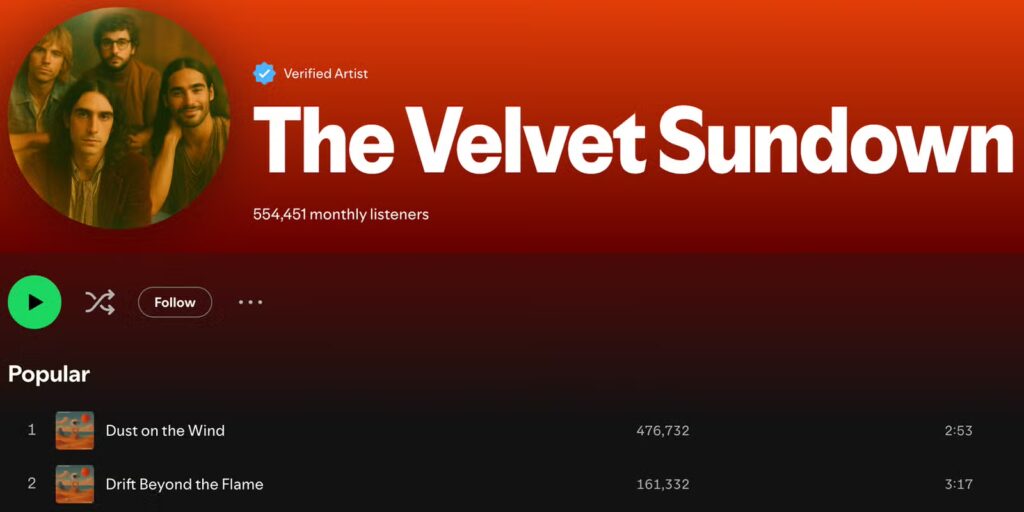
Velvet Sundown caused quite a stir recently when they “produced” an album. No one had heard of them prior because up until then, they didn’t exist. Technically, they still don’t. The four members play classic rock, come complete with retro 70s album cover, and are all AI generated, garnering over 3 million plays on Spotify by September the same year.
Innovation and phenomenal achievement aside, its rapid adoption is what threatens human creativity, potentially displacing skilled musicians, devaluing cultural significance. In fact, music on the Internet has already eroded the music industry without us knowing. The problem is further augmented with the help of music platforms, who have in the past decade or so, slowly but surely killed the radio star, and in partnership with AI, run the risk of removing the soul of music, wiping out demand for professional musicians and diminishing the incentives this industry once had.
AI music’s not-so-secret lobbyists
AI music works like all other generative media: machine-learning happens through vast databases, genres and categories are recognized and stored, then wait to be put together based on human prompts. Today, any user with a phone or email can sign in to AI composers like Suno and “make” music without the need to know notes, chords or theory. What adds to the problem are some narratives from within the industry that favour AI music, lauding tools like LANDR and SongStarter for “helping” producers and musicians compose more efficiently. Some creative communities, perhaps in the name of progress, even trumpet their collaboration with AI, claiming it helps them be better.
However, all that’s still not the biggest culprits. Perhaps the biggest influencers of today’s spiral in for professional musicians come masked as heroes, ironically claiming their position as purveyors who have made music more accessible. They disguise as champions of artists, yet remain fans of AI slop behind closed doors.
They’re called music platforms, and they killed the radio star, video star and everything in between. Little wonder why their protest against the invasion of AI music has been fairly reserved, if any at all.
For years now, streaming giants like Spotify and YouTube have given listeners a dream deal: all the music you want, for a small monthly fee. In the book Chokepoint Capitalism, its authors break it down for us, shedding light on the pittance artists get. They tell the story of independent cellist and composer Zoë Keating who has long shared transparent reports on her streaming income, with records dating back to 2012. She gave an example that in September 2019, her music was streamed more than 200,000 times on Spotify, yet the payout amounted to a mere $753—roughly $0.0036 per play. Although not every artist experiences the industry the exact same way, her case highlights the stark realities many face in today’s streaming economy.
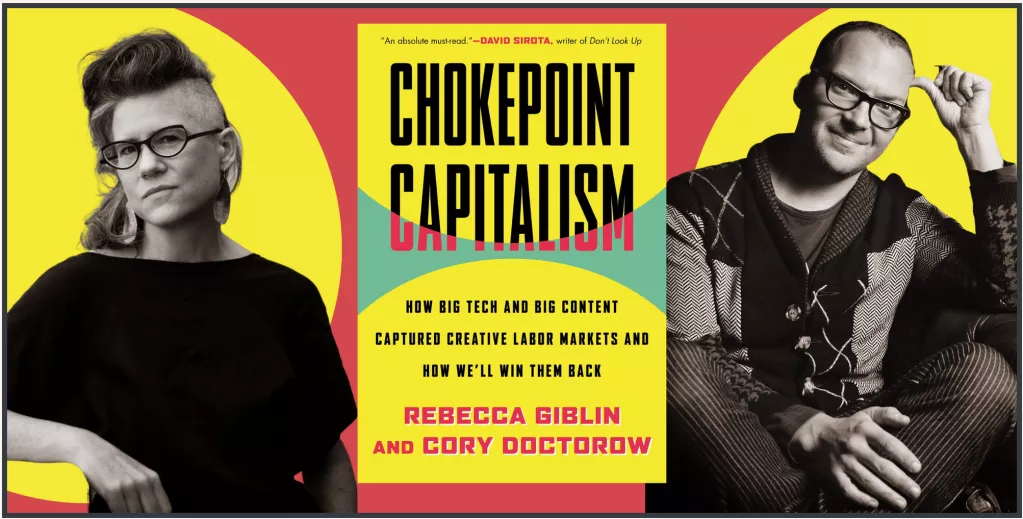
Agreements between streaming platforms and record labels are designed by giants for giants. The cream of the crop stand to get richer, while the niche, indie and upcoming artist get the receiving end of a very broken system. One structural feature of this economy blatantly skews the deal in favour of major stars though the way royalties are distributed. Chokepoint explains that most platforms employ a pro-rata system, where subscription fees are pooled together and paid out according to share of total plays. This means that if Bieber accounts for 5 percent of all streams, his label collects 5 percent of the revenue—even from subscribers who have never played a single one of his songs.
The other problem is that it’s never enough. Spotify’s Q4 total revenue last year was a staggering €4.2 billion. One would assume its owners would be popping the champagne, and that the streaming giant would be content. But that is rare with any monopoly. Even worse, there is no governing body to pull the handbrakes. Spotify has even gone further to claim it is not making profit. In fact, they stated paying out $10bn in royalties in 2024, the highest annual payment from any retailer in history. As a way of stemming the massive bleed in finances, would it not be surprising then if they secretly welcomed AI music? If a high percentage of AI music is streamed, then that part of the royalty pro-rata would not have to be paid since the US supreme court has banned copyright for all AI art. With that in mind, why wouldn’t Spotify love AI music? And why else would “bands” like Velvet Sundown be ticked as “verified artist”?

Velvet Sundown and other “Verified Artists”
AI music has already blurred the lines between “artist” and “machine”. And other less conspicuous musical deepfakes are already taking up cultural space that should belong to real emerging musicians. Who’s calling them out? Definitely not Spotify.
Truth be told, Velvet Sundown speaks of the potential and but they’re not the threat. The truly misleading are supposed artists like BGM Cafe, who have produced hundreds of soothing background jazz in just under 2 years, and eating into the pie that is supposed to go out to honest, skilled musicians. Like Velvet, they too are “Verified Artists”. In fact, CNBC recently reported that Spotify will move further into AI in partnership with Sony, Universal and Warner. With such a bleak future, skilled musicians now have even less incentive to create. This is not just theory, it is already happening across the globe, with Grammy-nominated artist Jess Cerro aka Montaigne considering throwing in the towel, telling Financial Review how she took 3 years to craft 10 songs, while AI now spews a song in 30 secs. Beyond her personal experience, she showcases the depth of AI music, and how it can already imitate real music with warmth and character. Hers is a hard, honest look at the future of musicians.
Threat to Musicians
The music sector is projected to lose up to a quarter of its income to AI in the next four years, an estimation that was recently featured in the Guardian. The soul, art and craft that defined culture and created revolutions is slowly being replaced by mediocrity. Real musicians across the Internet are engaging in conversations about AI composers, acknowledging its technological wonder whilst pondering their future. Beyond just session musicians, one of history’s most beloved cultural icons have disappeared over the last two decades, largely due to streaming platforms.
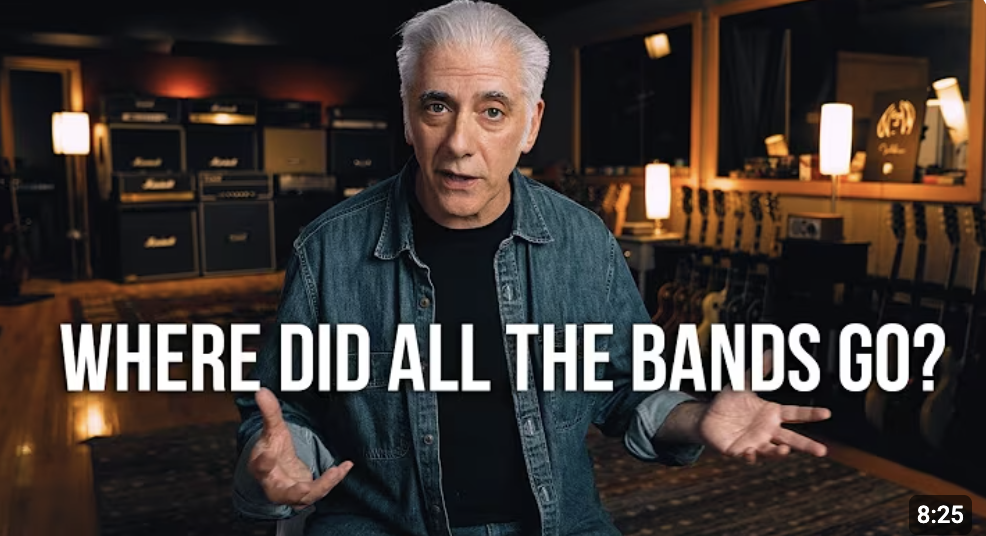
If names like The Beatles, Bon Jovi and Coldplay mean anything to us, then we would appreciate the creative culture they’ve brought to humanity, and we should be equally alarmed that they are on the road to being a thing of the past. Rick Beato, member of 90s band called Billionaire, studio musician and producer, takes us through the slow but sure demise of rock bands.
Death of the Rock Band today, then who next?
In one of his YouTube videos, simply titled Why Are Bands Mysteriously Disappearing?, Beato shares the sad figures of dwindling rock bands over the last few decades. In a nutshell, there were 146 weeks when bands were number one in the 80s, 141 in the first half of the 90s and a depressing three bands in the first five years of this decade. The top comment on this video was perhaps meant as a joke, but it got 10K likes. It simply said: It’s hard to split $0.003 between five members. Although the way record companies operate was the main contributing factor according to Beato, he ended the video by pointing out how technology has made it so much easier for companies and soloists, so much so they no longer need band members. With AI in the mix, it will only take us closer to the end of the music star. It spells a valuable loss to creative culture, one that built world-changing music revolutions, gave us the soundtrack of our growing years, and still provides a valuable form of escapism today. Beyond music stardom, musicianship as a career is becoming less and less of an option for many.
The big question is what can we do today, as the powers that be wrestle with possible solutions? While there can be no guarantees, surely not all is lost for musicians and music culture?
Silver linings
The most obvious would be policy and regulation likemandatory labeling of AI-generated music, streaming platforms creating separate categories for AI vs. human music, limiting mass uploads of AI tracks to prevent flooding, and even music awards shows having separate categories for AI music. The industry needs to set the stage, but there many corporate hoops to jump, and it will take time.
Another idea lying around is “collective action” suggested in Chokepoint, which includes limiting protection for production cartels. The public knows little about the exploitations of talent by the big corporations with enough power to call the shots with streaming platforms:
“Spotify had to get into bed with the major labels, giving them the sweetest deals and biggest freebies. As Liz Pelly reminded us, they also got to decide the terms of engagement: streaming “was shaped by the majors for the majors.”
Taking the Writer’s Guild of America as an example, writers, very much like musicians today, used to be “employees” of TV and film studios, and found it hard to claim rights to their work. Today, writers are protected with minimum wage, benefits, and residual payments for work reuse, among other rights. In the same way, Chokepoint suggests that musicians and bands under the streaming payment stand to gain more if less autonomy was given to record companies, making a livelihood in music a glimmer of possibility.
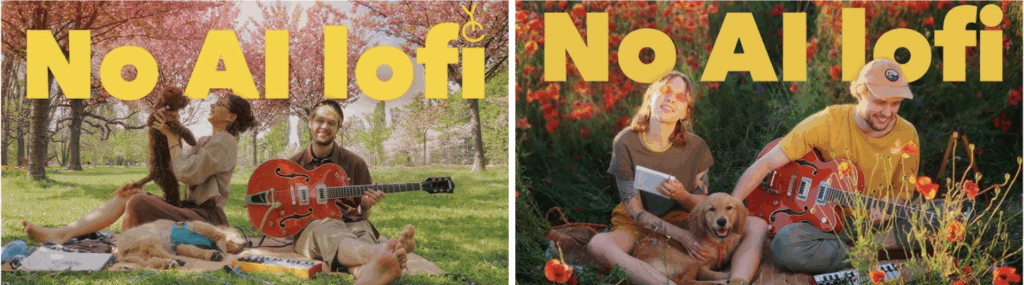
Many other ideas float around on the policy front, but implementation takes years. For now, it is you, the listener, who holds the most power. Wired suggests ways from the expected like buying your favourite band’s CDs, vinyls and merchandise, to the less obvious like streaming their songs even when you’re not listening, and purchasing through sites like Bandcamp and Resonate, who give artists much higher percentages of sales (up to 85%). Also turn on your antenna against AI music. Subscribe to creators like Yellow Cherry Jam, who label themselves No AI lofi, and record hours of themselves playing in very lofi surroundings. If all else fails and you need ideas, why not ask AI how to support independent musicians?
We’re merely scratching the surface in this uphill battle to preserve an often overlooked human ingenuity. Let’s not outsource our soul to machines. How many new Beatles, U2s, and Linkin Parks have we already missed because of streaming and Ai? A world without the musician will simply be soulless, dictated by popular but not very culturally-discerning data.
 TianYuran
  Lu Yunyan
  Pauleen