
“Sorry, your ‘Afternoon Warm Sun’ furniture package subscription has expired” (the little figure on the screen has been forced to stand up from the sofa)
“Want to unlock the ‘Cook Pasta’ skill? A single rental only costs 0.99 simulation coins”
“Detecting that your house is consuming too much cloud computing power. Please upgrade to the ‘Platinum Landlord’ membership to continue using the bay window.”
You might think I’m telling a funny joke, but let me tell you something real. This is the “design” blueprint that EA has for the upcoming “The Sims 5” (code-named Project Rene) in 2026. This is likely to be the daily gameplay of the game in the future.
I’m not sure how the executives of EA would laugh during the closed-door meeting. After all, they have indeed successfully transferred people’s “rent” and “decorating costs” to the virtual space. Compared to Life is Sim 4, the latest Life is Sim 5 is making the game itself free, meaning it eliminates the one-time fee for users. However, it adopts a subscription model, which means there are a lot of “micro transactions” in the game. Although they are called “micro” transactions, they are by no means “micro”.
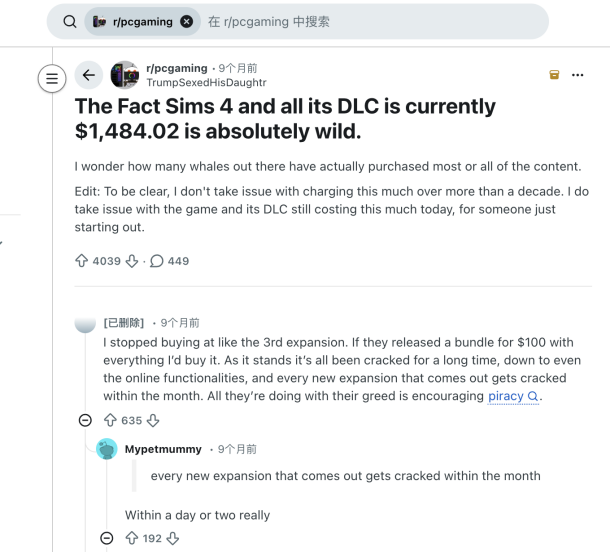
Because this subscription and charging mechanism for furniture and almost all items has been in place since Life is Sim 4, and in the free game mode of Life is Sim 5, more content will be presented in the form of subscriptions. According to pcgaming’s statistics, there are over 100 DLCs in Life is Sim 4, with a total cost of nearly 1,500 US dollars.
This is precisely what is creating the world that Jeremy Rifkin described in his book The Age of Access (2000), where people’s ownership is disappearing and replaced by “usage” transactions. I would say that EA has turned this prediction into an extremely ugly cyber laboratory.
The “The Sims” series was once about the joy of “construction and ownership”. This meant that players could earn virtual currency by working hard in the game world and purchase a bed of their own. However, in the future concept of Project Rene, these efforts have shifted from “playing” in the virtual world to “working” in the real world.
And EA claims that the free-to-play model of this game further demonstrates this ambition, that is, within the gaming space, people are being asked to pay a higher price for what seems like an attractive “free” option. EA’s removal of the “buyout system” is to force you to click the payment button in every aspect of your life.
And this model of including the costs within the virtual game has been glorified by EA’s official as a kind of “ultimate customization”.
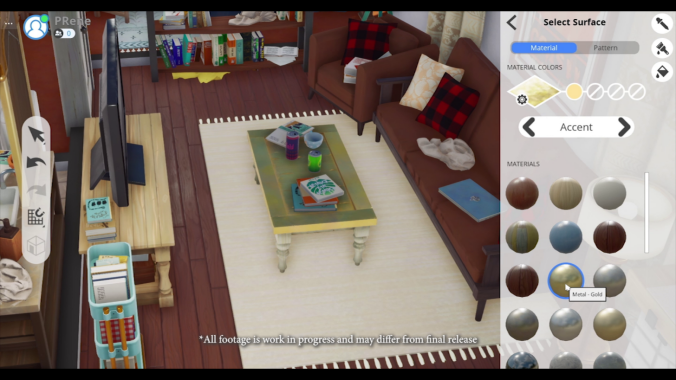
On the surface, players can adjust any aspect, even those shown by the official, of the sofa – the color of each backrest can be changed. In fact, this means that each leg of the sofa and each cushion can be priced independently.
In the end, Project Rene did achieve a certain “realistic simulation”, but it did not simulate life itself; instead, it simulated the pervasive and suffocating control that capital exerts over individual space. As we have become accustomed to subscribing to everything in reality – from streaming services to heated car seats – this logic has finally eroded our last spiritual refuge. If we need to exchange the right to “sit down” in the virtual world for a payment button, then not only do we lose the game, but we also lose the last bit of imagination about “ownership”.
 Shoujie Wang
  Han Tianyong
  Yinan Zhou