
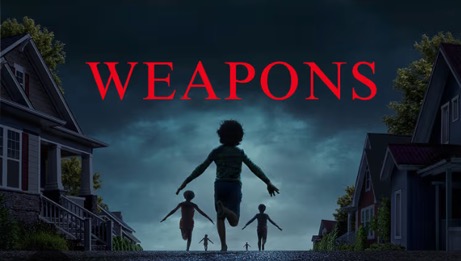
Zach Cregger’s “WEAPONS” transforms a quiet Pennsylvania suburb into one of the year’s most unsettling portraits of mass panic, revealing how quickly fear can erode the structures meant to keep communities together.
Released in August 2025, the film lasts for approximately two hours. Once released, it attracted widespread public attention and intense online discussions. Especially, it gained much attention due to its disturbing setting and fragmented narrative structure. The film begins with a chilling incident: at 2:17 a.m. one day, 17 children disappear from their homes into the darkness at the same time. They leave no clues – no warning. By dawn, streets are crowds with anxious parents, and the sound of police sirens cuts through the morning air, and the once-quiet community quickly collapses. Creggerdoes not focus on the mysterious event itself but uses the disappearance to show how a community can fall apart. This reflects a growing cultural anxiety in the United States – many people fear that children are not safe, even in places that were once seen as secure. According to a 2024 report on school safety in the United States, four in ten percent of parents are concerned about their children’s safety (The Times of India).
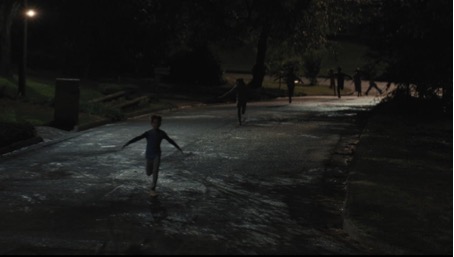
The term “Weapons”, does not just mean children disappearing. Instead, it represents a broader social anxiety surrounding the vulnerability of children’s safety in contemporary American society. In America there is worry concerning campus safety, AMBER Alerts, community surveillance and child abduction. The simultaneous vanishing of 17 children is not just a narrative device. It signals a society which understands in existential terms that safety may vanish overnight.
The collective fear of everyone in the morning strengthens the theme of the film. The American community response to a real crisis is evident from watching the frantic parents running away with the crowds at the school gate. As panic sets in, information cannot be shared clearly or quickly. The emotional shock felt in these suburbs is familiar from films that depict children disappearing, being abducted, or falling victim to unseen dangers.
Before this film, Zach Cregger directed Barbarian (2022), this is a horror film set in an ordinary suburban house. Its main plot unfolds through the fears experienced by each character. The film has attracted attention due to its oppressive scene setting and its focus on the vulnerability of individuals living in a confined family space. Here, danger lurks in the shadows and gradually comes to light. Compared with Cregger’s previous film Barbarian, while “Weapons” turns the whole town into a landscape of fear. In other words, the anxiety around child safety that we see today does not stem from a single threat but multiple variables in daily life. The shift from individual fear to collective anxiety indicates that danger is no longer imagined to be confined to specific locations, marginalized groups, or secluded spaces. Instead, fear has become widespread and universal, reinforcing the notion that threats can arise anywhere and affect anyone at any time.
One of the most powerful shocks in the film involves Justine, a schoolteacher portrayed by Julia Garner, whose car is spray-painted with the word “WITCH” – panic quickly turns into accusations. Inclusion this scene creates dramatic tension; but it also highlights one of the key issues of the American child-safety crisis: institutional distrust.
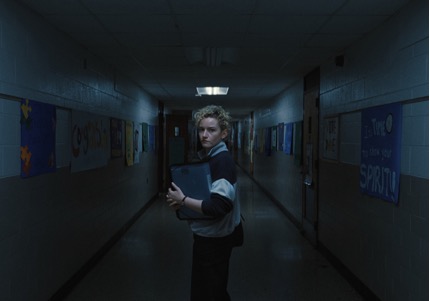
When a child goes missing in a town, adults don’t unite behind the school or the police. On the contrary, suspicion divides the community. Parents blame each other, the adults responsible for protecting children come under attack, and teachers were also suspects. This is similar to what happens in the United States in reality: teachers are often criticised in the absence of evidence.
That’s why Weapons points to a deeper problem. In the United States, child safety is not only about resisting external harm, but also about the disintegration of trust between families, schools and institutions. The film shows that the factors that threaten children’s safety come from both the outside world and from the failure of the internal systems that should have protected them.
Weapons uses a fragmented, multi-perspective narrative. The scenes appear repeatedly but have different meanings, no character has a complete narrative dominance. This is not just a style experiment, but a simulation of the common chaos that often surrounds real child-safety crises – incomplete, contradictory, and constantly updated.
Parents received the news at different times; the descriptions of witnesses contradicted each other; and the spread of rumours on social media was faster than the official clarification. By placing the audience in this chaotic structure, the film reconstructs the information disorder in the real crisis, making the audience feel as uncertain as the characters.
In the end, Weapons becomes a cultural mirror, reflecting the deep anxiety of a country that firmly believes its children should never be harmed. Through the shifting of fear from a single cinematic scene in Barbarian, to the entire community in Weapons, through its depiction of how panic starts to erode trust, and through a reproduction of the chaotic flow of information through real crisis, the film paints a deep picture of contemporary American life. Though the disappearance only happened once, the fear it has brought is still present. Above all, it indicates that in America, the systems that should have guaranteed the safety of children are equally unstable, and so are the threats they want to prevent.
 He lian
  VickyWu
  REN Ren