
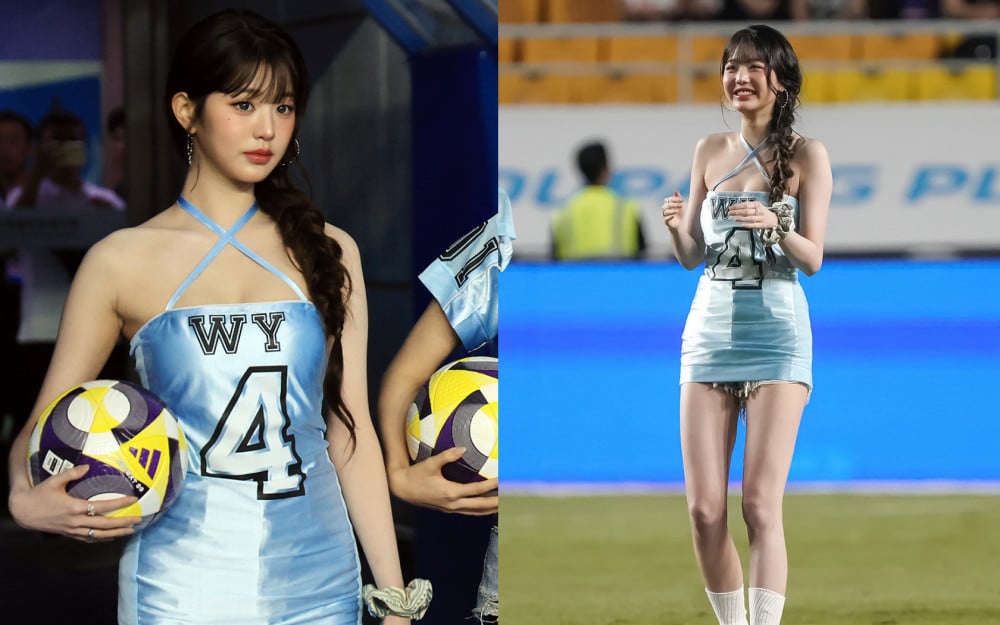
What was originally meant to be a cheerful, celebratory performance quickly turned into a storm online. After attending the kick-off and halftime performance at the 2025 Coupang Play Series first match at Suwon World Cup Stadium, a prominent member of the K-pop group IVE, Jany Won-young, found herself in the centre of the storm of online criticism for the choice of her ceremonial outfit. Won-young faces the criticism of being “inappropriate” and “immodest”, particularly when comparing it ot the attire of the other group members. The discussion has ignited an intense argument, which has made Won-young the focal point of a broader conversation about fashion, modesty, and the scrutiny that female idols have faced in the K-pop industry for many years.
The case has indicated that it showcases the broader tension of the expectations in the K-pop industry between the domestic and global audiences. In the digital era, globalisation has become an unstoppable force. The controversies were able to spread far beyond the local area of South Korea to the rest of the world. K-pop content can now be consumed by international audiences through platforms like Twitter, Instagram, and YouTube, allowing for participation in the judgment. In the K-pop industry, Female idols generally face greater pressure and judgment in the balance of cultural norms and differing expectations to balance the domestic values with the international visibility.
Within the K-pop industry, Idols are generally held accountable for an inflexible standard of “Perfection”. They are under the expectation of maintaining an approachable, scandal-free approach while aligning with the traditional values at the same time, projecting cutting-edge fashion. From their outfits to their hairstyle, they are carefully crafted in every detail and curated by their agencies in order to align with the expectations of the audience. This is inconsistent with the Western performers who are generally able to have greater personal expression without facing the same level of backlash associated with K-pop idols. The contrast highlights the restricted environment that the Female K-pop idols currently operate in.
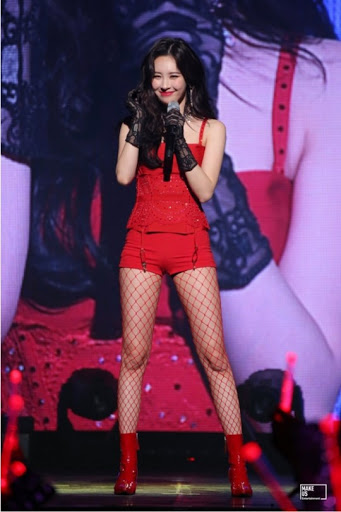
The online debate happening around Won-young is not unique in the K-pop industry or even the whole entertainment industry. Providing examples from other Idols, Sunmi once wore a bright red ensemble, which was criticised by many online, claiming she resembled a “prostitute’s outfit”, saying it was not appropriate to wear on stage. This further demonstrated the fact that in the K-pop industry, Female idols have to take time to manage the navigation between self-expression and social expectations, as they disproportionately face criticism way more often than their male counterparts.
This contrast becomes much clearer when viewed through a global lens. Looking at female artists in the Western entertainment industry, with the different cultural expectations, judgments regarding fashion choices can result in a completely different result. During the Vanity Fair Oscar Party this year, Megan Thee Stallion was wearing a green Chanel gown with feathers and nipple pasties was actually declared to have been a bold and fashion-forward move. However, even though she also received some criticism of her look as “not being it,” but more applauded for the blending signature of “hot girl” confidence with high-fashion sophistication that she represents. The construct of how culture changes the attitude of the voices received by female artists has been demonstrated.
Female K-pop idols are often constrained by the conservative expectations in their domestic markets, working under the expectation of being modest but also having to appear stylish and trendy. However, in contrast with Western celebrities, who are actually encouraged to push boundaries and use fashion as a tool of personal and professional expression. The constust has further revealed the system pressure experienced by Female K-pop idols, where minor deviations from prescribed norms can become a widespread online backlash.
By comparing those cases together, it provides a better understanding of the way female performers can be judged by the dressing options and reflects that this judgment is not just about fashion itself but is more so related to the deeper cultural values, gender norms, and industry power dynamics. The experiences that Won-young, Sunmi, and Megan Thee Stallion each have demonstrate fashion as both a control and self-expression, which further helps ot understand that under different cultural backgrounds, the level of freedom and public judgment faced by performers varies.
The issue of body gazing and gender inequality has been underscored through the debate surrounding Won-young’s outfit. Compared to male idols in the industry, female idols often face more intense judgments, partially due to their appearance and clothing. The way critics labelled her outfit “unnecessarily provocative”, identifying it as a violation of traditional standards, which deeper reflects this response, is regarding total system pressure rather than a judgment of a single fashion choice.
As a result, the case regarding Won-young’s outfit illustrated the underlying challenge that female idols are facing: navigating cultural expectations, enduring gendered scrutiny, and managing the amplified pressures of global attention. The issue with this is not unique; it has happened to other idols in the industry. However, this has reflected the persistent patterns within the industry, showing how online commentary, international exposure, and deeply ingrained gender norms combine to shape the experience of young performers in K-pop.
A deeper structural issue in the K-pop industry, the pervasive problem of body gazing, has been revealed through the controversy over the outfit worn by Won-young. Female Idols in the K-pop industry are facing frequent positioning as objects of visual consumption, as defined by Western feminism, which is identified as “male gaze.” Talking from the Western point of view, the male gaze is generally described as how women are primarily represented for women to please heterosexual male viewers and often is through reducing them to their bodies rather than acknowledging their agency. Although this is in the western perspective, it is much relevant in the K-pop industry where female idols have often been marketed through visual aesthetics to emphasise their youthfulness, purity, or hyper-sexuality, depending on the desired image.
Through the studies of fan accounts, we figure out that the female K-pop Idols often face being objectified by male fans. The research has suggested that the experience of being gazed at not only affects their public image but also influences their self-esteem and body image, bringing the suffer in the inner self. Many Idols have spoken about their mental toll openly, living under their scrutiny, speaking out about their intense anxiety, because of the constant evaluation of their bodies. Particularly being watched under the media, it has a dire effect on Idols’ everyday living and forces them to meet the unrealistic beauty standard and face criticism for any small change or difference to their expectations.
In SBS’s documentary “Bodymentary,” many Female Idols have been invited to speak out about their struggles and challenges working in this industry.
The male-centred structure in the K-pop industry is what has been causing body insecurity. Female Idols generally don’t have a say in their own outfits, and it is generally decided by agencies based on what they are selling point is. Clothing for idols is meant to appeal to fans but to reflect their personal style. The criticism of Won-young’s outfit generally ignores this lack of control, and blaming her alone hides the bigger, system-wide issues.
The issue of body gazing and self-image is a direct struggle that has been fed into female idols, which has often been shown through media reports and their personal stories. One of the articles in the Korean Times has highlighted the fact that female K-pop singers/idols have been speaking publicly about the pressure of body management, and they face it has been praised by viewers, and they are seeing this as an act of courage. The stories in this article have showcased the hidden cost to maintain the ‘perfect image‘ for female workers in the K-pop industry, where a small change in weight or clothing can ultimately become a public debate or criticism.
The struggle is far beyond a personal struggle, but a systemic one; agencies are routinely enforcing a strict diet and exercise routines for idols. The expectation of being thin has become a cultural expectation for women in Korea, which has been compounded by the K-pop industry’s view of perfect beauty, which forces the performers to be constantly chasing impossible standards. Even with fans supporting idols that openly share their struggles, they continue watching and remain in the industry. Idols are praised for honesty, but at the same time are judged by the same gaze that caused their insecurities.
Bring it back to the case of Won-young, the issue is more than just about an outfit, it is how the ongoing toll of the system continues pressuring young women to maintain perfection and face constant judgment, control and put on display.
The case of Won-young has clearly exposed the double standards between male and female idols in the K-pop industry. Studies show that because of the gender role Korean society assigns to their sex females, they are often limited in freedom and restricted to a systemic patriarchal standard. Meanwhile, men usually experience a freer and longer career journey. The inequality in treatment highlights the gender imbalance not just in the industry but in the whole of society in Korea.
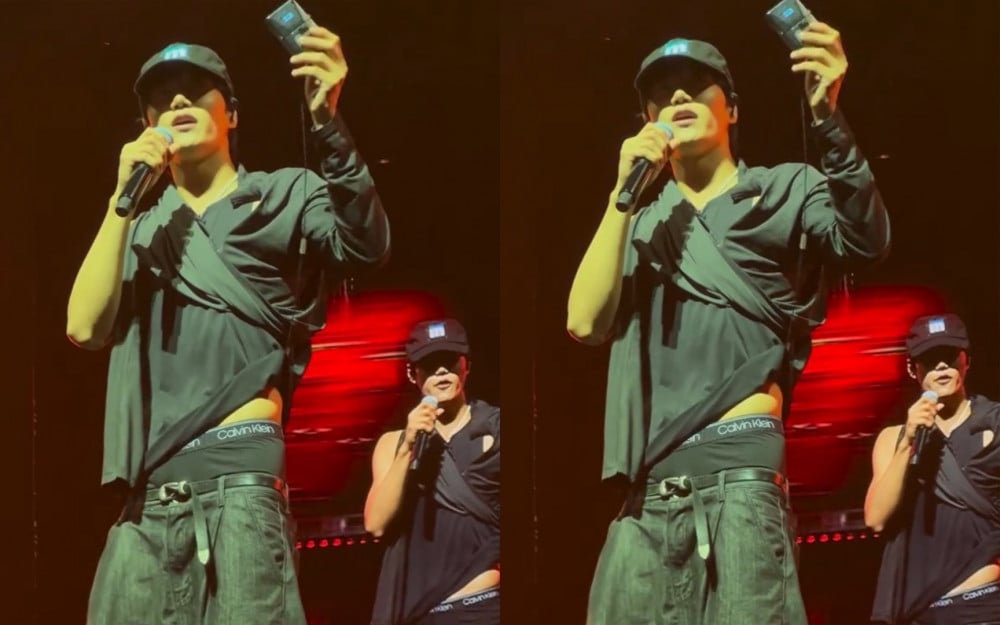
A similar case that happened around the same time as the ceremonial outfit has made this a double standard in the K-pop industry much clearer. On July 14th, a post was made on Instiz (a Korean APP) questioning
Is it a trend for male idols to show their underwear as a concept these days?
This was followed by an image of EXO’s Kai during a soundcheck. Although that post has sparked some debate on the modesty and stage presentation, the reaction compared to what Won-young has faced was relatively mild in this incident, and it didn’t spread much further. This contrast reveals how, with similar or even worse choices in fashion and clothing, male idols are often treated more leniently. Further demonstrate the gender bias in public perceptions and criticism within the industry.
The double standard can be seen clearly in the way audiences react to idols’ clothing. For Males, idols who wear those revealing or “open” outfits generally receive compliments and are celebrated as “sexy”, showcasing their strength and charm. But when female idols face similar clothing choices, they are typically criticised for being “inappropriate’ or ‘shameful’. has shown how gender norms have consciously influenced the ideas of modesty and sexuality. Female idols are generally trapped inside this paradox where there is a high expectation of being visually appealing, yet condemned when their visual identity is deemed too suggestive.
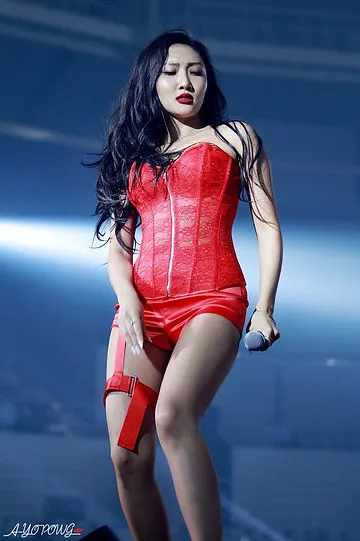
A direct example that explains this double standard would be seen through Hwasa, a member of the girl group MAMAMOO. She was critically shamed for her outfit, which she wore on stage, as it was “Showing too much skin”, even though it wasn’t actually too bad.
On the other hand, Jay Park, who was shitless, no one really cared and even was complimented on being ‘sexy’.
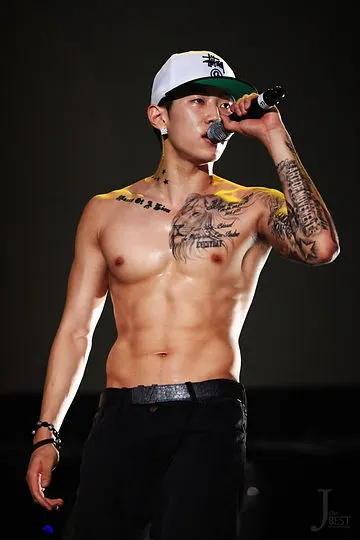
The dynamic has been perfectly illustrated by Won-young’s case. Male Idols can perform shirtless or even in provocative clothing. Still, it is rare for them to face sustained criticisms, whereas female idols performing a ceremonial duty in short outfits can become a subject of international outrage. The inequality that has been present has not only exposed the gender biases of audiences, but also has highlighted how the system that idols live in capitalises on these norms.
Won-young’s case regarding her appearance was not just about one outfit; rather, it is a mirror reflection of how the K-pop industry has continued to put women to impossible standards. Even though the criticism that she faced online was about her appearance and clothing, the incident itself actually deeply reflects the issues existing in the industry, where they are facing strict expectations to always appear perfect, working under the pervasive influence of the male gaze and navigating between the Korean traditional values and the modern perspective of the global audience. Partially comparing with Western artists or male idols in the industry, female Idols generally face harsher judgments regarding their aesthetics.
Looking at similar cases of Sunmi and Megan Thee Stallion further demonstrates that the difference in cultural context can change and shape public judgments, which reveals how Western acceptance of bold self-expression and the conservative pressures in South Korea can differ. Talking beyond fashion, the debate that has happened around appearance has also underscored how ideals are positioned as objects of visual consumption, which has negative impacts on their mental health, self-image, and autonomy, which concludes that the experience of Won-young accually the persisitent geneder inequality and double standard not just in the K-po industry but within the nation of South Korea highlight the ongoing tension that has happened around self-expression and societal expectations. This has illustrated how the industry structurally controls, judges, and constrains female performers in ways that their male counterparts rarely experience.
 Guan QiuYu
  REN Ren
  Tan Kane