
Taylor Swift is a musical artist that has taken the world by storm, but she isn’t just a singer, she is a master of marketing in the digital world. Taylor Swift has released 11 albums and her 12th album, The Life of a Showgirl, is set to be released on the 3rd of October 2025 and over the course of these albums, her marketing has strengthened. The music industry has evolved drastically as social media and streaming became the new normal. To capture an audience’s attention, traditional marketing like posters, tv ads or radio announcements are no longer sufficient in generating awareness for an artist. Artists now can reply on social media, digital platforms, and fan engagement to promote and share their music. Taylor Swift has been highly successful in harnessing the online space to create campaigns that combine music, marketing, and fan interaction. Taylor Swift’s marketing works consistently because of interactive campaigns, strong parasocial engagement, strategic use of digital platforms and cohesive branding that together, redefine music promotion in a digital age. Taylor swift has grown from a small country artist to a worldwide pop star and this article examines how her marketing strategies have helped her achieve this level of success.
Interactive and Gamified Marketing
A vital part in why Taylor Swift’s marketing constantly engages audiences and drives her commercial success is how her content is interactive and gamified. This refers to the use of game design elements in non-game contexts (Hamari et al., 2014) and an example of this is the sparkles that appear after commenting “TS12” on TikTok’s. Not only is this a game like feature, the colour of glitter continued to change in line with album cover releases, keeping fans on their toes. This was to promote her upcoming album, The Life of a Showgirl, and is an example of Swifts gamified marketing. Taylor Swift is well known for leaving clues (easter eggs), hidden messages and puzzles on her social medias for fans to solve (Cosmopolitan, 2023). But only a trained eye can pick up on these clues, leading to obsessive analyzation of every post, outfit or move Swift makes. For example, before announcing her new album, 1989 (Taylors Version), Swift wore exclusively blue and new outfits at a show at The Era’s Tour which pointed to the album announcement at the end of the show. Taylor also employs gamification into her marketing strategies.
Professor Sarah Montano (2025) argues that gamified and cryptic marketing techniques are vital in building anticipation and transforms audiences into active participants in promotional press. Montano analyzes Swift’s upcoming album The Life of a Showgirl. She shares that the announcement, being on a podcast and the album cover being blurred, was secretive. Swift relies on cryptic strategies that encourage fans to speculate and share theories online. This builds a sense of anticipation and transforms the audience into active participants rather than passive consumers.
“if we look at the teasers, clues and lack of information as a marketing tactic, and the accompanying media coverage that has been generated in the last 24 hours, then a strategy that drives curiosity and interest seems likely to succeed and mirror former record-breaking achievements” (Montano, 2025).
This shares that Swift’s marketing approach extends past the reach of her owned platforms as fans share and spread content and create their own media coverage. The effectiveness of these tactics aligns with broader ideas of interactive marketing, sharing curiosity and engagement encourage active audience participation. Taylor Swift’s announcements dominate cultural conversations and that is partly due to her mastermind marketing. Swift leaves the details up to fans to decipher, causing fan generate content and mass media attention.
Parasocial Bonds Between Swift and Fans
Another way Taylor Swift has created such a successful brand is because of fans’ strong parasocial connection to the singer. Taylor Swift fans are incredibly loyal.
“A parasocial relationship is one where an audience member experiences a one-sided relationship with an artist or performer that exists in the mind of the audience member.” (Maxwell et al., 2025)
Swift deliberately fosters this idea by being known to publicly thank fans, comment on social media posts, host secret listening sessions in her own home and provide online personal updates. Swift found herself in a battle to the ownership of her master recordings and documented this story online. Because of this, fans demonstrated loyalty by boycotting versions of her music she did not own and instead streaming and purchasing her re-recordings. Such fan activity serves as an example of how parasocial ties may result in tangible economic advantages. Because fans feel personally involved in Swift, they don’t just buy music, they actively promote it for her. On social media apps, they share theories, edit videos, create memes, and spread news faster than any official campaign could and that is arguable the most important marketing tactic of the digital age.
Maxwell et al. (2025) completed a study on Swift’s media empire and found that parasocial connections can directly influence consumer behaviors. These behaviors include loyalty, purchasing merchandise and creating user generated promotional content. Swifts’ ability to foster strong parasocial bonds creates successful marketing performances because fans are more inclined to purchase and engage with her content. By presenting herself as relatable and authentic online whilst maintaining clear boundaries as a global superstar, engagement with Taylor Swift is highly sought after. When Swift does interact with fans, its intentional and strengthens parasocial bonds. These strong ties ultimately mean loyalty and that bond is becoming unbreakable. This illustrates how parasocial interaction is a purposeful marketing tactic that continuously secures Swift’s financial success rather than only being a byproduct of fans.
Strategic Use of Digital Platforms
A parasocial connection with Taylor Swift would not be possible without digital platforms. Taylor swift strategically uses digital platforms like TikTok, Instagram, YouTube, and Spotify to create viral content. These sites are not just for releasing her musical media, they are pillars in how she shares promotional content.
These platforms utilise algorithms and Swift understands how to harness and adapt to online culture. The article “TikTok and Sound: Changing the ways of Creating, Promoting, Distributing and Listening to Music” by Bojana Radovanović Šuput (2022) shares the several ways Swift aligns with digital platforms. The article focuses on the app TikTok, noting that the music used in a TikTok is central to the potential engagement. Music leads to lip-syncing, remixes, and challenges, which turns music into a participatory experience on the app. Taylor Swift highlights and encourages this when posting her music in the app.
Swift understands how to adapt content to platform-specific algorithms. As well as TikTok, Swift uses Instagram, YouTube, and Spotify. YouTube offers long-form narrative through its dramatic music videos, while Instagram updates frequently feature highly stylised photography that supports her branding. Spotify is deliberately employed for countdowns, exclusive releases, and carefully selected playlists that entice listeners to bookmark albums or songs in advance. These apps vary in features and Swift knows what works and what doesn’t. Together, these tactics create a deeply solidified brand across multiple platforms. This creates immersive and unavoidable marketing across the digital world. Swift does not just use digital platforms; she leverages them to promote her music.
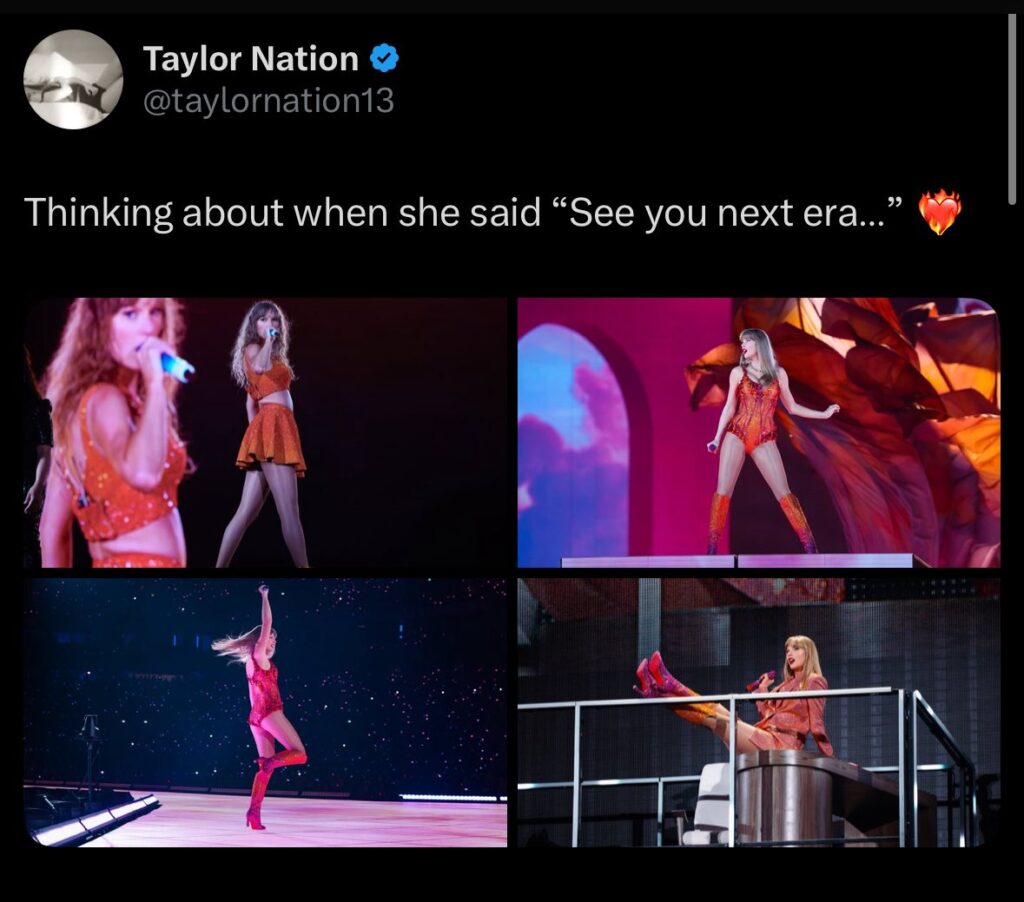
In this post, Taylor Swift’s marketing team, Taylor Nation, teases a new era. This shares her strategic use of digital platforms. This singular post creates hype around the idea of a new album, and this is because of the strategic use of digital platforms. Taylor posted this post across all her social media sites, adapting it slightly to fit the parameters of each platform. This means the post was impossible to miss, causing mass excitement for a new album on the horizon.
Narrative-Driven Branding
Narrative driven branding is something Taylor Swift does extremely well and is proven to be a marketing tactic that produces successful campaigns. Her brand persona connects with her music, public appearance, and promotional campaigns. The approach Swift takes is unique and differentiates her from other artists in the music industry. Swift constructs an overarching story that unfolds across her albums, tours, and public appearances and in her fandom, these are referred to as Era’s. This narrative strategy strengthens her parasocial connection with fans, as audiences feel intimately involved in her personal and artistic journey. Narrative driven campaigns are the overriding factor in what makes Taylor Swift so successful. Across platforms she forms cohesive branding strategies.
The Eras Tour provides a clear example of cohesive branding in effect. The distinct sets of the show highlight the phases of her career, allowing fans to differentiate and participate in Swifts evolving identity. The continuity of her brand story was reinforced by the association of each “era” with certain visual styles, music, and promotional materials. In order to combine in-person and virtual involvement, fans dressed, produced and shared material, in associated with these periods. This demonstrates how Swift’s branding is dynamic rather than static, combining conventional marketing with fan-driven promotion on YouTube, Instagram, and TikTok.
Swift guarantees that every marketing campaign feels intimate, immersive, and strategically integrated through narrative-driven branding. It is what ties together her success. Her marketing success is a combination of interactive marketing, parasocial bonds and digital platforms tied together by cohesive branding and it is redefining modern music marketing. In the digital age, the key to success is in harnessing the powers of online technology and storytelling and Taylor Swift is the blueprint in unique digital marketing.
Taylor Swift creates a cohesive brand across platforms by marketing her content in a way that is suited to a digital age. Swift ensures that her audience is constantly on their toes and engaged with possible announcements or album drops, which in turn, ensure her commercial success.
In a digital age, marketing in the music industry is evolving and Taylor Swift is revolutionising the way artists harness the digital space to promote their music. Swift’s marketing is no accident and is a result of interactive campaigns, strong parasocial connections, strategic use of digital platforms, and cohesive, narrative-driven branding. By creating an interactive campaign that leave fans guessing, she fosters further engagement with releases that extend beyond her owned platforms. Swift encourages strong parasocial relationships with fans that leads to loyalty. This generates long lasting connections and consumption of her music. She successful does these things by harnessing digital platforms and their algorithms, making her marketing extend across platform specific designs. Finally, her narrative-driven branding ties every campaign, album, and public appearance into a cohesive story that fans can follow and participate in.
Together, these strategies demonstrate that in the digital age, to successfully market music means more than just visibility. In addition to revolutionising music marketing, Taylor Swift is laying the groundwork for artist-driven engagement in a connected society.
 Guan QiuYu
  REN Ren
  Tan Kane