
More and more bloggers like to post some seemingly casual photos; take random photos to create their own relaxation and create a “lively feeling”. But in fact, every photo may be designed.
We are tired of exquisite and perfect filters and people and begin to pursue content that looks “like real people”. As Taylor Lorenz pointed out in the Atlantic Monthly, this thirst for “realism” is essentially an aesthetic fatigue and trust crisis for over-commercialized content, and social media platforms are turning “authentic” itself into a product that can be produced and consumed.
Sociologist Owen Goffman proposed in Self-presentation in Daily Life that social interaction is essentially a stage performance, and people present their idealised selves in the “front desk” through “impression management”. And carefully created life-oriented videos; lively photos make the “backstage” itself become a new “front desk”. The “sense of life” has changed from a state to a label, and then from a label to a set of replicable operation templates.
This trend is especially obvious among young people. Open Redbook or TikTok, and you can see “How the day is going”, “The record of touching fish in class” and “Diary of the final week” – the camera is aimed at the messy dormitory, dark circles, messy hair, exaggerated expressions. These contents seem to show the real state, but in fact they have formed a new “realistic” performance paradigm. When “I’m not perfect” and “I can’t learn” become a kind of content that can be praised and resonated with, it is difficult to distinguish between real fatigue and false fatigue. As Lorenz said in the article, contemporary young people are experiencing an “emotional inflation” – to prove their truth, they need to act more exaggeratedly.
This forms a bad cycle: the more I want to see the realism, the easier it is to fall into the elaborately designed “real” trap. When the “sense of living” becomes a label, when “imperfection” has a standard process, we are getting further and further away from the truth.
The real sense of life does not need to be advertised. It happens when no one is watching – it is the naked face that really faces the camera, the real emotions that can’t be controlled, and the kind of “no intention to show it to anyone”.
Instead of longing to see the real life, it’s better to accept yourself at any moment and record yourself with the camera at any time.
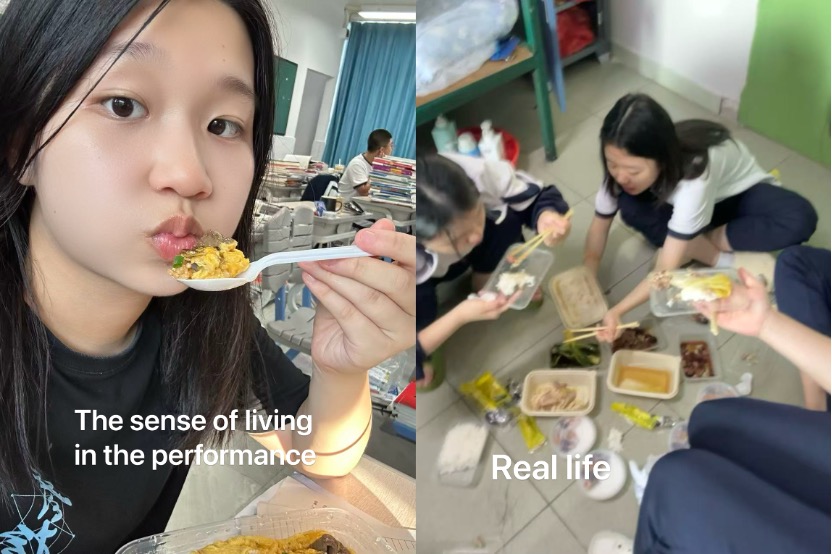
The photo on the left is the perspective that campus bloggers often take while eating. But the real meal in high school is basically like that to the right.
 Joleen Jublee
  Jamez
Jamez  Scarlett Johnstone