

It’s difficult to look past our present gaming environment, with the chaotic mixture of entertainment, profit and online behaviour. What used to be a simple one-time purchase for hours of fun is now a field of unethical monetization practices designed to keep players playing and paying more, and at the same time, engaging in troll behaviour towards each other on the playing field. This raises the question: how does gamer behaviour contribute to the decline of ethical standards in the video game industry? This article argues that the ethical standards of video games are diminishing in part due to player behaviours like trolling, and supporting poor developer choices and practices in the gaming industry, such as predatory monetization schemes like subscriptions and limited-time offers promoting fear of missing out (FOMO).
With the global production of video games and capitalism at its side, monetisation rode in with price tags strapped fast and at the ready for the average video game consumer. After the modernisation of video games and immense popularity growth, it wasn’t long before the video game industry boomed into a billion-dollar industry. The transition from a hobby to a billion-dollar industry shows that the interest in video games increased exponentially, therefore creating incentives for lucrative ways to monetize them. One common way the video game industry put that incentive to practice was microtransactions.
Microtransactions turn a free-to-play game into continuous funding, allowing players to purchase optional content. Microtransactions are common in video games marketed as free-to-play, allowing players to make purchases for in-game rewards—items, currency and cosmetics, for example. Because players can buy virtual items, currencies or cosmetics that can increase progress, change appearances or improve the gaming experience, the barrier between free-to-play and pay-for-fun gets smaller. A form of this can be seen in the loot box and gacha.

Loot boxes and gacha (the abbreviation for gachapon, the Japanese toy capsule machine) are types of microtransactions that resemble gambling mechanics by selling a chance at rewards to consumers rather than the rewards directly. Loot boxes and gacha are forms of monetization that rely on the players perceived chance at receiving a randomly selected item out of a pool. The chances in these prize pools are usually very low. Because random rewards are received from a large pool and prices tend to sit at the lower end of the price range, players are able to spend repeatedly without certainty of obtaining their desired reward. This effect is amplified by limited-time offers and FOMO tactics.
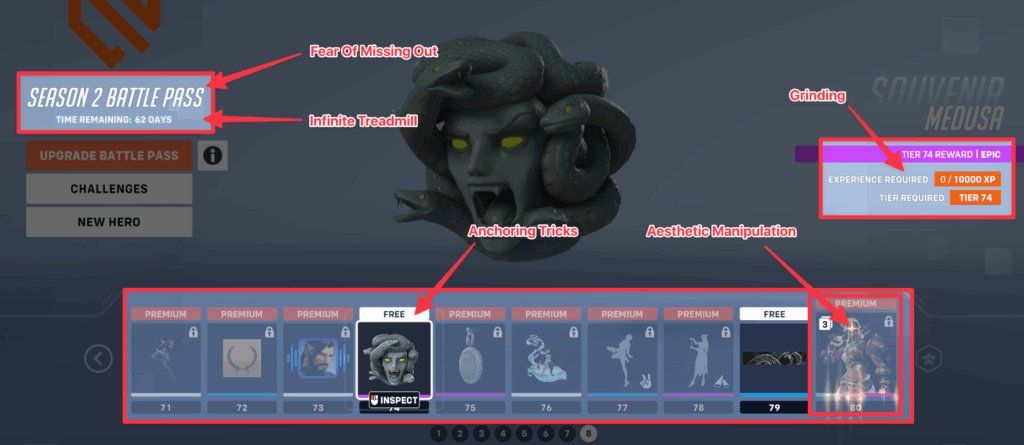
FOMO is a term used in relation to limited-time rewards or offers. They pressure players to make quicker decisions in order to spend faster. Limited-time rewards incur FOMO by applying urgency to players through a series of tempting rewards that will no longer be available after a certain period of time. When events are open for a short period of time, the pressure to make a purchase increases because the deals may disappear indefinitely. Where limited-time rewards function through impulse spending, subscriptions rely on an ongoing purchase for their content.
Subscription models refer to gating access to content via a recurring paywall. The content that is restricted varies based on the product. In this case, it is an entire catalogue of video games like Microsoft’s Game Pass, which allows players to download or stream video games under a subscription. By charging a fee prior to giving access for a set period of time, income is guaranteed and encourages consumers to continue paying in order to finish their game. Putting content behind an ongoing paywall indicates a priority for profit and reinforces player engagement, which puts player consideration in the background.
Microtransactions contribute to the decline of ethical standards because they redirect design goals from player experience to revenue extraction by making ongoing purchases a core part of the game. Microtransactions have become a peak development practice in the gaming industry. Activision Blizzard, for example, earned over $4 billion from microtransactions in 2017. Activision Blizzard also patented microtransaction systems. Additionally, microtransactions give players a way to obtain premium content like items, cosmetics and currencies. Often found in free-to-play models where the player is incentivised to make purchases to move forward through the game where it may halt progress. This indicates that developers promote monetization over user experience. This also shows that direct revenue from microtransactions is a huge financial incentive that can influence design choices, that developers prioritise revenue and normalise profit-focused design choices and that these decisions are deliberate. Furthermore, when microtransactions conceal long-term costs, such as virtual currency, players can’t make fully informed decisions about spending. Microtransactions become predatory when they conceal the real cost of the transaction until consumers have already attained financial and psychological commitment. For example, when players pay for virtual currency with real-world money at a higher visual cost than the currency is shown in the store. At a glance, players feel like the product is cheaper, therefore concealing its true cost.
As for loot boxes, they normalise gambling-like mechanics in video games. The predatory method for loot boxes includes low success chances, promoting increased spending, where the amount of ‘pulls’ to receive the desired reward is undetermined. Loot boxes are similar to gambling (slot machines, for example) because player skill isn’t needed since the outcome is completely random. However, they are not considered gambling because spending money on them is not considered a financial loss, and the value of virtual rewards is considered to be zero. This further indicates that developers deliberately divert goals from the player experience to methods of inciting purchases for revenue gain.
In the case of subscription models, they take incentives from one-off sales to ongoing sales, which can switch developer priority from fairness to profit. Subscriptions to gaming libraries (Microsoft Game Pass, for example) use similar strategies to companies like Netflix, such as producing exclusive content, encouraging players to subscribe. This demonstrates that presenting libraries as a product to incentivise continual access via payment can be a motivator for companies to change their monetization models. Microsoft isn’t the only company to employ the subscription-based gaming catalogue. Playstation, Electronic Arts, and Meta have joined Microsoft in the business model. This suggests the industry’s direction in keeping players engaged through ongoing payments than through a player-focused design model.
Monetization, microtransactions and subscriptions all contribute to how the ethical standards in video games are being eroded by predatory developer practices through the way games make profit and the way players respond to these. However, these systems do not operate in isolation, and to determine whether ethical practices are getting worse, we need to look at how gamer behaviour contributes to developer decision-making.
Gamer behaviour can influence developer choices that contribute to unethical game design because of how players spend their money, and the way players interact online, and in-game, not only shows what developers can get away with, but also shows how developers align themselves with players’ goals, whether unintended or not. For example, when players complain about loot boxes or expensive subscription fees, they may still buy them. They may also pressure other players by gloating or teasing them. Microtransaction models are driven by player purchases, so developers derive purpose from encouraging such models, and are potentially influenced by personalised data in order to incentivise player interaction with certain purchases, which could contribute to overspending by more vulnerable age groups. Younger gamers, for example, could be insufficiently equipped to judge the value of some transactions. Player frustration over price is evident, showing awareness of predatory practices and pay-to-win models (players paying real money to gain an upper hand over each other), which can cause a divergence between players with more money than others. This reveals a feedback loop where players press the purchase button regardless of their criticisms, signalling to the developers that this method is profitable, allowing them to continue providing this content, and thus the cycle repeats itself.
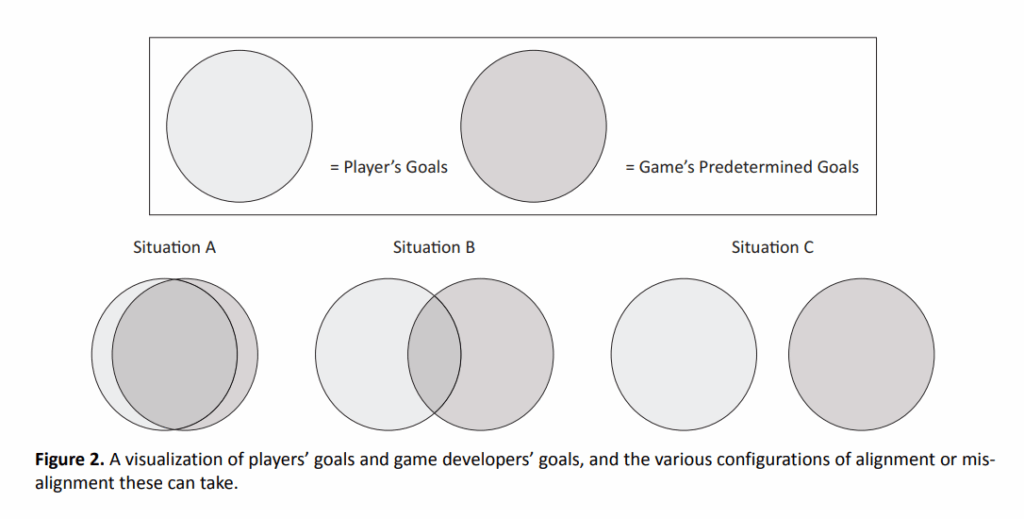
Situation A in the figure above indicates that when player goals and developer goals overlap, the gaming experience is created in co-operation with each other, and when they don’t, co-operation fails and the experience falls apart.
So, gamer behaviour does more than simply influence developer choice through spending; it can contribute to toxic behaviour within games, social settings and communities. Even more than how gamers spend their money is how they treat each other, especially through trolling, which shapes how ethical the gaming world is created.
Toxic gamer behaviour, such as trolling, is one example of how gamer behaviour can contribute to the decline of ethical standards in video games. Toxic behaviour is essentially part of the package in today’s online gaming sphere, and it is a detriment to the gaming industry. Griefing, a form of cyberbullying, can lead to players reacting with even more toxic behaviour, such as leaving a game in the middle of a match to prevent further ridicule, and report systems intended to report toxic behaviour can even be abused by griefers targeting innocent players. It is shown that ethical standards exist outside what can be managed by developers, and they can also shape the community, potentially changing design choices of the game. If not, at the very least, it can reduce the quality of the gaming experience, showing that player behaviour is part of the ethical structure in gaming.
When you take microtransactions, loot boxes, subscriptions and toxic behaviour and combine them together, it shows that developers are not steering ethics on their own. Feedback between developers and players reinforces a cycle of give and take, where monetization strategies and gamer behaviour constantly interact. Monetization schemes are designed to profit from the player base because players continue to engage with them. This is shown through company revenue increases, and the players’ own choices, even when criticised and more so between each other. Through this, the developer-player relationship is revealed to be complex, yet central to the ethical concerns in the gaming sphere.
The decline of ethical standards in the video game industry cannot be attributed to one factor. In a place where entertainment, profit and social activity mingle, the gaming industry is facing its own ethical challenges. As displayed above, predatory monetization—microtransactions, loot boxes, gacha and subscription models—don’t develop from nothing. These practices are given form by consistent player engagement. Developers design profit-driven systems because players interact with them through continuous spending and pressure, whether they agree or not. On the same side of the coin is toxic player behaviour that shows ethical concerns are not just drawn on a company whiteboard. Toxic behaviour—griefing and harassment—between players showcases the creation of environments where profit-driven choices and a warring community reinforce one another. If developers and players make different choices, the video game industry can, perhaps, return to an era where fun, fairness and passion were once shared by everyone.
 Guan QiuYu
  REN Ren
  Tan Kane