
First of all, most people are likely familiar with LinkedIn, and for some who do not know, LinkedIn is a platform for user to express their achievements towards their career, displaying a digital resume, and an actual hiring platform. Although LinkedIn has not disabled its initial functionality, people are still there to recruit and be recruited by a company. The purpose might have shifted a little, whether for the better or worse, depending on which side we are looking at. Lately, we might have heard of humblebragging all around LinkedIn – what does it mean? Based on the Merriam Webster (2024) definition, it is a basic self-statement, self-critical, and the purpose is to raise attention and for people to be drawn to admire them based on their way of ‘self-humbling’. In this article, the author researched the bigger vision of how this might have affected the perception of people with this type of content on the internet.
When discovering about ‘humblebragging’, it is interesting to know that we are regularly exposed to it on social media or in real life. This self-praise and bragging come down with a bigger element of competing with others and stating that ourselves is the best, which sounds very ego-centric (Matley, 2018). There are some other kinds of humblebragging, as some people use complaints to disclose how much effort they put into their job title or their respected status in their job field, and some people shield behind humour like accidentally spitting coffee at a celebrity at a random time (Jabar et al., 2025).
It is another way to tell us ‘I did not realise how time-consuming it is to finish this job as a Director’, or ‘I did not realise who I spilled my drinks to’, and there are many more out there. These behaviours deliver fuel for self-promotion and self-respect, and they also come with articulating their humiliating moment while intentionally gaining more admiration from the platform audience (Jabar et al., 2025).
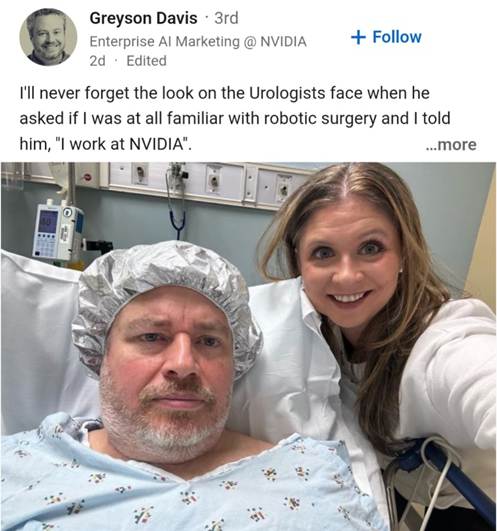
There is a special name for this phenomenon, ‘LinkedIn Lunatic’, where people are posting articles to gain praise, attention and higher engagement. Something about it does not seem odd until reading what they wrote and posted there. Here is one example:
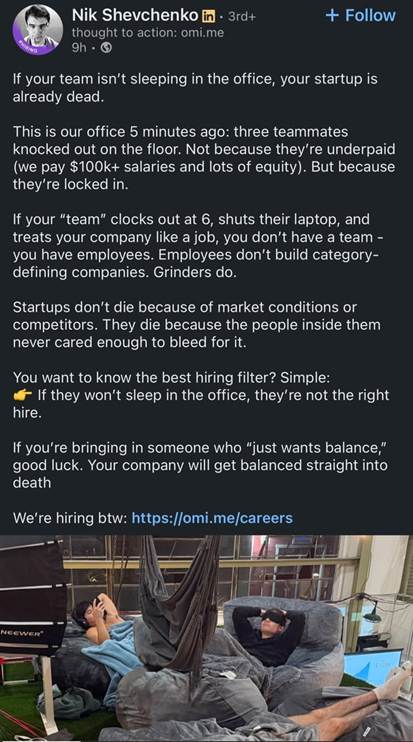
On Reddit, people are making this phenomenon into a sub-reddit or group for ‘LinkedIn Lunatic” where ‘redditors’ are there to gather and share this corny, toxic positivity LinkedIn content. It is quite interesting to see how there are not a few people who agree that these trends of humblebragging are sort of out of hand. One LinkedIn article says that people in the start-up are supposed to sleep in the office, otherwise the start-up is already dead, and the team are not meant to treat the company as a job and continue to mention that the work-life balance equals sending the company to the graveyard (Shevchenko, 2025). Hehehe40 on LinkedIn Lunatic mentioned that the start-up died due to the bad culture, and most people are not willing to do it unless people have no boundaries, then this could be their place. While SadNoob476 mentioned that if these guys ever thought of burnout or aging, they would wonder what plan they have in mind, since this habit would take a toll on their health. LinkedIn feed has been downgrading to mental rot for the past years, it is seemingly a bad business encouragement covered in pretentious and pseudoinspirational language that has high engagement with the audience and received tons of likes and shares, while others claim themselves as adviser or coach and continue spreading misinformation (Rosehill, 2020).
While humblebrag has seemingly become normal on social media, this phenomenon has spread across Instagram and Facebook, as well as to LinkedIn, where it has its own bragging. Although here, we are focusing more on LinkedIn. Some humblebrags are harmless and comical, and some could motivate us, so there should not be a serious concern about them. Then, some humblebrag could look like this: some user shred unsolicited advice on how they save or invest their money as a ‘successful *insert job position*’, and not to forget to mention how many assets they owned and how much money they just invest on VOO, or some humblebrags might be posting about what they are eating for breakfast that contains healthy fats, lots of fibre, etc., that they made everything from scratch daily before starting their 9-5 job. Which might seem very odd for it to be on LinkedIn. However, if seen from a different perspective, it could be an insight for other people who ‘actually’ want to create the same meal that is also healthy, but how many of us are actually inspired by it?
Though from all the fun parts of LinkedIn, the humblebrag could be concerning when the articles are becoming heavily toxic, such as normalising awful working habits, encouraging people to exceed their working hours, and exposing misinformation, that is when things are going terribly wrong. It should not be natural to work until employees get burned out or mentally exhausted, as this might lead to more serious health problems, as some other ‘humblebraggers’ encourage other people to grind hard; otherwise, they are missing out or behind in life. Which is horrible, as humans, we need to work enough, rest enough and keep things in balance.
Another person humbles themselves by bragging about working 16+ hours a day and mocking other employees who finish their shift on time, meaning they are not working hard enough, not enjoying their job, or not passionate about what they are doing. While other posts would say that they are not being productive if they do not start the morning with a running marathon before their office job starts. It is absolutely a good routine to maintain, but it is not very wise to put other people down because not everyone is capable of running a marathon daily. It gives the energy of ‘I am better than you’ because ‘I run 9k every morning before my 9-5’.
Despite this, humans are not machines; even machines would eventually give up if used constantly. People are also built differently; some might feel productive when rested well, and some might have health problems requiring them to take it gently. There is life outside the office building; some people have kids that they need to take care of, and spend time with their loved ones.
It is disappointing to discover that humblebragging makes people lie about their story, their content, in order to gain popularity, new followers, or to expect their writing to be viral and be visible on many LinkedIn homepages. This sounds like people might have low self-esteem, yet the easiest and fastest way to boost their ego or confidence is through the LinkedIn feed. This does help the writer get the satisfaction, especially when their post gets recognition, hundreds of people put likes, getting comments, ‘kudos to you’ or ‘well done!’ – perhaps that does feel like being heard and seen by strangers. While this feels good to be true, because of how unreal it is and how destructive it can get to create the ‘a little bit of lies does not hurt’ and ‘I am thirsty for attention’ mentality.
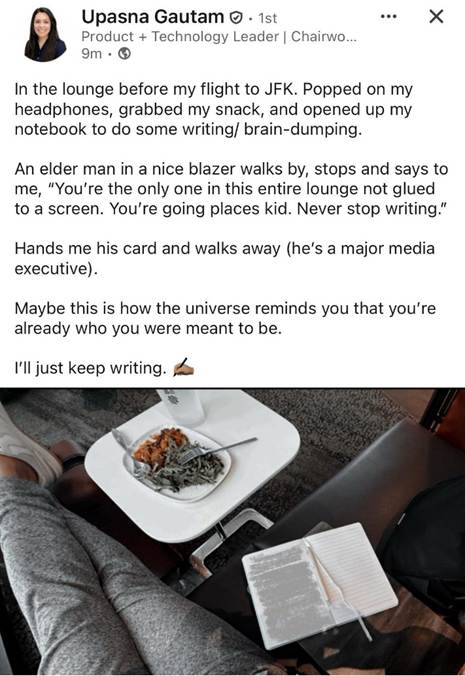
Here is another example of humblebrag, it is giving the ‘I am better than anyone’ energy, being the only person who writes instead of watching the screen – guess what? Absolutely, a Major Media Executive approached her. Like any other LinkedIn Lunatics article, we might have seen out there.
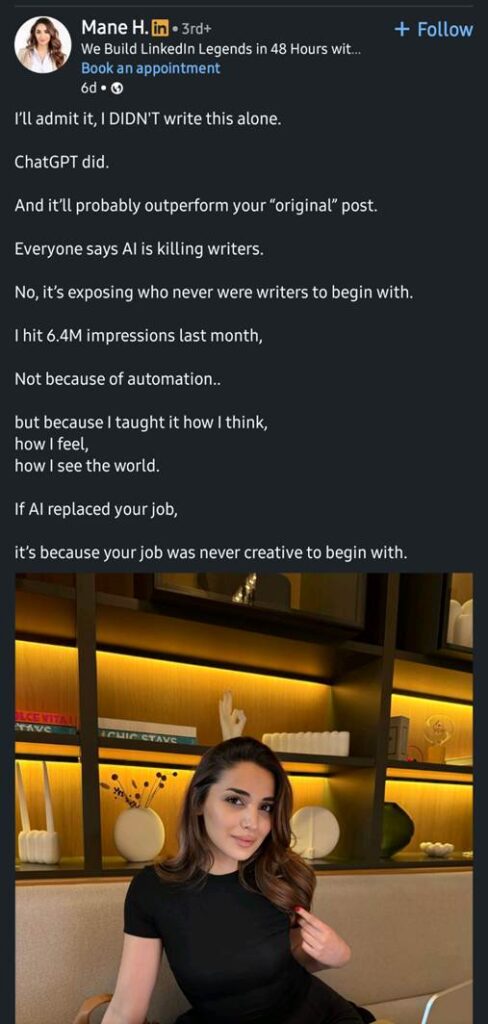
However, humblebragging was not a big problem – these humblebrags had shared various content regarding motivation, genuine advice and toxic positivity. It is best to be mindful when consuming content on the internet. Taking the positive side of it, consider checking the factuality, as there are misstatements on LinkedIn. Any content on social media should not be the standard to define our productivity or how we thrive in life, based on LinkedIn feeds, based on how many hours they have worked or how far they have run today. People could easily fake their posts to be seen as consistent and determined, yet we would never know the truth; thus, it is up to the individual to consume these feeds wisely. At least this lady was honest:
 Guan QiuYu
  REN Ren
  Tan Kane