

The year is 2025. Your shoes had quadrupled in size over the years, but the hands that always tied the knot around the aglets remain the same. Your bag is heavy. Your back is even wearier. The bus that brings you to campus erupts with a roar: it’s time to leave home; you’re only getting older. Yet so are they. The buildings that make up the foundation of a previous generation had long since been gone when their grandparents moved out to another residential area, but the wood underneath the flooring only wrinkles even further than their feet could walk across from the entrance to the kitchen way. Devotion becomes an investment as parents pour their love and tender care into raising their children, presenting themselves as the primary caregiver for the one they brought into this world. As the quote persists, it takes a village: the community’s impact on education and general accessibility could help to shape the child’s perception of caregiving. Perspective goes a long way, especially for single children families when the chick finally grows up to leave the house and a persisting guilt sits at the edge of their heart for being the sole effort of their parents’ care. For all their life, they were told to “pay a debt of gratitude” to their parents, so isn’t it only natural to repay their efforts?
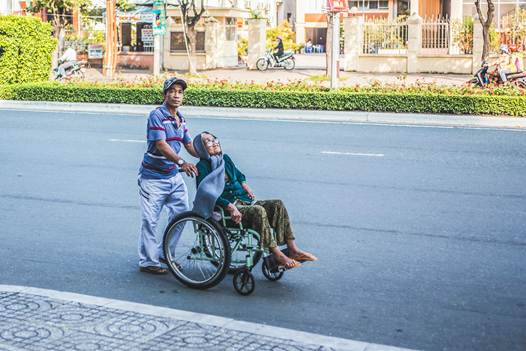
Photo by Nam Phong Bùi: https://www.pexels.com/photo/man-pushing-a-woman-sitting-on-wheelchair-3101214/
It almost feels like a startup, or an ROI (Return on Investment) that continues to demand attention from them (the child), continuously feeding it without certainty that it would be a successful return in the endgame. But a parent’s generosity cannot be liquified into something as simple as a financial return.
Caregiving comes with the identity tag of “labouring through love”, implying that for there to be a mutual cause for generosity, there should be a factor that plays into existence. The general idea of exchanging care for parents is to provide them with a safe space as they had for most of their children, all accounting for hardships experienced in the past. The child does not want to be a “burden”, deemed an irresponsible figure to the public eye, but could the same be thought of by the parents themselves? It’s difficult to consider the “other” party when little to no communication was established with the “receiver” of the two. Yuan (2025) describes informal caregivers as unpaid individuals, oftentimes spouses, family members or friends. They are tasked with the responsibility to care for their loved ones with day-to-day activities and health-related concerns. Sharp years of attending middle school and high school are gone in a flash, the “child” is suddenly wearing shoes four sizes larger than what they last remembered.
The keyword echoes: enough, but what is “enough” to them could be under or more to someone else. Generosity is a currency that has no physical form yet seems to be the sole factor that elevates the value of human life. The adult child braces themselves to the harsh critique of modern society, who constantly surveys them through camera lenses: parents posting stories on Instagram about what their child bought for their 60th anniversary, children equally arranging visual collages celebrating monetary happiness in a gift economy, some fail to recognise the importance of “being there” versus simply gifting them money just “enough to get by” or beyond that. And then, there were expectations.
“My mum just tells me to buy her better-quality coffee.” – Elvira, one of the respondents to my Google Form survey on this topic.
The family setting is a complicated subject to tackle when considering that one’s individual needs may conflict against the whole group.
The relationship between family and adult children is a fine line to strike. There is the implication of obligatory motivation that drives the child to return all actions owed to their parents, such as an “I owe you” example. But the term ‘owe’ in itself suggests a case of possession; that generosity is not something to be received, but to be returned to its rightful “owner”. Functioning emotions and rationality decides the value of the child to be determined by what they can ‘give back’, either in monetary or non-monetary form: sending back gifts or spending time with them while they are able to. Children strive to feel included regardless of emotional attachment (Edström, Gardelli and Backman, 2022). Expectations can stem from the concept of reciprocity: you reap what you sow. In instances such as being the oldest child, even more so as the daughter, the feminine gender is pushed towards a narrative that they must be caring and communal (Babcock et al., 2018). Not just at home, but at work, too. People reciprocate gestures out of obligation, for the most part, but internal factors such as social and cultural upbringing is also engraved into a person’s identity.
“Responsibilities as a child, and as the oldest sibling where you become the role model for your siblings is tough for sure, but I like to believe in kindness.” – Christie, another survey responder.
Then enters the long goodbye: age-related conditions such as dementia, a cognitive condition that affects an individual’s memory, thinking, and reasoning. It becomes a slow process forming between emotional breakouts between the giver and receiver, impacting daily responsibilities of both sides. They become someone else, an identity completely separated from “the parent”, but the child remembers those wrinkled hands that once gently changed their diapers and taught them how to tie their shoelaces. Conversational boundaries could be breached between children; index fingers pointed at each other on who should look after mum or dad for that week when work has been calling for the last couple of days. Family becomes personal; it always was. Independent living becomes reconsidered for some families. The oldest or only child becomes the “primary” caregiver, but within an Asian context: they would be the only one needed. Like Harlow’s monkeys, they would be taught to parent, to love and to live within community. Aging in place seems significant to the viewer (child), observing as the space of that loved one’s chair begins to deepen over time with the meals shared in-between people, under flickering fluorescent lights and outdated newspaper clippings by the television set.
It comes, it disappears, and the coffin closes.
They say it’s a moral dilemma: dealing with the consequences of independence and being indebted to the hands that once raised you. In that, the child has indirectly begun to celebrate loneliness in grief, finding meaning or not in the nature of their surroundings. Is it nature to find identity in love, for those with or without them (parents, friends, etc.)? The concept of belonging and belongings becomes synonymous with possession: both the child and the parent’s items have shared value in that they have become ‘personal’.
No one is born with love but are instead taught by it and with it. They associate subjects of importance through the people that bring it up. All these instances of an ‘ambiguous loss’ falls to the caretaker due to the reality that we were taught from a young age how ‘time is money’; expensive, to have none is to waste it away. The demands of caregiving are always changing. It is unpredictable, anxiety-inducing. Often struck into a state of hyper-vigilance, the ‘cartetaker’ insists on taking control of the present timeline through the actions committed under their own impulse. Both social and financial capital are built in this stage of life. Young adulthood suggests that we move out of the home, but what happens afterwards? There is a structured conditioning invoked in the child: to lay out a path for themselves with wants: a career, a family, a nice place to live and to move towards it the best as they can. Caregiving becomes the gatekeeper, initially; it doesn’t always have to be.
Hiring nursing services, also known as a professional caregiver, can be a difficult choice for some, especially when living within a community that stresses the importance that children should be the main attendant to the elderly. A ‘relationship satisfaction’ must be achieved to predict the certainty of one’s choice. Both the parents and the child’s experiences are shaped in continuous tandem by their interactions with the other, such as retirement, the death of a spouse (in the child’s case, of a parent) and even job loss, much less divorce. Cultural revolutions have led to the impression that the oldest is the one who should take up the mantle, but in other cases, parents took the opportunity to talk to their children and express their expectations: mostly to look after them when they got older, or otherwise, not to worry too much about their own well-being. By consensus, the child was encouraged to leave the nest for good, only returning in forms of monetary compensation or otherwise hiring a professional nurse to aid in their parents’ retirement. Parts of the house become familiarised to those returning to it after a long run in the working industry.
There is the expectation that children would naturally be indebted to their given ‘parent’ as a form of repayment for the food they had eaten, or the clothes that kept them warm when nighttime fell. The demanding role as a caregiver is often overlooked or reduced to the label itself: the ‘giver’ is also considered a ‘taker’. They ‘take’ care of their loved ones because they believe it is deserved by them, potentially putting their own needs at risk of the receiver’s own maintenance. The emotional energy, money, the ‘self’ is considered an extension of the former two versus seeing themselves as individuals capable of their own actions outside of caretaking. In a house dominated by memories, nostalgia can only do so much in the long run. It can get demanding. Impossible, even. Which is why care facilities and government initiatives are important to consider maintaining the functionality of a stable relationship with parental figures. Details need to be shared; emotions have to be expressed in an open and welcoming environment: a safe space. The fact is: it isn’t for everyone, caregiving. What makes contemporary caregiving so hard? It could be the personality of the person, or the illness that has potentially overtaken the individual themselves, the system makes it so that ‘care’ has to be made ‘difficult’ to seem like it’s all worth it in the end when it should not have to be that way.
There are people at home who change colostomy bags in the middle of the night, even some that run dialysis machines at home. Generally speaking we want to care for each other, but we should not have to be expected to care at the professional level medically necessitated state because there is no other option. There are layers to a relationship, beyond the emotional and physical state, but also external factors that dictate it: government initiatives is the central backbone to make society run smoothly, hence care access is equitable for the fulfilling majority.
Caregiving for the elderly can also be a new chapter in one’s lifetime. There is potential for growth for both parties, but revealing the raw truth of it is that it’s something that cannot be taught in a day. Experiences can be messy, jumping between family to family, care itself lacks a unified interpretation. Does it matter if one ‘owes’ to their parents? The kindness of one can be a lesson for a thousand moving forward. Conversations are a rare gift that persists in today’s world, whether digital or physical, but communication becomes the turning keypoint that shapes how parent-child relationships are formed; for better or worse. Any society should look into itself and determine whether they are giving the right tools to the youth, in terms of accessibility for the elderly and disabled altogether. As such, it would be wise to promote active participation in discussion for both givers and “takers”: parent and children alike.
 TianYuran
  Lu Yunyan
  Pauleen