
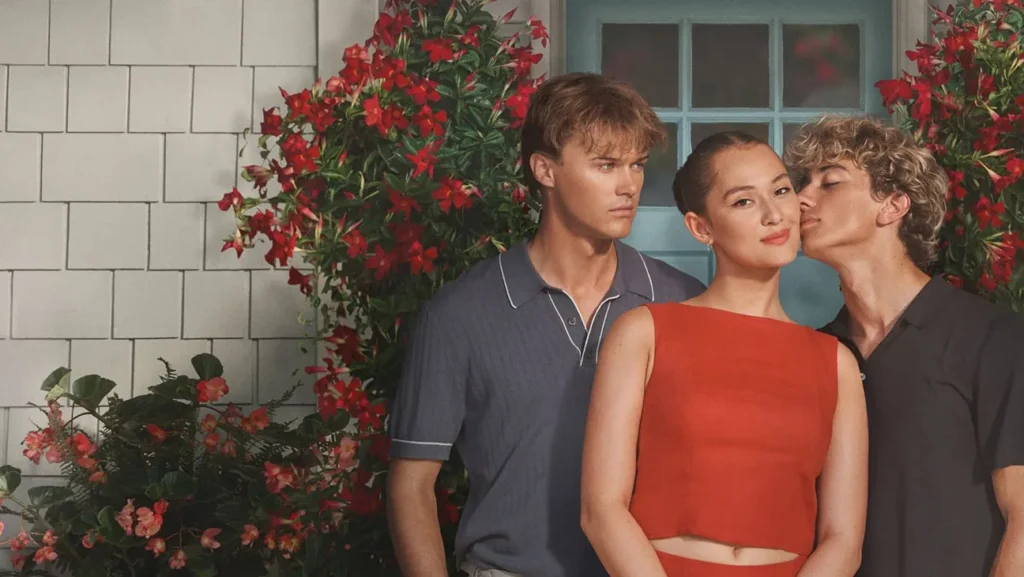
Prime Video’s ‘The Summer I Turned Pretty’, (TSITP) is the world’s current online fixation, adapted from Jenny Han’s young adult trilogy, the show has become the centre of conversation for summer 2025 with the burning question on viewers minds being Team Jeremiah or Team Conrad pulling in viewers of all different ages, backgrounds and genders who are not the typical target audience of teenage dramas, all patiently watching to see Belly choose the correct team. Whilst at first glance ‘The Summer I Turned Pretty’ is a dreamy coming of age romance with an addictive soundtrack, a closer look reveals a series that is both inviting and flawed, succeeding in creating atmosphere and community however simultaneously struggling with character depth and narrative balance.
‘The Summer I Turned Pretty’ thrives on atmosphere. The series set in a coastal town feels like a character of its own, engulfing viewers in a never ending summer and the feelings that are associated with summer. The seaside house at Cousins Beach is not just a backdrop but a feeling, with its classic porches and endless rooms filled with summers sunlight it conjures a sense of timeless summer, the kind of place audiences wish to be a part of. This visual world is reinforced by carefully constructed cinematography and colour with the endless golden-hour shots and pastel toned wardrobes screaming of summer and teenage longing.
The show also uses colour to distinguish between its central love interests, subtly guiding audiences perception and pushing the to prefer one over the other. Jeremiah is frequently associated with shades of blue whether in his clothing or the cool-toned lighting of his scenes. The colour blue is often tied to feelings of stability and reliability, calmness, and loyalty, which reflect his sunny and dependable nature which represents his role as the more emotionally available brother. In contrast however Conrad is linked to the colour red. Red suggests passion, intensity, and volatility, which aligns with Conrad’s brooding demeanour and the emotional weight he carries, but it also does represent the passion and intensity of his love for Belly and vice versa. This contrast not only visually sets the brothers apart but also reinforces the dynamics of the love triangle: Jeremiah embodies calmness and stability, he’s a safe and comfortable choice whilst Conrad represents desire, depth, and unpredictability, the more uncertain choice but one that evokes more emotions. The colour coding adds an extra layer of symbolism, allowing viewers to sense the emotional stakes of Belly’s choice and sense how she feels about the brothers without her needing to say anything.
‘The Summer I Turned Pretty’ also cleverly uses an impressive soundtrack to reemphasise this summer aesthetic and tell the story. Music choices specifically from popular artists such as Taylor Swift, Gracie Abrams and Olivia Rodrigo aren’t just used as background noise, they act as emotional accelerants, emphasising every kiss, moment, heartbreak, and revelation that the characters have. The music adds to the story in a way not many shows are successful at doing with viewers being able to pull apart episodes and dissect them based on what song was used for each moment. Taylor Swift songs in particular are often only used in moments between Belly and Conrad, emphasising their emotional connection and adding more significance to moments that may not have seemed significant to viewers otherwise.

‘The Summer I Turned Pretty’ does also lean heavily on melodrama. Belly’s character often comes across as reactive, her personal growth journey is overshadowed by the back and forth between brothers Conrad and Jeremiah. The love triangle, whilst central to the series entire plotline, takes up so much room that it dominates the plot completely that it reduces the story to a simple choice instead of exploring the themes of identity and grief that it briefly touches upon. This reduces the complexity of her coming-of-age story to a love triangle, a choice that weakens the show’s potential to examine selfhood more deeply.
Despite its flaws, ‘The Summer I Turned Pretty’ fulfills an important role for summer television. It offers viewers an escape, an emotional space where even the smallest moments feel huge and important. For its usual and targeted audience, that mix of fantasy and relatability is exactly the point of why they watch the show, and it explains why the show has become an important part of the last few summers.
Overall the series does leaves lingering questions about what it means to tell a coming-of-age story by centring Belly’s transformation almost entirely around romance, the show does risk overriding the full range of growth one goes through such as friendship, ambition and resilience, all things that define change and growth from teenagerhood into adulthood. However whilst ‘The Summer I Turned Pretty’ may not deliver the most layered exploration of growing up and adulthood, as a show representing longing, nostalgia, and the heartache of love, it offers enough substance to remain relevant within the genre and provide an emotional escape each week whilst creating a community of fans all invested in the characters outcome.
 Heyonglin
  He lian
  VickyWu