
Introduction
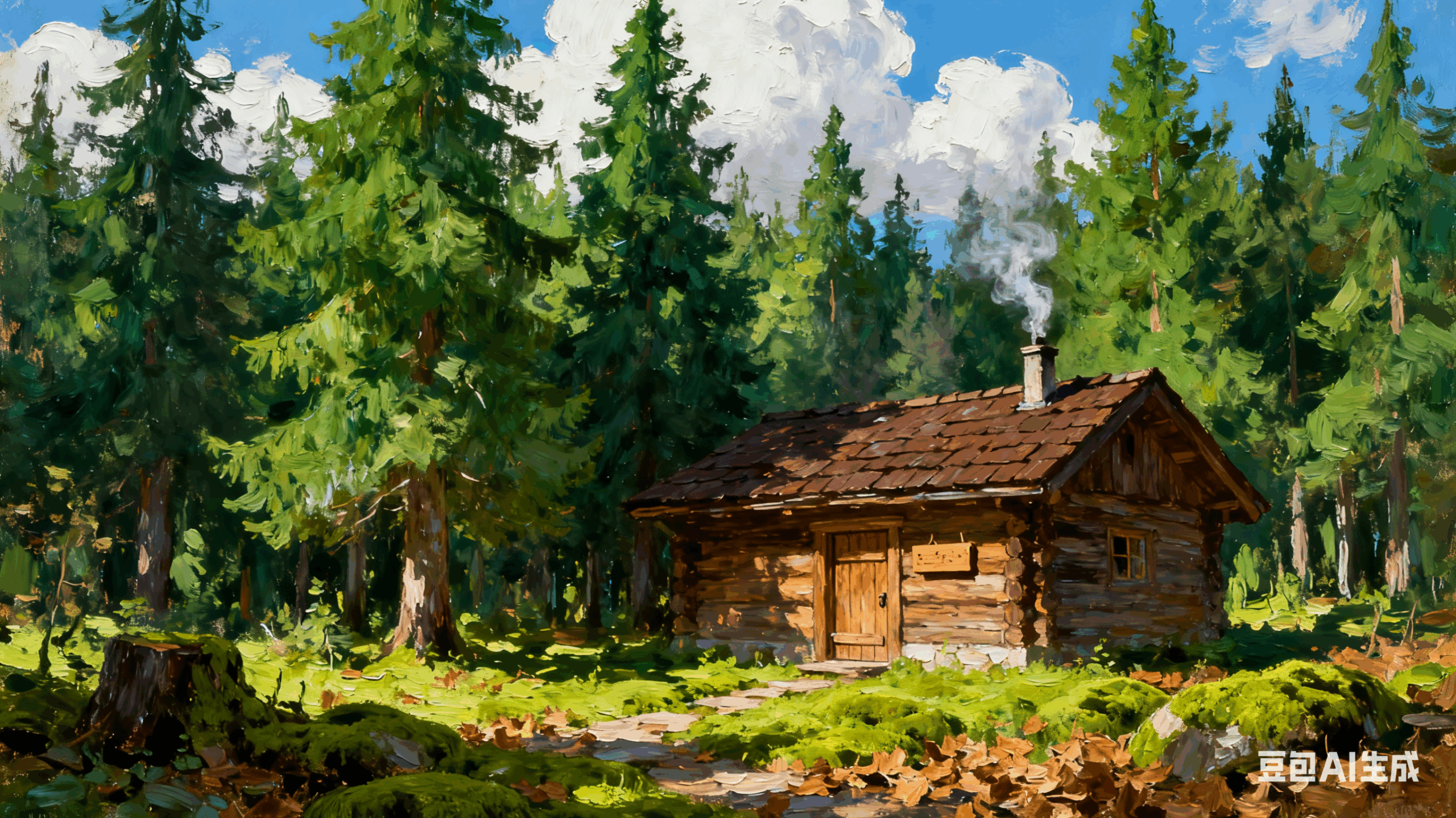
AI-generated artworks have gone viral across online platforms. However, AI tools rely on massive datasets which are built by scraping human-made art without consent. Recent disputes such as Getty Images suing Stability AI and artist-led protests show that this is not only a technical issue but a cultural and ethical conflict. While it opens creative possibilities for millions, it also blurs the line between inspiration and theft, democratization and exploitation. As algorithms continue to reshape the meaning of art, society must decide whether to treat AI as a tool that amplifies human imagination or as a threat that erases it. As the technology is advancing, we should pay more attention on how to preserve the emotion, ethic, and human nature of artistic creation.
The Fine Line Between Inspiration and Theft
Recent research shows that AI image generation fundamentally depends on learning from vast human-made datasets. According to Elasri et al. (2022), artificial intelligence models analyse and process accurate data to create new images from many learned scenarios. These models can now produce realistic visual works such as human faces, objects, and scenes that are almost indistinguishable from real images. They operate by learning patterns from existing artworks and reproducing stylistic and structural features across domains such as text-to-image, sketch-to-image, and scene-to-image generation, effectively imitating the creative logic of human artists. Similar problems have been identified in AI music generation. Yin et al. (2022) found that deep-learning models like Music Transformer often reproduce melodic sequences and harmonic patterns from their training datasets. Their originality report method revealed that the model’s outputs fall below the originality threshold of human-composed works. It means that such systems are just memorizing human works and regurgitating them rather than genuinely creating. These research show that AI technology is influencing all fields of art making and they are all suspected of plagiarism.
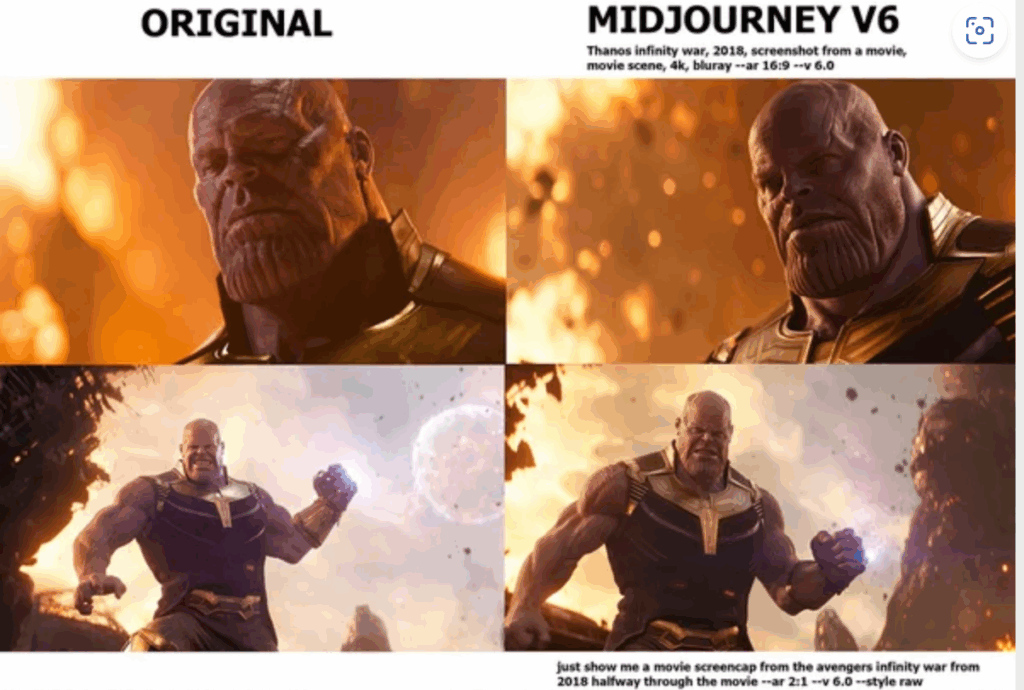
Photo from Marcus & Southen, 2024 Generative AI Has a Visual Plagiarism Problem – IEEE Spectrum
From where I stand, this situation is directly threatening the individuality of artistic expression. Those distinctive features or brushstrokes that once belonged uniquely to specific artists now appear repeatedly across thousands of AI creations. Artists built their recognizable styles through years of training, personal experiences and their emotions. But now they can be reproduced within seconds by an algorithm. In this way, the boundary between homage and theft collapses.
Due to this, many artists are boycotting the AI-generated artworks flowing into the market. In early 2025, more than 3,000 artists signed an open letter demanding that Christie’s cancel its planned AI art auction, calling it an act of “mass theft.” They argued that many of the artworks on sale had been created using models trained on copyrighted images without permission. In essence, this action has transferred the common creative labour of lots of human artists to an unfair profit (The Guardian, 2025).
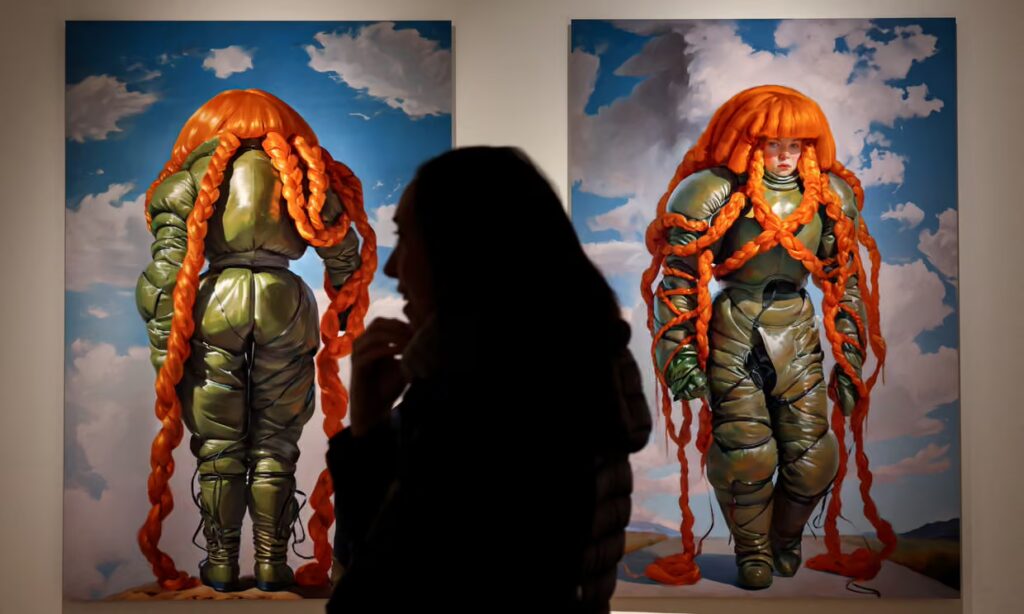
Photograph: Brendan McDermid/Reuters‘Mass theft’: Thousands of artists call for AI art auction to be cancelled | Artificial intelligence (AI) | The Guardian
The incident shows that AI-generated art has entered the traditional art market, competed with human artists. It’s no longer confined to online experiments that for attempt or for fun. What’s worse, some algorithmic images are treated as high-value commodities because they are newfangled. This development has provided ordinary people without any artistic background with chances to “create” art pieces for sale by using AI. While the original creators receive nothing. This raises serious ethical and legal concerns: if AI productions incorporate identifiable artistic elements from copyrighted works, but are not direct copies of any single piece, do they qualify as fair use or plagiarism? The law hasn’t caught up with this grey zone yet. From my perspective, what appears as technological innovation can also be a form of creative exploitation. Because human’s original works have become raw material for algorithmic profit.
Democratizing Creativity or Exploiting It?
On the other side, there are also many supporters claim that AI technology has brought many advantages to art field such as allowing more people to produce art easily. According to Zhou and Lee (2024), generative AI tools such as Midjourney and DALL·E substantially enhance both the productivity and impact of human artists. Their large-scale study of more than 50,000 users found that AI adoption increased creative productivity by 25% and the likelihood of receiving positive peer evaluations by 50%. Moreover, many AI-assisted artworks with novel ideas were judged more positively, regardless of original creativity. The authors also found that the use of AI led to a more equal distribution of resources among creators. It suggested that generative AI may democratize creativity to let individuals produce and share art effectively. In addition, some people even support that AI artworks are challenging the qualification of art. As Chatterjee (2022) said, artificial intelligence does not need to “understand ideas or experience emotions” to produce meaningful and evocative art. Their works are based on the summary of human’s aesthetics. He believed that AI can serve as a collaborator that amplifies human creativity rather than replacing human artists. For instance, painter Pindar van Arman used robot painters that he personally trained and considered they can improve his creativity. In this sense, AI may not necessarily destroy human art. Instead, it expands its definition, pushing the society to rethink beauty, authorship, and the essence of creative expression itself.
However, these optimistic claims often overlook the invisible human labour behind AI’s success. The so-called “democratization” of art is built upon large datasets composed of artworks created by real artists while most of them were never credited or compensated. The convenience AI provides to the public comes at the cost of exploiting countless creative professionals whose works have been absorbed into training models without permission. True equality in creativity cannot exist while one group’s labour becomes another ’s free resource. Therefore, if AI art is to be truly democratic, it must operate with transparency and fairness. For example, paid licensing systems, open training records, and clear labeling of AI-generated works should be required. These are important to ensure that AI technological progress respects the human creativity.
Caught in the Legal Grey Zone
When it comes to the regulation of AI artistic creation, the issues will be very complicated. From the moment this technology was developed, it was destined to involve some level of infringement. As we mentioned before, Generative AI systems run with large-scale data scraping, which unavoidably includes copyrighted materials. As the Harvard Business Review notes, the legal system is still struggling to define what qualifies as a “derivative work” under intellectual property law. Different jurisdictions interpret fair use in inconsistent ways, making it nearly impossible to enforce a united standard for AI-generated content. This legal ambiguity leaves both artists and developers in an uncertain territory. Moreover, the responsibility for intellectual property protection is increasingly being shifted onto creators themselves. For instance, Stability AI announced that artists could choose to exit its next generation of image generators (Appel et al., 2023). However, this “opt-out” policy places the burden on artists to protect their rights rather than demanding developers to gain consent at the beginning. These current regulations are reactive rather than preventative, which may be meaningless.
At the same time, the living conditions for original artists may continue to deteriorate as AI technologies expand their dominance in creative production. The automation of artistic processes not only reduces the demand for human labor but also undermines the motivation of professional artists. They may feel that their years of practice and individual expression are being devalued. According to a 2024 global economic study commissioned by the International Confederation of Societies of Authors and Composers (CISAC), generative AI poses a significant threat to the financial stability of human creators. The report estimates that by 2028, AI technologies could replace up to 24% of music creators’ income and 21% of audiovisual creators’ income worldwide. While the market value of AI-generated content is projected to rise exponentially, human authors’ revenues are expected to decline. CISAC warns that without urgent reforms in copyright regulation and licensing, generative AI could “hollow out” the global creative economy. Profits are diverting away from original creators toward technology companies. This growing imbalance risks turning art into a purely algorithmic enterprise, where human creativity is no longer valued.
The Empty Heart and Biases of AI Art
Except for those risks, there are also some other interesting debate towards AI artistic creation. One of them is do AI artworks have true artistic value? Eric Reinhart argues in The Guardian (2025) that art’s true worth lies not in the physical artwork but in its capacity to convey human experience. Human’s original artworks contain the emotions, vulnerabilities, and memories that connect individuals across differences. By contrast, AI-generated art is “uninhabited”. It lacks a body, desire, or self-consciousness. So they can’t transmit genuine feeling. Although algorithms can simulate beauty, they can’t carry the lived struggles and contradictions that make artistic expression meaningful. As the author warns, this hollow imitation may destroy people’s emotional structure and social fabric. What we lose is not only originality but the important sense of shared humanity that art has always sustained(Reinhart, 2025).
What’s more, recent research also indicates that AI-generated art does not merely copy aesthetic forms, it also intensify social biases embedded in its training data. Glickman and Sharot (2025) demonstrated in Nature Human Behaviour that human–AI feedback loops can amplify perceptual and social biases. When participants interacted with biased AI systems, their own judgements gradually became more prejudiced over time. In one experiment, the generative model Stable Diffusion produced 85% of its “financial manager” images as white men, which is deviated from reality and shows the obvious stereotype. After brief exposure, human participants were more likely to associate leadership with white male faces, even though they were unaware of this shift. This reflects that AI-generated imagery can subtly influence our aesthetic and social cognition and increasing existing inequalities. Moreover, participants consistently underestimated the algorithm’s influence on them, suggesting that such bias operates unconsciously(Glickman & Tali Sharot, 2024). From this perspective, algorithmic art becomes a new form of bias spreading, which is an unmentioned inequality under innovation.
Conclusion
While supporters believe AI helps more people express themselves and makes art more accessible, many artists argue that it crosses the line between inspiration and theft. Beyond copyright issues, AI art also raises other deeper problems. As we have talked, the debate over whether AI art is true creativity or just clever imitation will undoubtedly last for a long time. What’s more, algorithms have been shaping our thoughts of beauty, culture, or even each other. In this case, whether we should define AI artistic creation as harmful will remain a hard question. As this technology keeps developing, setting fair and transparent rules for its use will take time and care. We need systems that respect both innovation and human artists whose work built the foundations of these algorithms. Finding the balance between human imagination and AI generation won’t be easy, but it’s a conversation worth continuing. The boundaries of AI art will keep shifting as our tools and understanding grow. Maybe one day AI will create artworks so realistic that we can’t tell the difference. But I still hope the light of original, human-made art will never fade.
References
Appel, G., Neelbauer, J., & Schweidel, D. A. (2023). Generative AI Has an Intellectual Property Problem. Harvard Business Review. https://hbr.org/2023/04/generative-ai-has-an-intellectual-property-problem
Chatterjee, A. (2022). Art in an age of artificial intelligence. Frontiers in Psychology, 13(13). https://doi.org/10.3389/fpsyg.2022.1024449
CISAC. (2024, December 2). Global economic study shows human creators’ future at risk from generative AI. CISAC. https://www.cisac.org/Newsroom/news-releases/global-economic-study-shows-human-creators-future-risk-generative-ai
Elasri, M., Elharrouss, O., Al-Maadeed, S., & Tairi, H. (2022). Image Generation: A Review. Neural Processing Letters, 54(5). https://doi.org/10.1007/s11063-022-10777-x
Glickman, M., & Tali Sharot. (2024). How human–AI feedback loops alter human perceptual, emotional and social judgements. Nature Human Behaviour, 9, 345–359. https://doi.org/10.1038/s41562-024-02077-2
Marcus, G., & Southen, R. (2024, January 6). Generative AI Has a Visual Plagiarism Problem – IEEE Spectrum. Spectrum.ieee.org. https://spectrum.ieee.org/midjourney-copyright
Milmo, D. (2025, February 10). “Mass theft”: Thousands of artists call for AI art auction to be cancelled. The Guardian; The Guardian. https://www.theguardian.com/technology/2025/feb/10/mass-theft-thousands-of-artists-call-for-ai-art-auction-to-be-cancelled
Reinhart, E. (2025, May 20). The trouble with AI art isn’t just lack of originality. It’s something far bigger. The Guardian; The Guardian. https://www.theguardian.com/commentisfree/2025/may/20/ai-art-concerns-originality-connection
Tobin, S. (2025, June 9). Getty argues its landmark UK copyright case does not threaten AI. Reuters. https://www.reuters.com/sustainability/boards-policy-regulation/gettys-landmark-uk-lawsuit-copyright-ai-set-begin-2025-06-09/
Zhou, E., & Lee, D. (2024). Generative artificial intelligence, human creativity, and art. PNAS Nexus, 3(3). https://doi.org/10.1093/pnasnexus/pgae052
Author’s other articles : A Pioneering Chinese Thriller: Girl On Edge at the 78th Cannes Film Festival – NETS2001 Writing on the Web
 Jessie Goates
  LeighCor
  Elizabeth Harris